| EARTH METROPOLIS AFRICAN STUDIES ART |
| Notes | Survey | Educ. | E-Mail | ClaudeClark.org/apparel | Art | Wordpress | Kemet | African | Oceanic | Greece & Rome | Video conference| |
| North Africa | Sahara | Arid Steppe | Western Savannah | Central Basin | East Africa | South Africa | Americas | PUBLISHER | Art Geography |
| | |
| |
|---|---|---|---|---|
| Sapien & Neanderthal Comparison | Egypt | Egyptian Wax Painting | Nubian Archers | Meroe Pyramids |
| Renaissance Tool Bar |What is Traditional African Art? | Coin Conspiracy | Civil Community | Scholar | Tradition | Western Civ. | Neocolonial | | |
When we think of the Nile Valley we think of the timelessness of civilization and Egypt’s architectural stone monuments on the West Bank of the Nile River. These monuments represent the cities of the dead; but little do we know about the metropolis areas of the living along the East Bank of the Nile. Click on black tool bar (first) and pictures (second) for more information in this section. This page is very, very, very long, so use the black tool bars to get to different parts of this one page. The pictures and green tool bar will take you to different pages. Click on the small yellow back buttons to return to the previous tool bar and click “Top” link if you wish to return to the top of this page. We are starting to add definitions to words used in the text. When ever you see them it is ok to click on the link in the text. A window will pop up defining the word. When finished you close the window. Welcome to African Studies Art Page. This page is a survey of African art. People interested in using material for art appreciation and art history may find it very useful. African art collectors and art dealers can find it useful as a starting point for information needed in their business. We try to supply material that can be used in a variety of grade levels, though most of the curriculum and pedagogy in the education area is for college and universities. Feel free to use the feed back form on this page. Some materials used to supplement what you find may be in another location. You may need help in finding those materials. You navigate this page by using the black tool bars or black tool menus and the yellow back page buttons. There will be text introductions over each link explaining what you should find in each location (note still in the process). I notice more people coming to this page now. They did not come to this page much in the past, because they didn’t know how to use it. I am going to suggest using only three black tool menu (bar) links for now rather than jump all around and not learn anything.
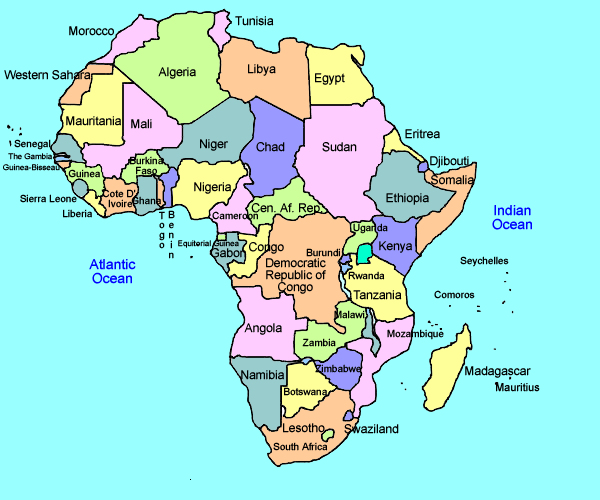
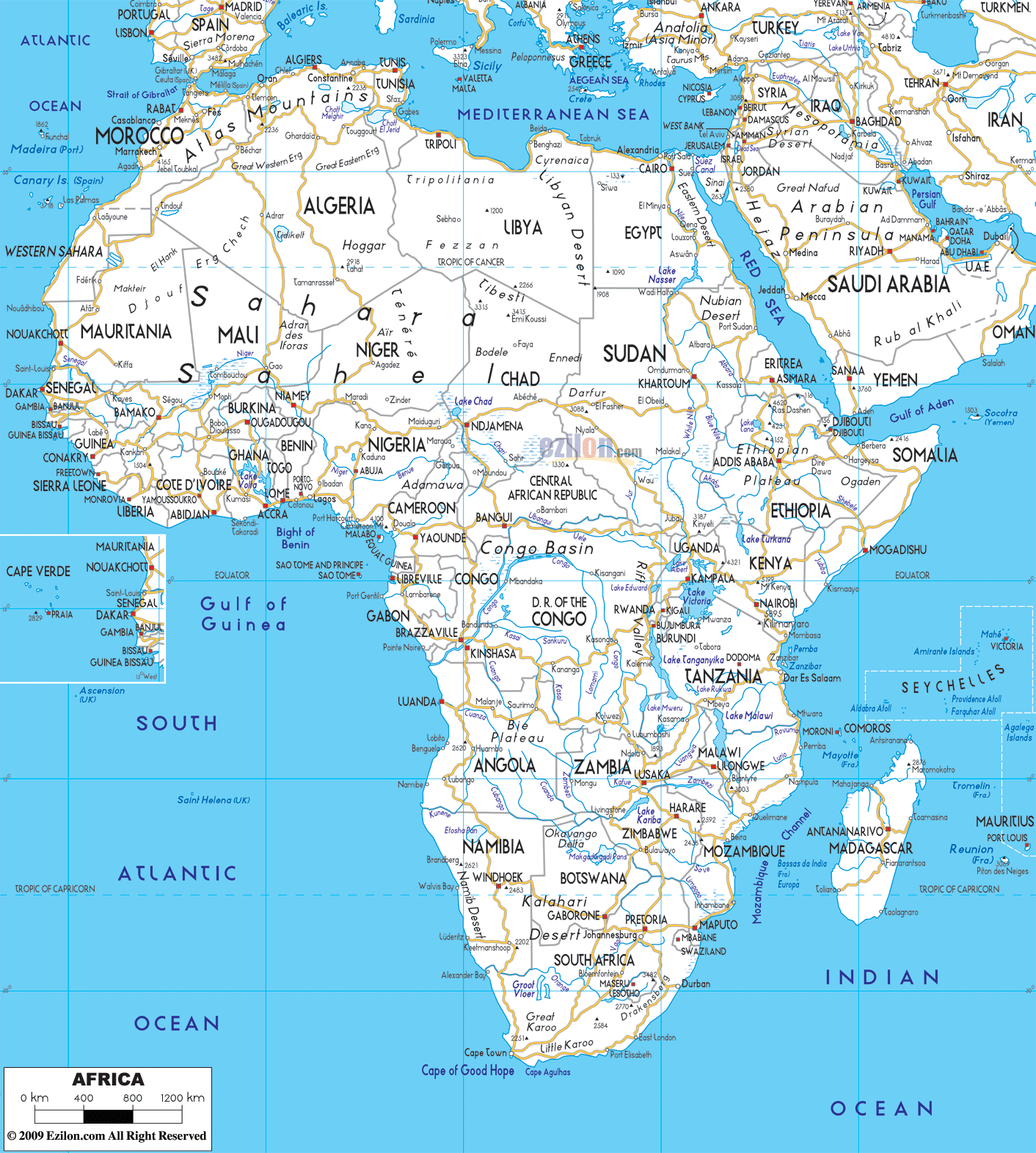
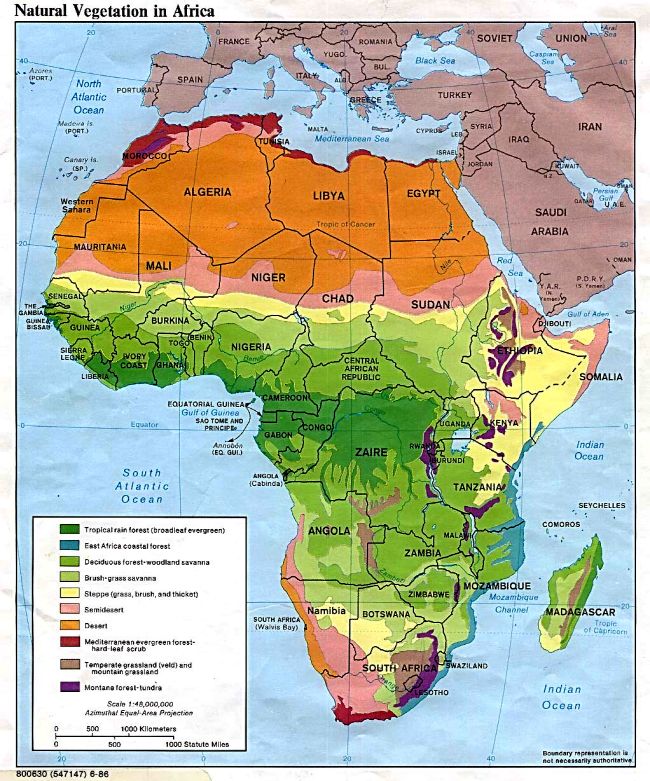
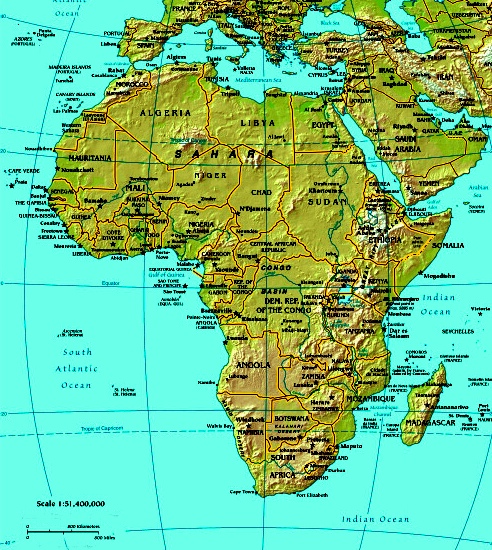
African country boundaries are not what influence the styles of traditional African art. It is environment, people and their culture that influence traditional African art. In Africa physical geography plays a huge role in the development of human culture and its people. Art is only one small part of that human cultural experience. In order to be able to identify a large number art styles easily, you are going to have to be able to understand the role physical geography plays in the arts. Political maps will not be of use here because foreigners (in this case Europeans) who had no understanding of people and their culture imposed boundaries that did not work. Europeans were not interested in people. Europeans only wanted nature’s resources. Above are several samples of African Political Maps and African Physical Maps; Political Nations Map, Political Road Map, Physical Climate and Physical elevation. There are two types of maps Political Maps and Physical Maps. This is an over simplification of mapping systems, but it clarifies how we use maps at this website. Political Maps are about Political Geography human imposed features. They show the boundaries of countries made by humans and other “human carved features” concerning human interest. Physical Maps are concerned with “Natures Work” Physical Geography. It used to be that only the pyramids of Egypt and the Great Wall of China were viewable from space, but that is no longer true. Unfortunately unsightly destruction of the planet due to corporate greed is viewable from outer space as well. Most of us living in metropolitan areas in China , United States and Canada are familiar with the daily sight of chemtrails and chemclouds which look far different from cloud formation known to us in the past. There will be the need for a new feature describing geography. We are dealing with culture with its roots in the past so physical geography will serve most of our purpose here. We have worksheets list the African ethnic groups by country, which comes under political geography. As you will see cultures that existed before those boundaries were imposed don’t stay inside those boundaries. There are two main areas you want to look at first West and Central African Art. Most of the art groups like Igbo, Yoruba, Ashanti, Dogon, Senufo, Mende, Dan, Kuba, Benin; Luba etc. can be found in either West Africa or Central Africa. West Africa is divided in to two regions Arid Steppe and Western Savanna. These are two very different physical geographic areas in West Africa. Those two geographic areas are subdivided once more. Memorize the names of different groups of people and make note of how each ethnic group has work similar to other people in that same geographical area. Once you leave one geographical area and go to the next. The styles of art work changes drastically from the art shown in a previous geographical region. In the Central Basin there are two very different geographic regions there as well. Focus on Arid Steppe, Western Savanna and Central Basin first. It may take you several months or more to learn the art of those three regions. African countries are not what influence the styles of African art. It is environment, people and their culture that influence Traditional African art. You will learn quickly how to identify African art styles by using physical geography and cultural practice methods, rather than learn styles by using country or alphabetical listing of cultural groups. 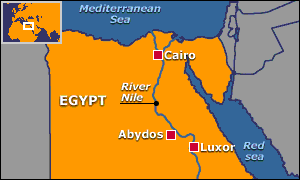 Many of you are having problems finding what you are looking for. We can tell by what you type into search engines and the number of seconds you spend searching this page for what you want. This page is an art survey and is divided into geographical regions, because people living in a given geographical areas tend to share the same artistic traits and principles. The question is what geographical region is the art you are looking for? All of the geographic regions appear on the black tool bar above. On the black tool bar below we have placed the names of popular art groups that people look for, but they may not be listed by the terms you typed in the search engines. If you look at the dark blue title page (strip) at the very top of your web browser you may see terms you used to get to this page. We look for short phrases that come closes to matching what we have on a given page, but the words in that discipline may change once you get to this page. We then change from the casual terminology to terms used in this discipline. These pages will be used by students taking African Art classes and we want to get them in the habit of using the correct names for subjects pertaining to the discipline.
The majority of Western and Central African art in our database and private collections come from works produced during 18th Century to the present day. African art continued to develop and change after the first Europeans arrived. It is only through a faithful few traditional African governmental groups, small kingdoms and African art collectors that we have any since of what African art is supposed to be like today. The small art items of Egypt were put in hiding places too numerous and well hidden to find. Most of the monuments along the Nile Valley were too cumbersome to steal or take anywhere and besides sandstone was not a valued commodity in the Western World. In Egypt art iconography and Egyptian written characters are one in the same. In West and Central Africa all the art forms carry a written iconography, but there are no dates or history recorded in the art, only its identification and use. Egypt wrote a record of its own history; West and Central Africa have no written record therefore there is no Western or Central African art History as of now. …. To be continued …. In conclusion I hope this brief presentation may be of some help concerning your use of this art introduction page. At a later date we will supply similar introductions or other lessons or pages as well. I hope this will help you with your better understanding of this page and that you will be able to achieve goals you set out to accomplish. |
| To the Top | Renaissance | Sherbro | Kongo | Akan | Edo | Ife | Igbo-Ukwu | Nok | Kemet | Nubian | Punt | | San | Skull | Post Renaissance |
|
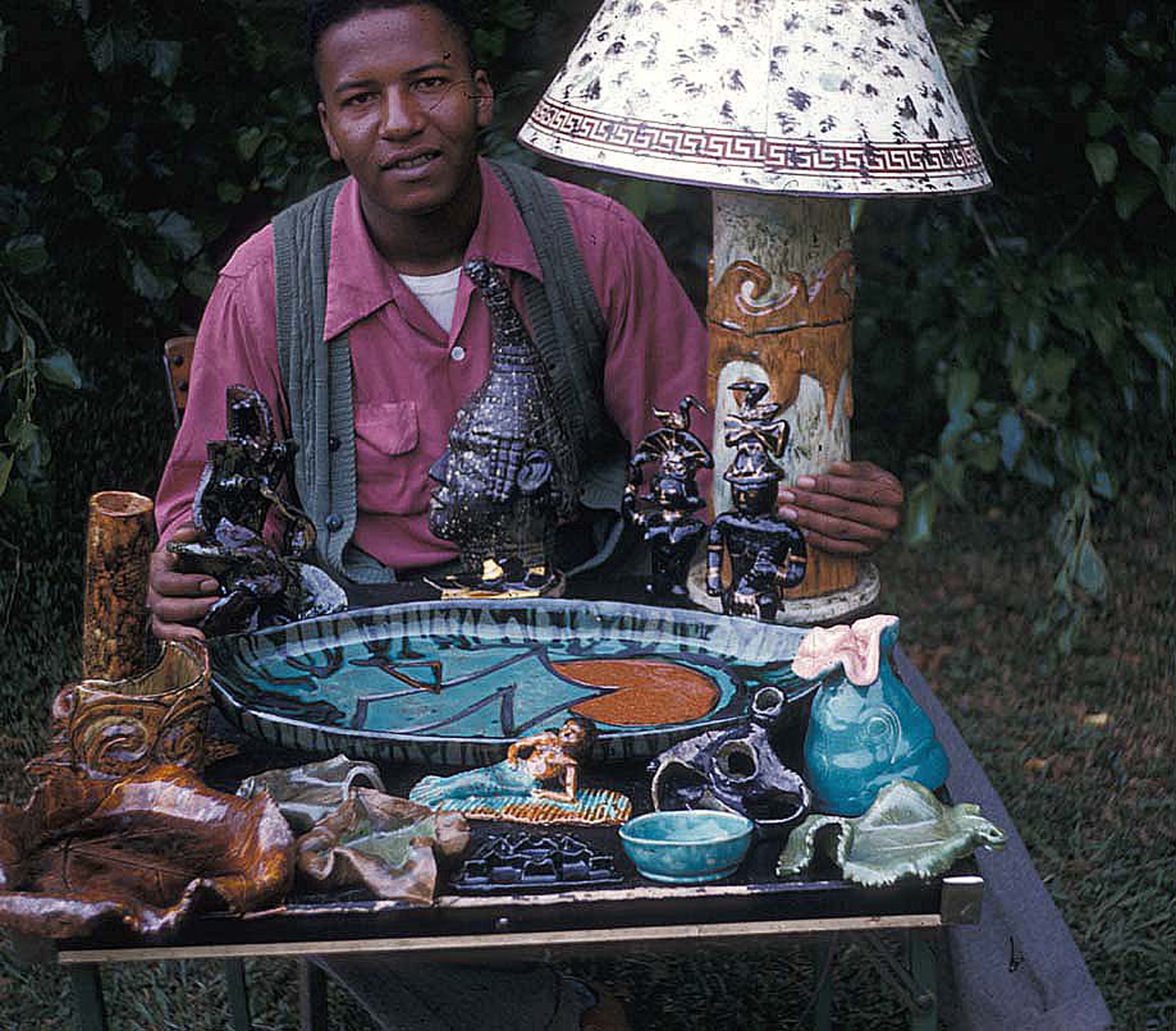
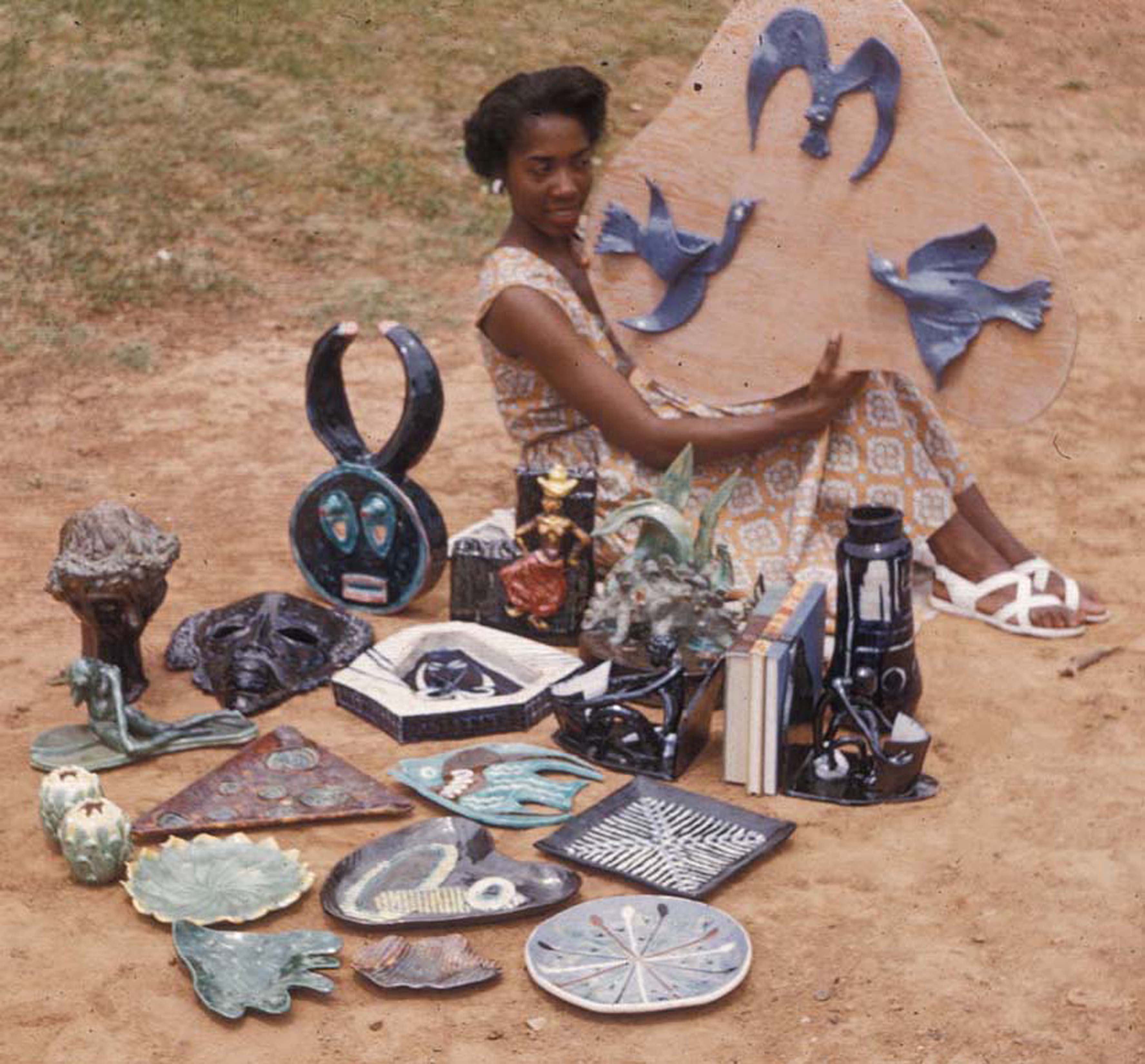
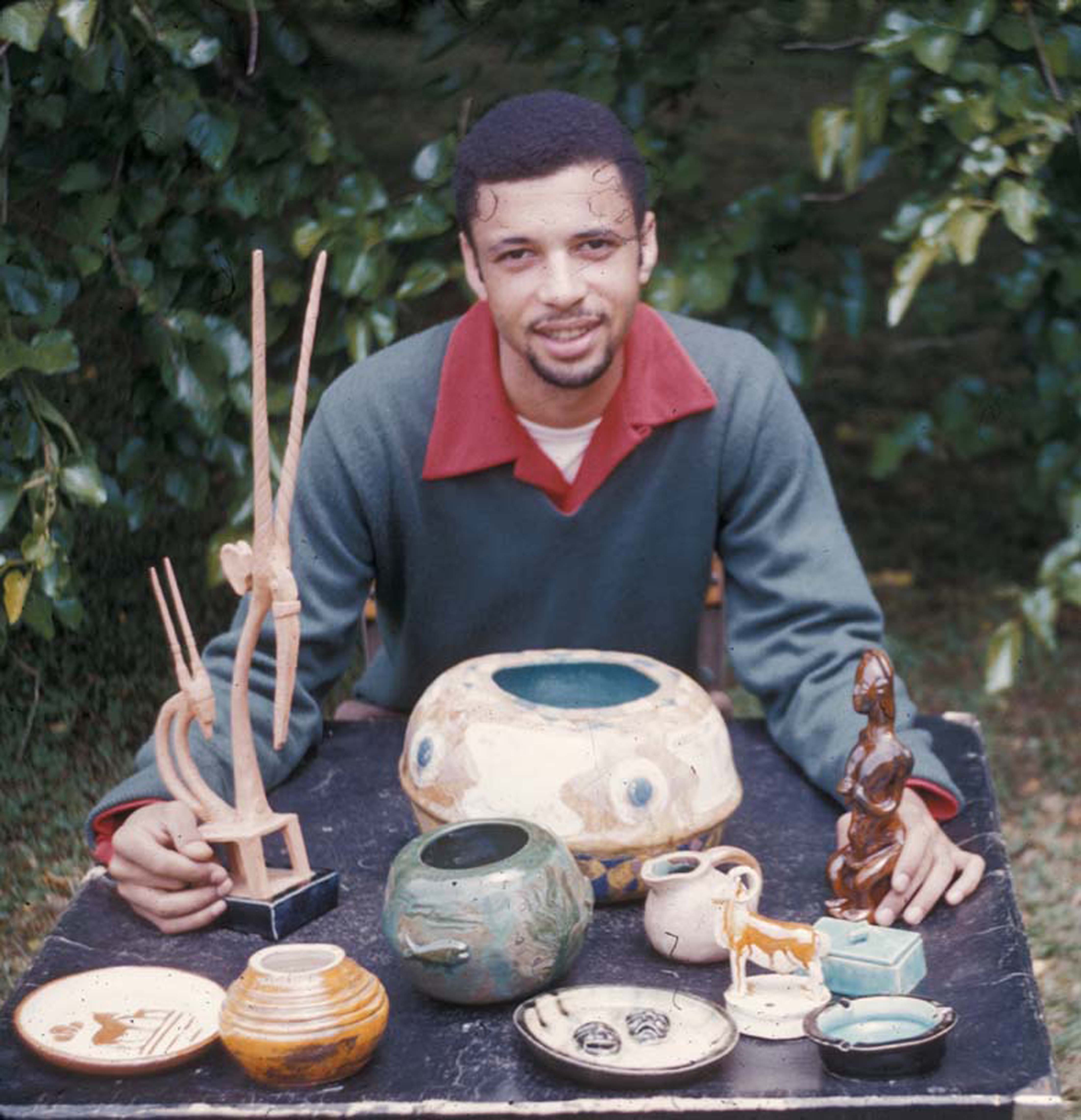
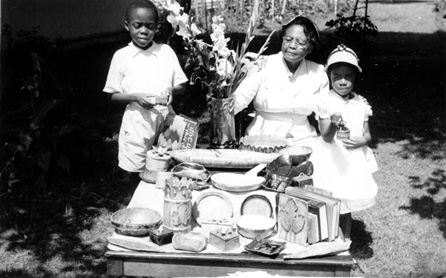
My middle path, since of mission and self identity began with the Talladega Renaissance at Talladega College in Talladega Alabama. My family spent 7 years in that community until I was 10. When the family left Talladega to come to California I did not leave Talladega. I took it with me. My father Claude Clark was the major force, key and catalyst of the Renaissance. In the art department it was a one man show. He taught clay processing, ceramics, methods and materials in making oil paints; preparing canvases; printmaking, drawing, painting, and art history and art education. Some of the materials for glaze calculation were provided with the help of the College chemistry department. They got iron oxide from rusty cans and copper sulfate from corroded copper to produced glaze frits. I asked my father where did he order the frit and he had never heard that word before. He only used the term “gaze base”. My father and I had enough skills to set up art departments anywhere in the world. Talladega College is where I received my start as an artist and Talladega is were I learning my first nation building skills. People who decide the course, or change in history for some strange reason are not always the ones trained or best qualified for that discipline. The movers and shakers are quite often people trained in other endeavors who become extremely dissatisfied, disgusted; sick and tired with things the way they are and wish to make a difference. Quite often the shakers may be people that sit and wait, thinking someone else will come along and make corrections. Guess what, the corrections are never going to happen, so there is only one thing left to do quit you’re complaining; get up and do it yourself. Renaissance
TALLADEGA RENAISSANCE
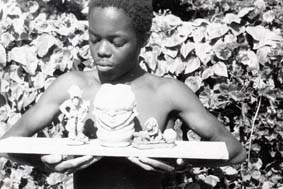
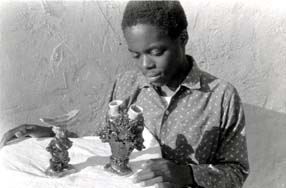
I began clay modeling in summer 1959 while in junior high school. I was 14 yrs. old. The Talladega Renaissance would reach its peak by the time I was 18 yrs. of age. After 1963 that Chapter in my middle path would be closed for ever never to open again. I would move on to more advanced spinoffs of the Talladega Renaissance. Four years had passed since the family moved from Talladega to come to Sacramento and then to Oakland California. As I mentioned earlier I was still in Talladega because I had some unfinished business to take care of. I had vowed before we moved to California that my father and those student were not making African Art, but that one day when I got older I would not only correct what they had attempted to do but do it better and I did. I had my chance in 1959 and the curtains closed on that chapter after high school graduation in 1963.
I became interested in indigenous art of Oceanic at age 12. I did not like what was being taught in public school because African culture heritage was not included in the education curriculum and learning about Europeans was very boring. My father attended Sacramento State College, Sacramento California. He was taking college courses in geography, paleontology and art anthropology. Art was my father’s major and anthropology became his minor. I took a deep interest in my father’s college minor courses. Each evening after I finished my school work I spent time reading my father’s text books. When I started this project I had intended to write about traditional African art of west and central Africa exclusively. Fortunately I began approaching the problem geographically. I got my cue from Dr. William Russel Bascom’s book titled “African Art in Cultural Perspective, An Introduction”. I knew Bascom from the time I was 14. We never talked but we often saw each other when I came in and out of the anthropology museum at U.C. Berkeley. I always had a note pad and I was drawing and taking notes about Native American artifacts displayed in the museum. In 1962 Bascom exhibited images from the museum collection of traditional African art at the Oakland Museum House located on the corner of Fourteenth Street and Oak Street. I said “museum house” and that is exactly what it was back in the day. It was the museum's first show of African Art in Oakland California. I would go there to watch films on African art. In 1962 I had ceramic sculpture on exhibit at that first show. I was age 16 then. Both Bascom and his wife who was also an Anthropologist came to see an additional display of my work one evening at the Oakland Museum. I was getting some attention, because I had become quite an enigma. He had a chance figure out who I was and gain some hint of my mission. In his book he made acknowledgement of Dr. Anthony Okion Ojigbo a political science major from Nigeria. I knew Ojigbo and his wife very well. We used to engage in lengthy discussions about African art and culture.
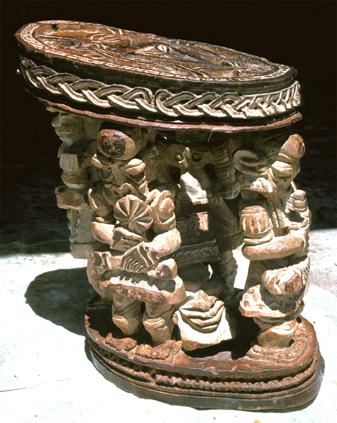
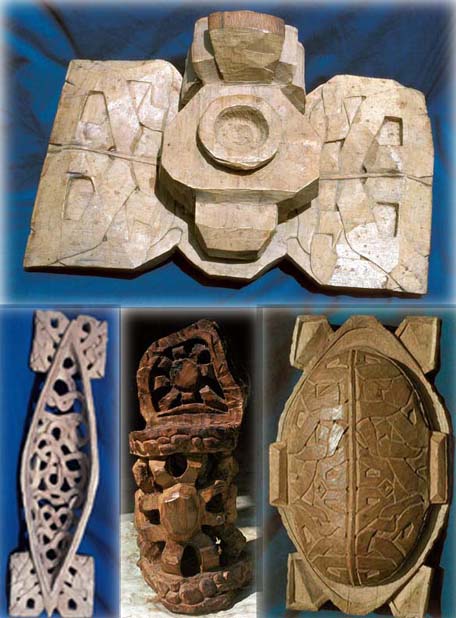
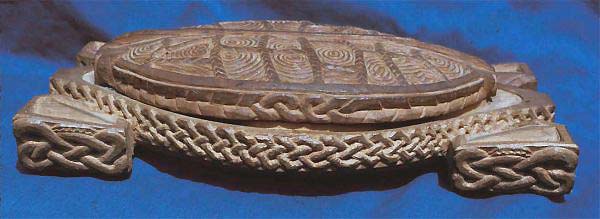
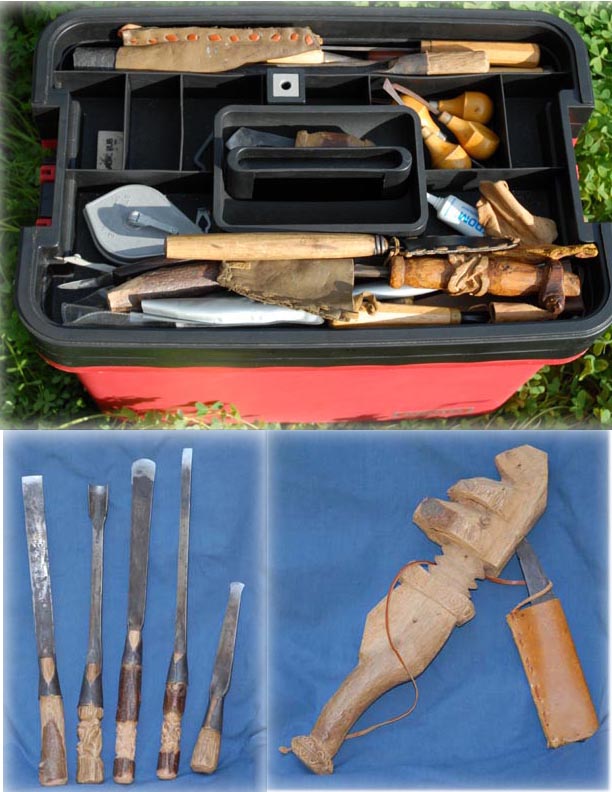
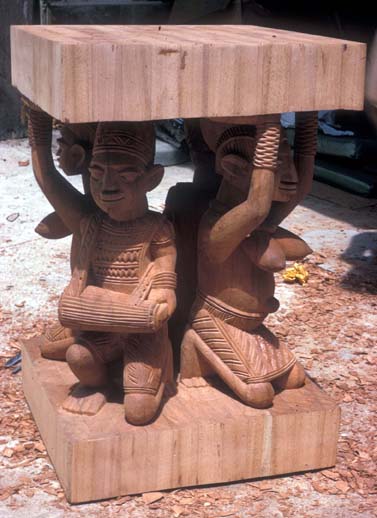
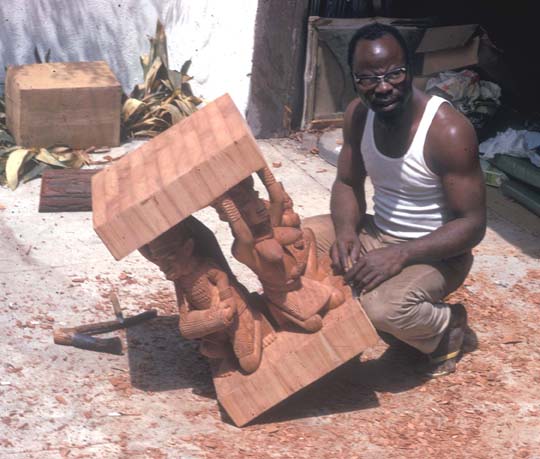
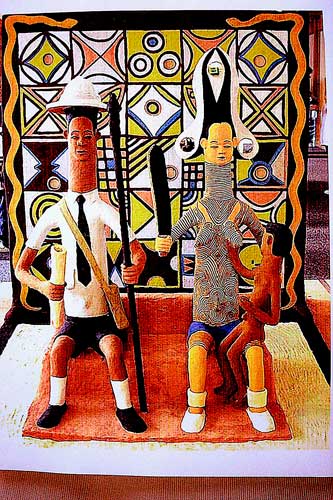
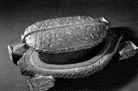
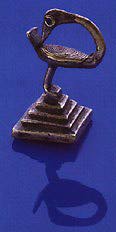
TALLADEGA POST RENAISSANCEI began writing African art essays in 1969 and started African woodcarving in 1973. My father published an art teacher’s guide in 1970. I wrote and illustrated the Traditional African Art section. My first dot com website was launched in 1997 and I began writing cyber essays in 1999. The first one was titled “Coin Conspiracy” but it did not acquired that title about 2002. There are four animals depicted above on the right hand side. The first one is an insect, represented in the form of a butterfly. The butterfly serves as a footrest for person using the commemorative stool on the left. The animal on the bottom left of the same picture represents a fish. It is just a generic form of fish; no particular type of fish. The fish is used as a tray. An arachnid is next in the form of a spider. This spider is a work stool. The last item is a reptile and it is represented as a turtle. The turtle is a box. I have plans to do amphibian, mammal and a bird next.
In 1967 Dr. Bascom organized an in-depth, extensive exhibition of traditional west and central African art at the anthropology museum at U.C. Berkeley. I spent several months taking notes and recording that exhibit on color slide film. Occasionally I had a chance to hear him give a guided tour while I was at work. The next year I photographed the Paul Tishman African Art Collection at the Los Angeles County Museum of Art In Los Angeles California. Bascom had confiscated a large number of Ife bronzes from a compound in back of the Oni’s palace in Ile Ife. The Oni was very upset about that. So Bascom gave bronzes back, after making plaster copies of the originals. Bascom had many publications about African folklore because that was his area of interest. Art was just a side line and not his main focus. When I became a graduate student at the University of California Berkeley in 1968, with the help of my father I was able to gain access to artifacts in the museum archives anytime I needed to. In 1976 I barrowed artifacts from the museum collection to exhibit at an art exhibit of African and African American art at San Jose State University where I was teaching African American Art History. I was curator of the exhibit. During the late 1970’s my mother a teacher in African religion and philosophy, became interested Egyptian Civilization and suggested I go hear Dr. Ben Jochannan a Jamaican immigrant from Harlem New York. He grew up in Harlem under the influence of Marcus Garvey. I came to know him fairly well. Dr. Ben dressed like Garvey and he talked like Garvey. During the early 1980’s and mid 1980’s I heard in person several other scholars Dr. John Henrik Clarke, John George, Ivan Van Sertima and Theophile Obinga. My father and I used George Peter Murdock’s book titled, “Africa its Peoples and Their Culture History” as a reference for organizing the art producing people in west and central Africa. The words “cultural history” is important concerning west and central Africa, because that may be all we can get historically. There is almost no history about the art. Most of the work is in wood and did not last long on the African continent. Metal and clay objects are much older, but not much is known about the work yet and there was no writing from that period of time. There are few exceptions. The Benin bronzes and chronology to go with the sculpture is still intact. skull 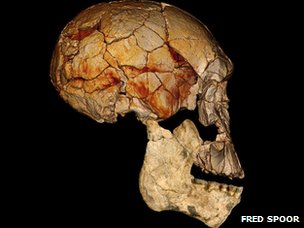 MAP OF AN ANCIENT AFRICAN CONTINENT |
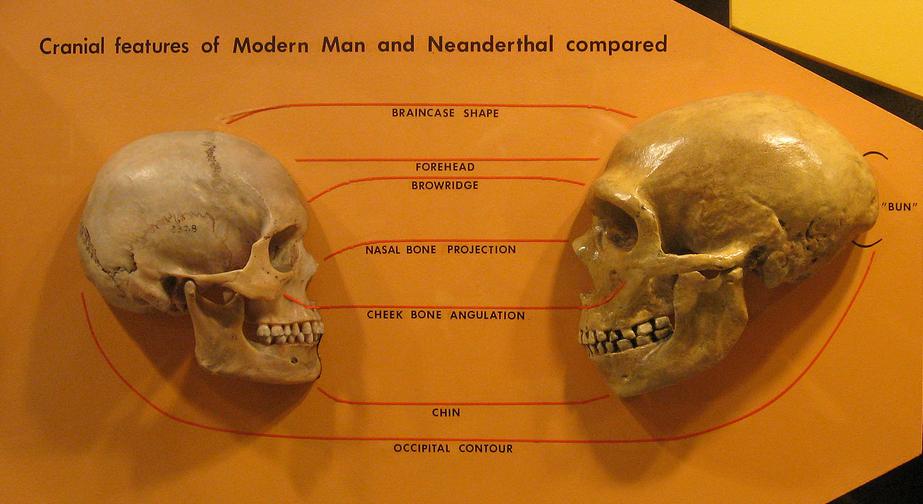
What were Africans doing before there were civilizations and who were these Africans? There were many Hominids types living in Africa. This is Homo rudolfensis. Homo sapiens, sapiens is just one of the many branches of human genotypes. Homo rudofensis looks much like our map of Africa does today. As you can see Nigeria and Cameroons are clearly defined. The great lake region on the eastern side of Africa is in place even though the Nile is not present. What is to become the Congo River is only a lake inside the Congo basin. As you can see things are beginning to shape up. For more information see BBC News. |
|
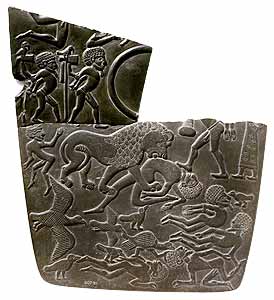
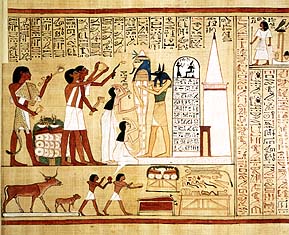
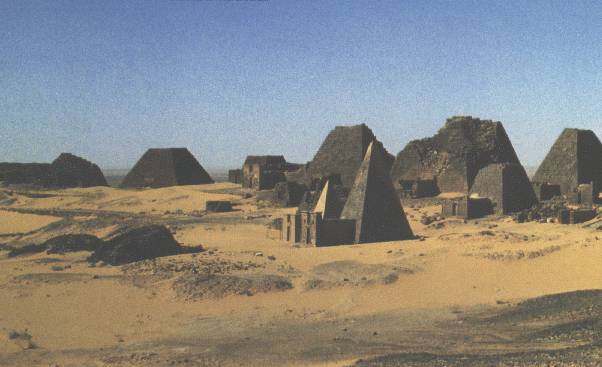
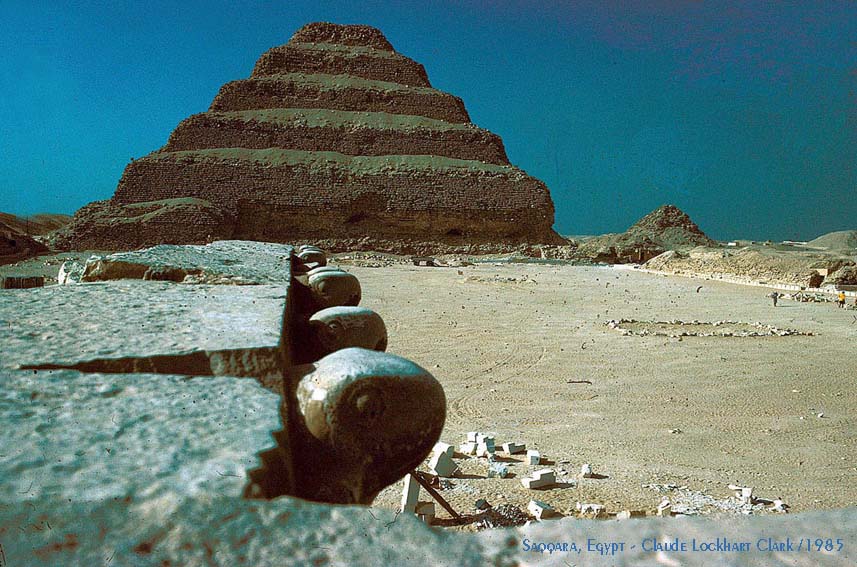
Egyptian Architecture is stark, plain and massive, emphasizing the use of lines and polygon geometric forms. This is a photograph of Step Pyramid at Saqqara from the 3rd Dynasty (2778-2723) B.C. Egypt (Kemet) is not a Mediterranean Civilization. The 3rd Dynasty is possibly earlier than Chinese Civilization. For the rest of the comparisons on this page you don’t need to include 1st and 2nd Dynasties because the 3rd is old enough. Third was more sophisticated than anything on the planet during its time and if there were other civilization outside Africa earlier than the 3rd Dynasty, then 3rd Dynasty has Nubian and Punt to back it up. 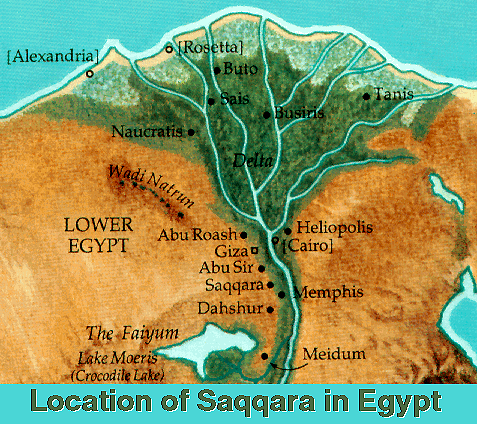 Ancient Kemet is not a Mediterranean Civilization. I am the one that took this picture in 1985. I couldn’t even see the Mediterranean Sea from Saqqara. Alexandria and Rosetta are located on the Mediterranean Sea Coast North West of Cairo. Cairo is inland on the East Bank of the Nile. Giza is on the West Bank across from Cairo and slightly south. Saqqara is south of Giza. Memphis which is older than Saqqara is located on the West Bank south of Saqqara. Minoan and Mycenaean settlements were just beginning and the first Civilizations in the Fertile Crescent (in present day Iraq) were just beginning to emerge around the time of the step pyramid in Saqqara. By the 3rd Dynasty Egypt now a full blown civilization, had become the world’s first monumental civilization and the 4th Dynasty at Giza had not yet arrived. During the Thinite Period which dates between 3000 B.C. – 2778 B.C. King Nar-mer united Upper and Lower Egypt under one crown about 3000 B.C. or earlier. The 1st and 2nd dynasties are Thinite because the kings from that period are from Abydos. Abydos is the birth place of Egyptian Civilization. I will let you check out the birth place on a map later. Current studies seam to suggest that the Sphinx in Giza is definitely older than the great pyramids. In which dynasty is its origin; is it 3rd, 2nd, or 1st dynasty? Remember Nar-mer was pulling together territories in the both in the north and south of Abydos. Egypt is possibly older than 3000 B.C. The origins of Egyptian hieroglyphics are Nubian and most of the Egyptian gods are Nubian accept possibly Amen Ra. Amen lives in Punt; at least that is what the Egyptians tell us. The world’s oldest pyramids are located in the Sudan. Both Egypt and Nubian have their origins in the Land of Punt and Punt is located in the Horn of Africa not even close to the Mediterranean. © Claude Lockhart Clark July 19, 2012 Egyptians used a form of pictograph characters for writing. They learned how to write by using pictures from the Nubians. In Egyptian art all iconography was the same. You can see the same iconography used in writing, carved relief sculpture, free standing sculpture, furniture, architecture, painting, pottery and jewelry. Mixed in with the pictures were picture symbols that represented consonants. Egyptians did not depict vowel sounds. You had to guess what the vowel sounds were if you did not already speak the language. 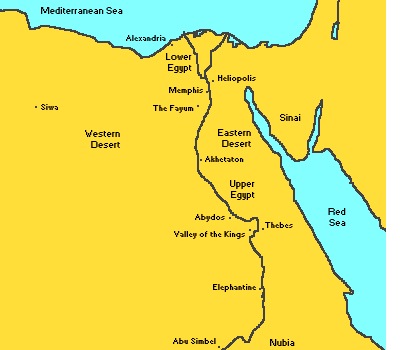 Map Of Ancient Egypt © Copyright 1998, Jim Loy The Egyptians were the first land surveyors. They produced an accurate means of measuring land in order to determine boundaries. A form of geometry was developed for this purpose. The invention occurred out of necessity. Famers would get into fist fight after the floods over who was stealing each others lands. This new invention helped control a number of social problems plus opened new avenues in landscaping and architecture. “Thus necessity is the mother of invention”. Before the invention of the plow in Egypt, Africans used a hoe and they organized their plots in a series of grids. Egyptians continued to cultivate farmland inside rectangular grids. The squares and rectangles were much larger than the grids of people using the hoe in the south. The plow was a much large farm tool so it needed a larger grid. CLC Africa is the cradle of Hominids. Africa is the birth place of Homo sapiens. Human Civilization began in Africa. The earliest forms of agriculture began along the Nile. Cattle razing began in the Near East along the Fertile Crescent and quickly spread to North Africa. Iron smelting was started in the Sudan. The first cities and metropolitan centers began in Africa. Egypt is the birth place of the worlds first metropolis. Egyptians learned the arts of stone cutting and pyramid construction from the Nubians. The ancient Egyptians learned writing, math and sciences from the Nubians, Kingdom of Kush and Punt. During the 18th Dynasty between (c. 1385 B.C. - c. 1350 B.C.) the pharaoh Amenhotep IV (Akenaten) created heresy by proclaiming there was one god "Aten", thus making Egypt the birth place of monotheism. Egypt helped spread the blessings and evils of civilization to the rest of the world outside of Africa. The basic concepts and principles of civilization began in Africa. Egypt was one of the last in a long line of Nile Valley Civilizations and Egypt was the world's first monumental civilization. |
|
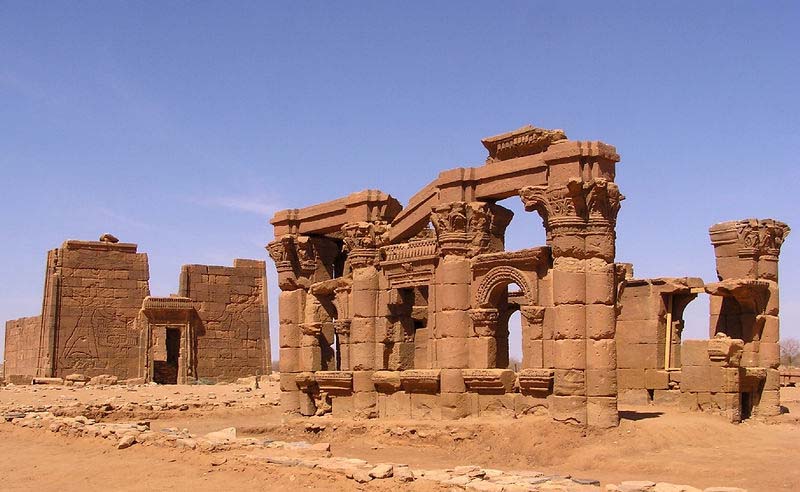
Nubian Architecture is decorative and linear emphasizing curves and rounded geometric forms. The example shown here is a product of Kush Civilization. It is "Kiosk" located at Naqa, Sudan sixth cataract, south of Meroe. The temple in the back ground to the left characterizes Egyptian architecture in its use of polygons.
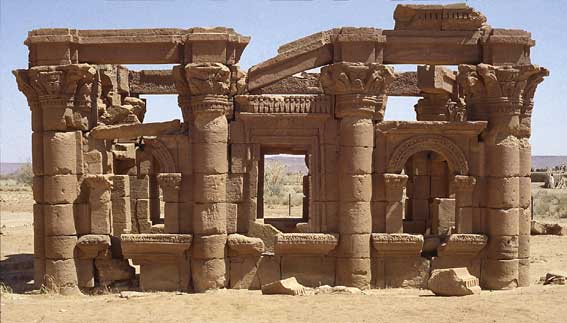 Another View of Kiosk Kiosk and the Temple of Amun were built during the Christian era, so there are Egyptian and Roman characteristics present as well, but the characteristics I described should reflect both old and new Nubian as well. The earliest columns were probably cubical rather than cylinder columns. The Egyptian buildings at Abydos reflect earlier cubical column types. 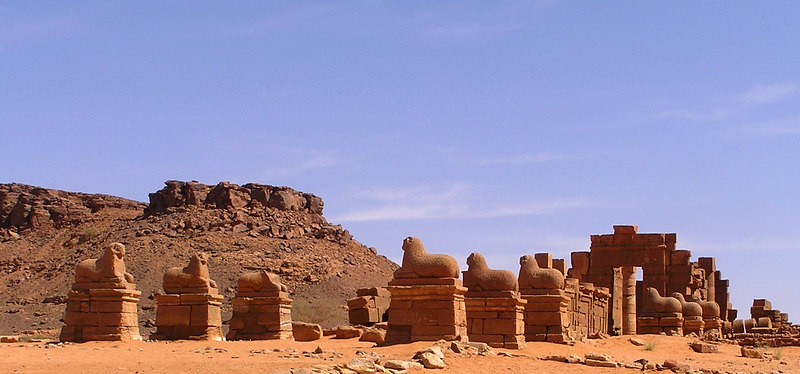 Temple of Amun, Naqa, Sudan (15 AD - 40 AD) Nubians developed the column which aloud architects to build structures with wide open interiors. Egypt could use this Nubian structure to develop larger monuments. Nubians produced the first pyramids, but they could not build big pyramids because they kept falling down. I think I have seen an early version of the Sphinx produced by Nubians, nothing near the scale produced by Egyptians in Giza. The great Sphinx in Giza was not produce during the fourth dynasty. That information is incorrect. There were no Great Pyramids in Giza then. The Great Sphinx was the largest architectural sculpture in that area for a long time, by itself. I saw a few very large pyramids near Giza that never made it because they kept falling down. Egyptians built their first great pyramid monument by constructing it in five layers like a layered cake.
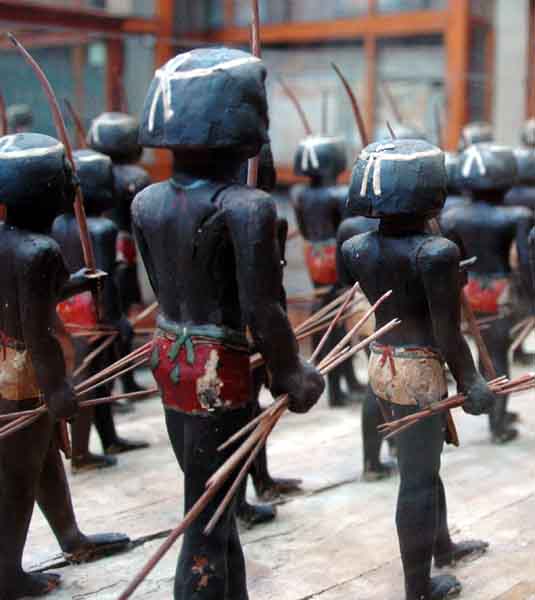
Anything that comes earlier than Egypt would be old and ancient as far as I am concerned. Egypt would be a great introduction for anyone studying both early and current civilizations, because most of the frills, institutions, bureaucracies, politics, social issues, and problems of the day, corruptions and plagues of society were already in place by then. After the rise and fall of Egypt there is very little new under the sun. Studying Egypt is like viewing your own reflection in the past before it happened and studying Nubian Civilization is learning about how it got like that in the first place. It was the ancient Egyptians that told us to “Know thy self” and they probably heard the Nubians say it first. They should know. Instead of beating our selves on the chest like some chimpanzee or guerilla we need to get down to business. 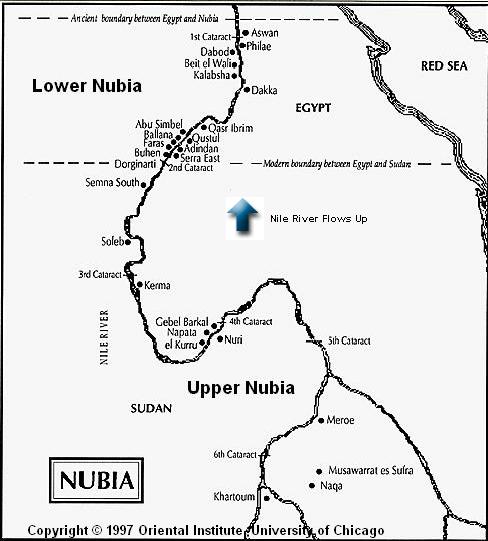 Nubian Civilization, Kingdom of Kush and Meroe are all Nubian Civilizations. Nubian Civilization had many off shoot cultures, kingdoms and civilizations. Egypt was once a Nubian settlement which later grew into a civilization after which it became the most famous civilization in the world and still is to this day. Egyptians developed their own language and political autonomy; then separated them-selves from Nubian Civilization. The ancient Kingdom of Kush was created by Nubians and run by Nubians. After receiving its own anatomy, Egypt would then inspire other people to become civilized through out the known world and several of those civilizations would come back to haunt both Egypt and Nubian people. Civilization meant many different things to different cultures and different people. The culture those people had before becoming civilized would play a major role in their development. People did not get rid of old beliefs and practice after becoming civilized. Civilization reinforced those beliefs and provided an adversary with a weapon to wreak havoc and misery on you later. If you give a mad dog a decent meal and place to stay with out curing its disease you would have probably been better off had you left that dog the way he was, because its ill fate might come back to haunt you; therefore let a sleeping dog lie. There was another reason for the Nile Valley collapse and collapse of African Civilizations as a whole. African Civilizations never developed their masses of people. Therefore the people didn’t have tools need to support their governments when ever there was trouble. African leaders still don’t develop the masses. Julius Nyerere is one of the few that knew what was needed to sustain a country, but his programs never got the support needed from the wealthy and middle classes. Meroe was the last Nubian Civilization. Nubians attempted to over throw the Romans, drive them out of Egypt and then restore Egypt to its original glory. The jubilation only lasted 200 yrs. When the Romans recovered from their defeat they went on a rampage from Alexander to Meroe. By destroying Meroe the Romans succeeded in destroying both Nubian Civilization and Egyptian Civilization at the same time. The destruction of Meroe became the key to getting rid of all Nile Valley Civilizations, unless of course you want to say that the Land of Punt survived. How could that happen? Large trees provoke the pride of strong winds while small, “weak” saplings go unnoticed. What took people 8,000 yrs. to build unscrupulous barbarians came along and destroyed it in seconds, so beware. Peace - © Claude Lockhart Clark July 24, 2012 |
|
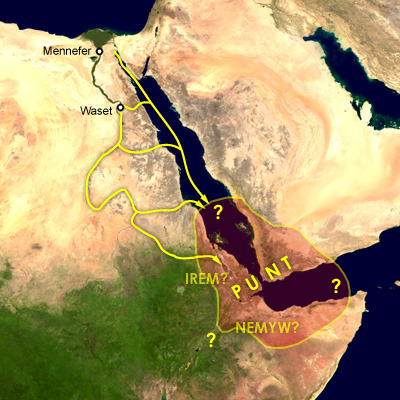
Too much emphasis has been placed on the Nile River and not enough studies about people living away from the Nile. There was the African horn. There was much activity taking place in that area. People were living there. What were they doing there and who were they? The Land of Punt; what is that? Punt was created separate from Nubian Civilization. We think it is older than Nubian. African American historians often called "The Land of Punt" Ethiopian Civilization, but there is vey little evidence to show that Punt began in Ethiopia. It began in the low lands close to water in a place known as Eritrea and Somalia. Ethiopia is in the rugged highlands away from great bodies of water. The Land of Punt that the Egyptians referred to was located in the African Horn along the cost line of the Red Sea South Eastern Sudan, Eritrea, and Somalia, Djibouti in Africa and South Western Arabian Coast and Yemen in the Near East. The Egyptians referred to Punt as the land of Amen (Egypt’s supreme deity), suggesting that the Nubian and Egyptian Sun deity lived there. All Egyptian and Nubian gods had there place of origin. Perhaps Land of Punt is older than Nubian Civilization and is one of the founders Nubian Civilization. Punt later went on to become the founders of Axum and the Ethiopian Empire both located in the Ethiopian highlands to the south. Abukar Ali, a former newsman and accomplished translator, believes that the majority of Nubian gods came from Punt. Here is his studied titled “THE LAND OF THE GODS”. There is another irony concerning The Land of Punt. Some of the world’s leading scientists, zoologists, geologists, anthropologists, and paleontologists live in Punt. Their ancestors started civilization and now people of Punt are trying to find out who we are and where we came from. They most important fined so far was a Hominid named “Ardi” that was a close link between modern chimpanzees and modern Hominids. Scientists co-leaders Berhane Astaw; Giday Wolder, Yohanes Haile-Selassie and and other Ethiopian scientists are working with European and American scientists along the Somalia Ethiopian boarder just inside the land of Punt. The specimens found there are tested in over 36 science laboratories around the world. ife 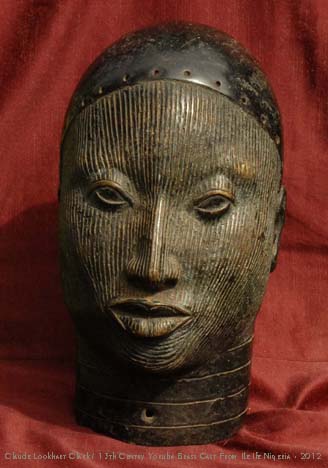 BRONZE CAST OF AN ONI FROM ILE IFE |
The bronze head you see before you is not bronze at all. This sculpture is made of brass, a combination alloyed made of copper and zinc and possibly a small amount of lead. If information from the British Museum is correct the alloyed was not a local alloyed. It was produced from brass rods transported across the Sahara desert by camel caravans(see research material at British Museum,London). The brass rods came in such small amounts that the brass casters in Ile Ife had to learn how to use the metal very sparingly. This head is light in weight and reveals a small shortage of metal along the lower right side, bottom of the neck. There are no gates or vent attachments detected making this example almost a perfect cast. The head you see was produced before the Italian Renaissance and it is older than Western Civilization. This brass cast was produced between the tenth and twelfth century A.D. which makes this sculpture 800 years or more old, almost a thousand years, which would be slightly less than half the age of European Civilization. This sculpture was the end results of two very different civilizations meshing together and coming up with an ingenious plan. The Oyo-s’ were from Egypt. They were driven to that area as a result of Islamic expansion and the Arab slave trade. They probably came in several waves, the first group Oyo-s may have been Coptic Christians, followed later by a wave of Muslims. The Nupe and other indigenous people had been in this region for thousands of years. These two very different set of experiences would come up with a plan that would revolutionize the global art world concerning human images. It would not be until the 19th century, 700 years later that artists in Europe would come up with the same theory from a different perspective. The Oyo-s’ were not a large group of people. They were very small in terms of numbers. They established themselves by leveraging the power of the indigenous priesthood of Ile Ife. The priesthood in Ife was recognized and respected by many communities in what was to become known as Yoruba Land. Oduduwa probably did not come directly from the Nile. Oyo migration probably was a gradual movement that took several generations to accomplish. Oduduwa sometimes referred to as Olofin Adimula (by one account) may have migrated from a community inside Yoruba Land. One theory has it that the Oyo-s’ originated in Ekiti and Okun sub-communities in northeastern Yoruba Land. That would only have been a temporary settlement long enough obtain familiarity with language, religion and customs of the region. The Oyo-s next move to the city of Old Oyo was probably where Oduduwa inters the picture. This move placed the Oyo-s close enough to observe the political infrastructure in Ife thus providing Oyo-s with enough knowledge concerning how to gain leveraging power to use Ile Ife as a “Trojan Horse” to conquer the rest of the region. There were not a dozen brass heads cast, two or three dozen brasses cast made. We do not know how many cast were made and how they were distributed. This example probably represents an Oni of Ile Ife, but the Alaafin of Oyo had portraits made too. The Oyo are the ones that implemented and controlled the brass portrait casting process. They tried to keep knowledge of this type of casting within the confines of Ile Ife. The Alaafin shared knowledge of brass portrait cast only with his older brother in Edo City (the city of Benin). The Oyo-s presented brass gifts to other parts of Yoruba Land but they would not tell or reveal the secrets of the process. There were large full brass figures made. Only one is known to exist from the Nupe village of Tada. It is believed that the Nupe people may have been the architects of Nok Civilization that dominated the region before the Oyo-s came. Several settlements in Yoruba Land learned how to produce human life like portraits in terracotta but only Ife produced the brass ones.
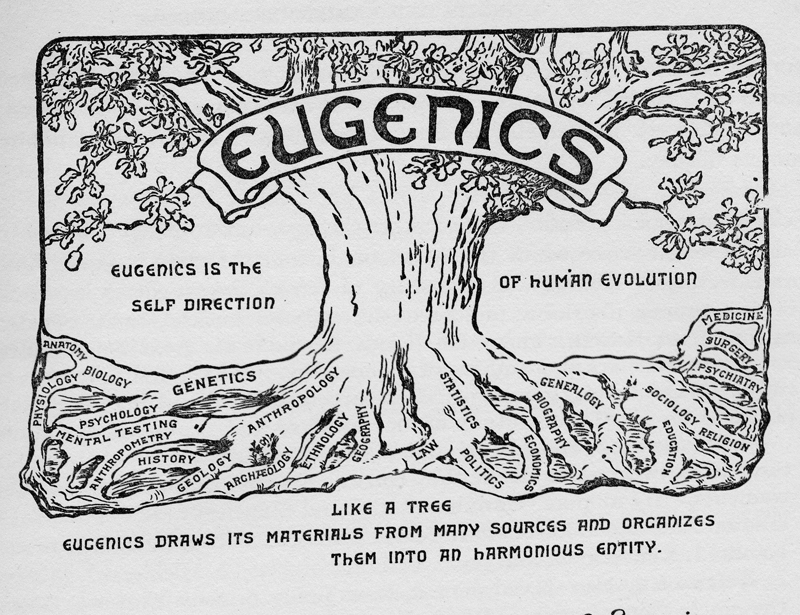
There is much confusion concerning how Ife brass sculptures relate to Greek sculpture. How does Ife portrait sculpture compare with Greek portrait sculpture, what are the similarities? The answer to that question is very simple, “they don’t”. Let me clear this up for you so that there won’t be any further confusion regarding this matter. First we need to go back to Athenian Greece and Ancient Kemet where all this mess started in the first place. The Western mind appears to be pervasive throughout the planet earth. However there are at least two civilizations (China and Far Eastern Civilizations) and a variety of cultures in Africa and elsewhere that might see this scenario much quicker than people schooled only in European and/or Western Civilization thinking. In Western thought people are taught to see human likeness only from Greco-Roman perspective and if the style of human portraiture doesn’t meet those requirements, they fail to conceive the possibility that there may be other options. European and Western scientist both have that same problem. The Egyptians were a very spiritual people. They could not conceive or envision a secular world. That concept would have no meaning to them. The same is true with the rest of Africa. The Athenians on the other hand were atheist. They were the first people to introduce a secular society to the civilized world. They believed that their gods were human like and lived on mount Olympus. They also believed that “Man was the measure of all things”. If there were problems to be solved Athenians did not leave any of the solutions to be corrected by nature. Athenians attempted to correct it themselves or study the problem long enough so that it could be corrected by humans at a later date. The later date evolved when Eugenics Society and scientist demonstrated the capability to manipulate biologic engineering of perfect genes and chromosomes in order to produce a more desirable species of human kind. Back then all the Athenians could do was produce art. They would have to wait another 2,000 years in order to accomplish there real objective. Egyptians on the other hand believed that there were two creative worlds; one consisting of nature and the other realm of art or human creativity and that both of these worlds were governed by the sun and other universal forces. They believed on one hand that nature knew best how to do it was doing and that humans should be concerned with creating a “cultural universe” of their own which would be entirely different from nature, but supportive of natural world. They did not wish to show any disrespect for nature by coping the creators work. Egyptians would continue to produce culture while creation continued producing nature and the two would some how work together. Where the two civilizations Greece and Kemet were quite similar is that neither Greece nor Kemet believed in harmonizing with nature or at least they never showed it in practice. Egyptians had since of insecurity and inferiority complex concerning nature. They were not able to initiate longevity and doctors were not able to control diseases that deformed and claimed human lives so Kemet tried to compensate for this. Civilization gave Egyptians a false since of being able to concur something, possibly by performing all these unusual cultural tasks the gods might do them a favor. The god kings and enormous monuments were testament of that desire to control and the Athenians were quick to pick up on that inconsistency and carry it to the next level by declaring that “Man was the measure of all things”. The art of both Kemet and Athens reveal the need to control their lives. Athenian field of medicine was not advanced enough to make physical changes in the human species so they accomplished what they wanted to see in human development through their art. Their idea was to produce a perfect human image. Nature was messing up and surely Athenians could do better than that. Their portraits in bronze and stone looked like real people but any signs of skin wrinkles or aging were missing. This approach to human portraiture was given the term “Realism”. The Greeks interestingly enough began with the same approach for modeling a human figure that the Egyptians were using. It helped them with completing there task of producing “Realism”, but they did not realize that there was a better way of trying to accomplish what they were after. Students in Western art are still taught to achieve human likeness by using the same archaic approach to constructing human images. The Greeks never understood why Egyptian artists were using polygons in the first place. Egyptians put straight and six sides on nearly everything they built. Their world consisted of polygons. By using this construction procedure and maintaining polygon principles in their finished product no one could ever accuse Egyptians of coping nature, because Egyptians did not see any of these principles used in nature. Egyptians applied straight lines and six sides to nearly everything they built. Their world consisted of polygons. By using this construction procedure and maintaining polygon principles in their finished product no one could ever accuse Egyptians of coping nature, because the human culture principles they used did not appear to be the same principles being used in nature. The Athenians saw Egyptian art as being “Stylized” because Egyptians did not know how to make human portraiture look “Real”. We will now view sculpture procedures in Ife using Nok sculptures as reference. We must keep in mind that human principles are important in the making of art rather than natures principles used in creation, because humans must not interfere with nature’s work. Nok people used the cone, sphere and cylinder for producing sculpture. Nok people were very peculiar. They would take any one of the three forms and construct a whole human head. The Nok produced a variety of cylinder heads, cone heads and sphere heads. This peculiar relationship to the human form must have appeared extremely bazaar and strange to the Oyo-s who were used to the Egyptian polygon approach. What was nice about Nok was you could never forget that you saw these three forms being used to compose sculpture, because the Nok people made an issue of their use by repeating the process so many times. Then it appears as though someone perceived an idea; why not specialize each of the forms used? The head became a sphere, neck a cylinder and the cone played a part where ever it was needed. © Claude Lockhart Clark August 11, 2012 |
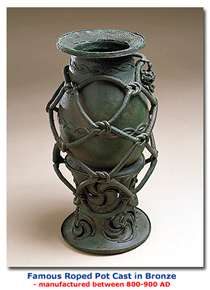 IGBO-UKWU BRASS CASTThis is a brass or bronze casting done by Ibo metal casters during the tenth century AD. Copper alloyed casting was being done in both Yoruba Land and Igbo Land around the same time. What is remarkable about some of the Igbo-Ukwu bronzes is the complexity of the cast art. The cast you see here has two distinct parts that are attached in some places. A vase sits inside a lace like outer structure. The two sculptures probably were produced from one mold, one single cast rather than two separate casts. The Igbo are a recent group of people in South Eastern Nigeria. The ruling class brought with them influences from out side the same as the Yoruba in South Western Nigeria (see “Ife” Black Tool Bar link). |
 |  |
|---|
| Top | Edo People | Western Civ. | Bartolomeo Marchionni | Share/Castrate | Soft Slavery | Renaissance Tool Bar | Edo Ivory | Race | | |
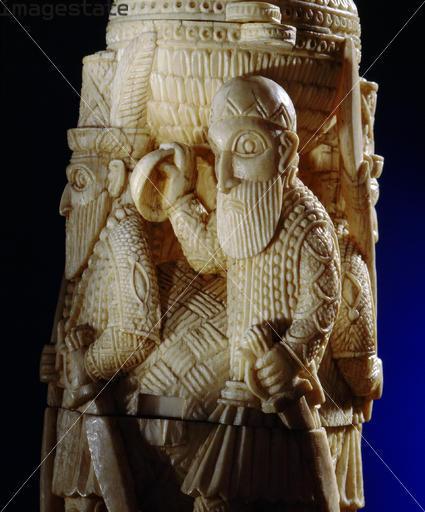
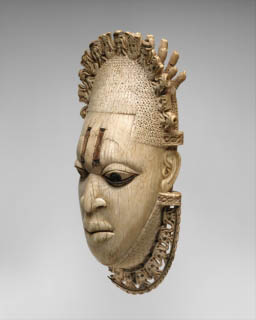
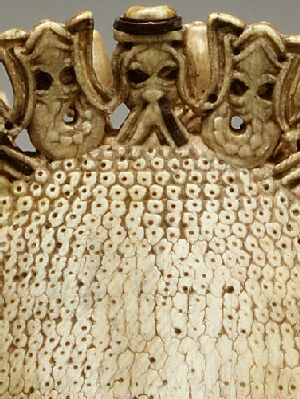
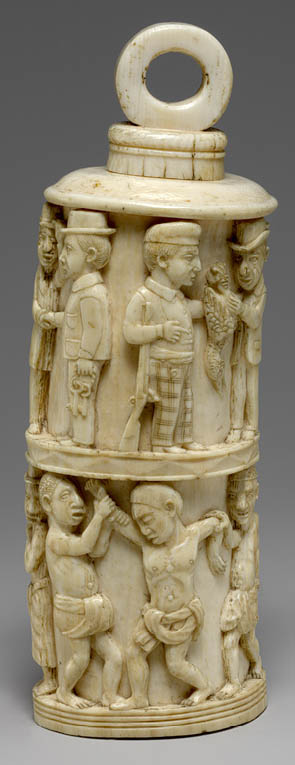
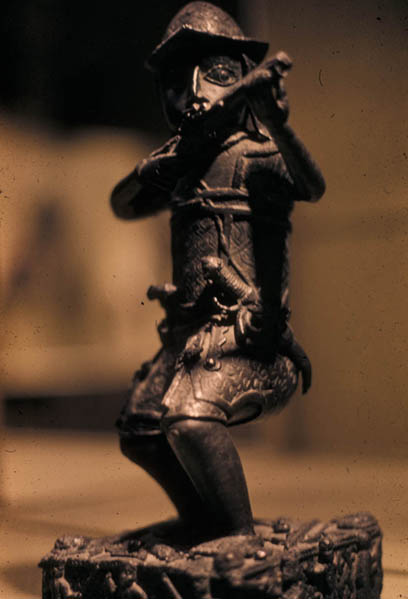
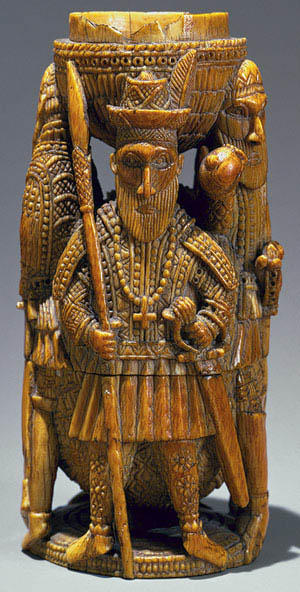
These two images depict two very different views of Portuguese done by two Edo artists. The bronze image is an Edo concept of what a Portuguese Soldier look like to an Edo (Bini) craftsman. The image of the Portuguese Soldier is viewed from an African world, not a hybrid world. Western Civilization is a Hybrid Civilization it grew out of Europe’s association with it’s over seas colonies. This image of a Portuguese Soldier is not Western Art. It is African art even though a European is subject in the sculpture. The ivory sculpture is not European Art though it reflects many of its values and at the same time it is only partly African. Therefore the ivory sculpture is a hybrid mixture of two worlds and must be considered Western Art. The following passages are a European or Western Description of the Ivory sculpture on the right. Saltcellar: Portuguese Figures, 15th–16th century Nigeria; Edo peoples, court of Benin Ivory ON VIEW: GALLERY 352 Last Updated July 27, 2012 "This saltcellar created by a Benin ivory carver reflects a local interest and emphasis on extensive detailing of dress and regalia found in other forms of Benin court art. Articulated in exacting detail, four Portuguese male figures, two richly adorned men and their attendants, are depicted around the perimeter of the receptacle. The higher status figures are depicted frontally, facing outward. The attendants are in profile, more crudely rendered, and in motion. This saltcellar created by a Benin ivory carver reflects a local interest and emphasis on extensive detailing of dress and regalia found in other forms of Benin court art. Articulated in exacting detail, four Portuguese male figures, two richly adorned men and their attendants are depicted around the perimeter of the receptacle. The higher status figures are depicted frontally, facing outward. The attendants are in profile, more crudely rendered, and in motion. The two wealthier men are laden with the trappings of their status. This includes the patterned high-crowned hat with a feather decorating its brim, the knee britches, a buttoned doublet with flaring shoulders and sleeves and bodice, keys, crosses, swords, and spears. Two-dimensional fabric patterns are translated into low relief, endowing the work's surface with an intricately arranged series of textures. This baroque layering of forms nearly disguises the structure of the object. This particular saltcellar is one of four of almost identical design; the others are currently in European collections. This is the only one that has survived primarily intact. It is believed that the four were intended as a set, perhaps as a gift for a patron's table". © Latrice logika Gedink Posted August 14, 2012 PEOPLEBENIN AND/OR EDO PEOPLE The people of Benin City Nigeria call themselves Edo people and the name of their royal city is Edo as well. The Portuguese are the ones that used the terms Bini and Benin, which points out another characteristic of Western Civilization. Imperialist were always naming things after themselves or giving names that pointed out characteristics that interested them. These same terms were then passed on to the indigenous people that lived there for thousands of years. This process can be referred to as “mental colonization”. Colonization is not a country; colonization is a process. It begins mentally and spiritual first, before becoming physical. Once the mental paralysis process begins death and rigor mortis can complete the process. The Edo royal family has biological links with the Yoruba-s in Old Oyo City. The art of Ife City bronze casting was introduced into Edo City by the Oyo-s during the 14th Century. WEST |
 |  |
|---|
| Dubai | Edo People | Edo Bronze & Ivory | Bartolomeo Marchionni | Kubla Khan | Marco Polo | Kongo | Sherbro | Edo Ivory | Columbus| Coin Conspiracy | |
| Top | Neocolonial | Amarigo | Globe | Cortez | Mayan | Map of 1507 | Matthias Ringmann | Martin Waldseemüller| Tenochtitlán | Race | |
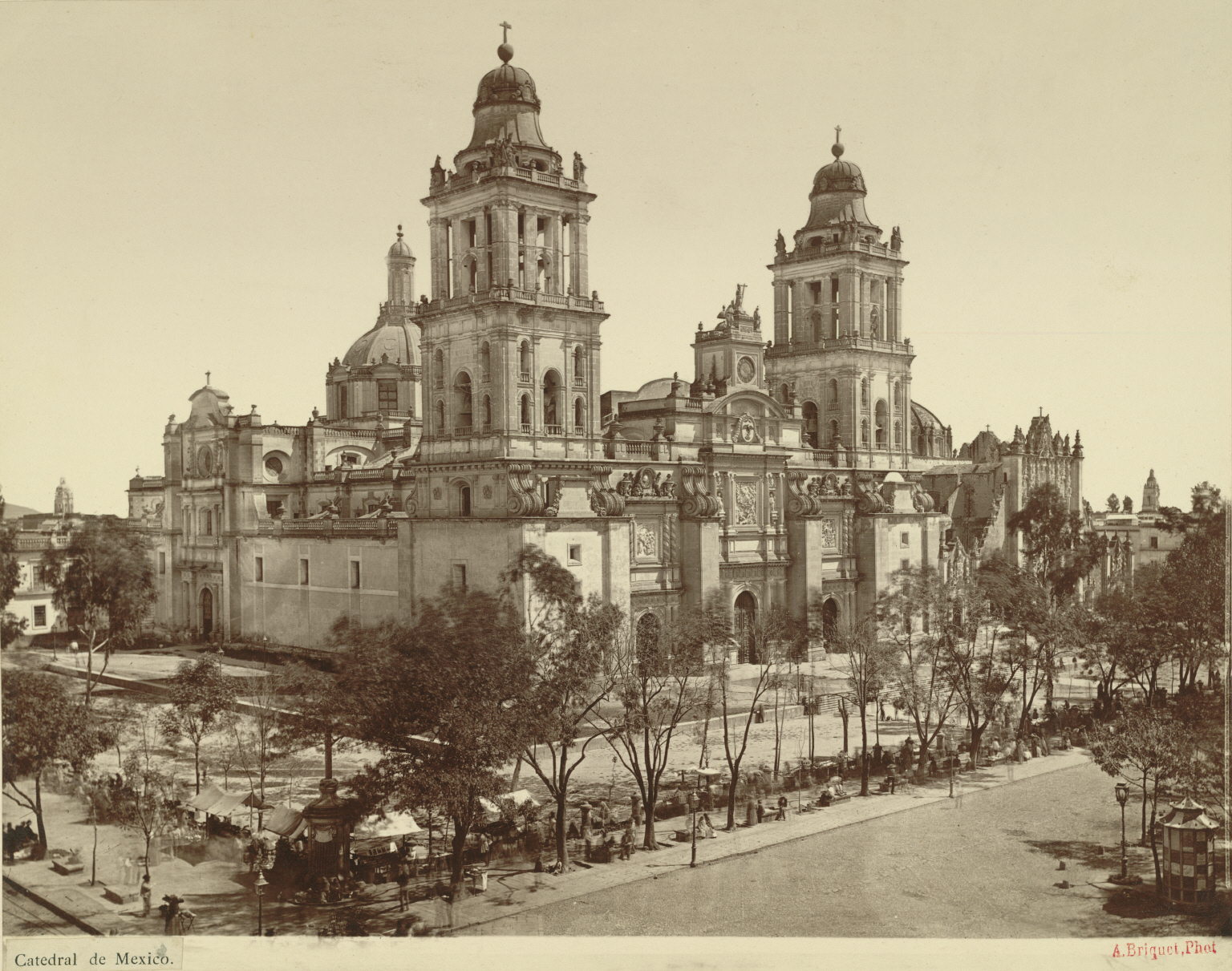
WESTERN CIVILIZATION Before undertaking a study of Europe and Western Civilization you need to change your culture consciousness first concerning how you perceive the world around you and get in the habit reading works by people that already have that consciousness. Next try reading written works by Caucasian historians and people of color who are struggling with their thoughts and see if you can translate their English writing into what would appear to most people as the twilight zone. You should be able to read between the lines and come up with a different picture that reveals flaws in a weak argument. There are debates going about where Western Civilization started and when it started. We cannot stop the debates, but we can make a stronger case for what we avocet. Some say Western Civilization started in Europe. Question: “Why does Europe need two civilizations if they already have one”? When the French revolution ended in Europe, as a result of infighting, Europeans lost two of their colonies. They probably didn’t fully understand what happened to them. When Europe lost those two colonies little did they know that they were waging a war against two settlements of single Civilization which they had helped create. The Haitians and Americans were members of one new Civilization with diplomacy, military personnel and practices similar to there adversaries. Americans used guerrilla warfare and did not always fight in uniform. Americans were sneaky. Haitians used voodoo to perform physiological warfare by gaining control of an adversary’s mind in order to defeat him. Both Haiti and America had administrative departments that had the same bureaucratic positions that their adversaries had. Mulattos representing various levels of Haitian bureaucracy were busy cutting deals with the French for Haitian liberation. The French made the mistake of thinking that their bastard offspring would side with them and both England and France thought the two different revolutions were separate incidents and made the fatal mistake of treating them as such. The most important lesson to learn from this study is that both Haiti and New England were playing out skills provided them by the colonist that would be displayed over and over again throughout the course of Western Civilization as more colonial subjects made their break for freedom. They all used skills provided them by Europe plus many surprises Europe didn’t know anything about. They took advantage of Europeans fighting each other or fighting too many adversaries all at once causing their military strength to spread too thin. Europeans were too eager to show their colonized subjects how to fight other Europeans. George Washington help the British fight French troops in gaining control of Ohio Valley and Midwestern territories. The French trained Haitian troops to help them fight campaigns in the New World and two of their officers Henri Christophe and Alexandre Sabès Pétion had fought in the American Revolution. Wow what a combination; you could not have put together a better combination for an insurrection in Haiti. It should be obvious to most historians by now that the American and Haitian revolution didn’t just happen by accident. If a Spaniard lands on New World soil and punches an indigenous person in the face starting a fight; did the fight take place in Spain or did it take place in the New World? Marco Polo brought back to Europe information about gunpowder that he learned from the Mongolians in China. Marco Polo saw rockets being launched, but neither he nor the Mongolians understood the scientific principles behind rockets. It was Chinese use of rocket warfare that drove Mongolians out of China. It would not be until 800 years later during the 20th Century that principles behind rocket fuel would be understood in Europe. During the 19th Century Europeans wanted to open trade with China and the Chinese said “Nothing doing” and began firing rockets at foreign vessels burning the sails and mast down and killing people aboard the ship. Rockets had an advantage of being able to be fired at a long distance. Europeans had a surprise return present for the Chinese, but they had to get in close to Chinese ships in order give them the present. European ships turned their bows broadside and a row of cutie little wooden like flap doors fell open exposing large menacing metal pipe like structures protruding out side the openings. Then an explosion and flash of light ignited from each pipe sending a volley of large iron balls the size of bowling balls in the direction of Chinese ships. That was the European’s way of saying thank you to the Chinese for their contribution to a new European Western invention. “Oh gees thank you very much for the present, good job, good job”. The iron balls succeeded in puncturing holes just above the ballast of the ships causing them to sink. In close fighting Europeans had smaller pipes that they placed near their shoulders and fired small lead ball from inside the pipe. On the front of the pipe was a long knife. They used that to subdue their enemy in close quarters instead of a sword. The Chinese quickly duplicate the barbaric weapon, but Chinese advanced weaponry would not have any practical use until almost 100 years later. Two brothers in the bicycle business with a burning desire to fly built the first airplane that flew. They were from the former British Colony of “New England”. By that time the former colony was bearing an impressive title of the United States of America. Moors and Ottoman Turks set up the first advance high learning centers in Europe. Arabs forced the Romans to get rid of their antiquated numbering system and adopt Western Arab numerals. India developed nine-character numeral system and the zero. In India the zero and numerals had spiritual significance and each number had a shrine. Arabs replaced the Indian characters with their own. The West Arab numerals became a European Civilization standard. India & Fertile Crescent contributed algebra, calculus and trigonometry. Geometry was developed in Egypt. They all contributed to developing European Civilization and making Western Civilization a remote possibility. Western Civilization was the first global civilization of mankind on the planet. It was the first global system created by an animal tetrapod, mammal, and primate hominid to affect an entire planet climate change; something no other species of animal on this planet has been able to accomplish. Christopher Columbus was its brainchild, founder and Godfather of Western Civilization. He never discovered American as most Western and European historians have suggested, but that is ok, no big deal. We all make mistakes. That is why it is important to have volunteers to step up to the plate and set the record straight. When you discover a place and you find humans already inhabit it, then we have to assume that the person or persons believe that the hominids living there are less than Homo sapiens; that would mean that people living there were discovered as well. If it turns out that you were discovered in the beginning of a chapter of history dealing with the European I can assure you that any dealings with them will not have a happy ending. Their thinking will never change with out a Cultural Revolution. Any crises between you and them will bring out the worst in both you. Did Europeans discover China? No. Did Europeans discover Japan? The answer is no. Did Europeans discover Thailand? Again the answer is no. In fact Thailand band the musical “The King and I” from showing in there country, because they were insulted by the content of the movie. Did Europeans discover the Moors? No. Did Europeans discover Ethiopia? Surprisingly the answer again is no. Did Europeans discover Africa below the Sahara Desert? And the answer is yes. You ask why and the answer is Europeans believed that Africans hominids below the Sahara were less than Homo sapiens and still are today. To be discovered by any other human is never a good position to be in. It is like a bad move in a game of chess. The word “discovery” tells you something about how humans think of each other; so be sure to make a note of that first move you made with your adversary. Right now we are on the bad foot with them. It will take more than “We shall over come” to get on the good foot. Oppressors have no respect for discoveries. Right now, Africans are like the spotted owl or green monkey; “a discovery” and an endangered species. Earlier civilizations like the Mayans and Angkor Wat of Khmer Civilization created small local climate changes compared to the one in progress due to greenhouse gasses being produced by Western Civilization. Western Civilization sprung its roots off the West Coast of Africa in the mid-late 1480’s and continued to develop in the New World after 1492. The two pictures of Western Architecture shown above depicted how architecture looked in the beginning of Western Civilization in Mexico City before the industrial revolution in 1750 and the second picture shows buildings in Kuala-Lumpur-Malaysia, built after the industrial revolution and at the beginning of High-Tech Information Age Revolution by year 2,000. Western Civilization is in the embryo stages of an advanced civilization. If an infrastructure of the West remains after global climate perhaps the rebuilders will have more intelligent solutions to problems they face because humans certainly didn’t learn anything from the smaller climate changes. |
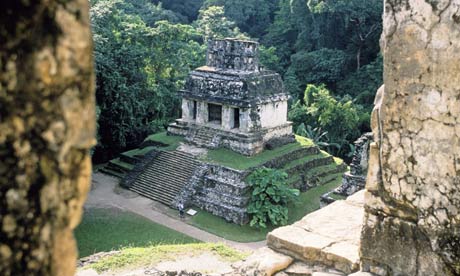 The Mayan ruins of Palenque and the Temple of the Sun in Chiapas, Mexico. Photograph: Rex features | 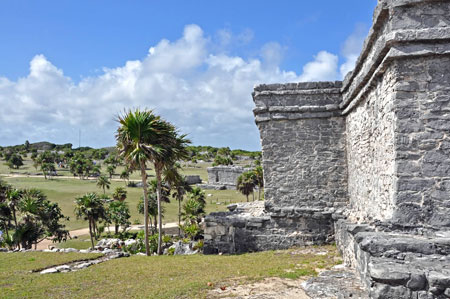 Mayan city of Tulum ruins, Yucatán Peninsula, Mexico. Credit: Michelle Werts |
|
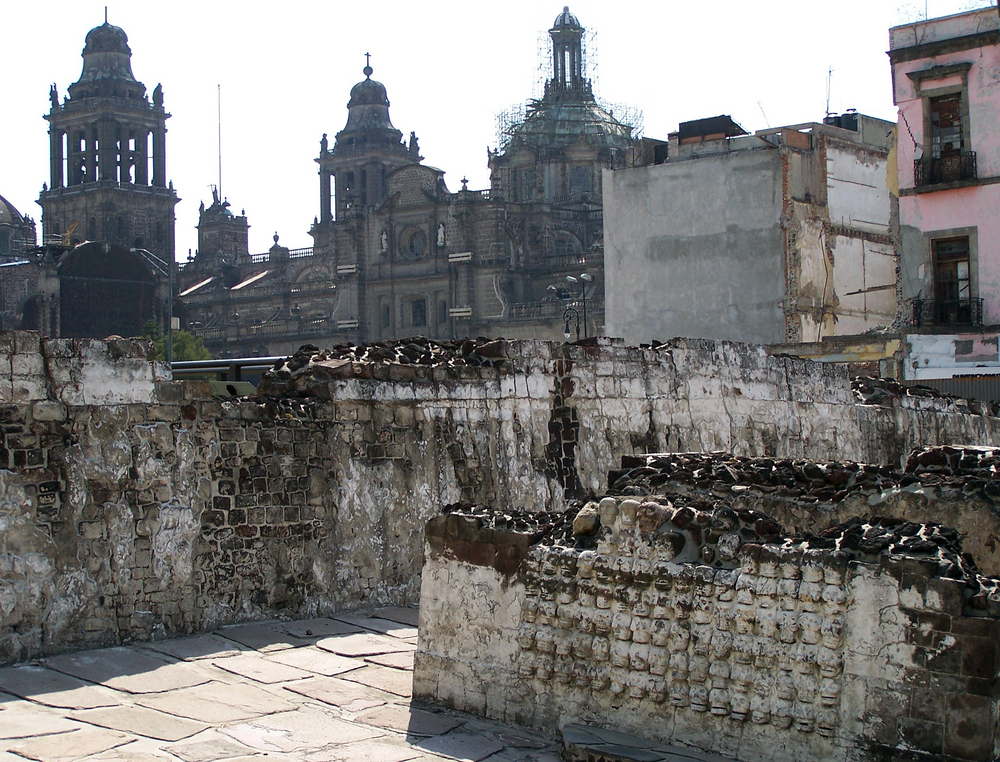
These two buildings represent a civilization that was once spread over most of Central America and Southern parts of Mexicana North America. These buildings were not a part of Western civilization. They were built long before Columbus was ever discovered or even thought of. The Mayan’s regard for nature consisted of a very strange dichotomy. On one hand Mayans had an extreme reverence for plants and animals, which was reflected in their art and on the other hand they showed disrespect for nature by cutting down all the trees around their city structures and they could not understand why the gods didn’t like them. Mother Nature purposely turned the water off causing famine and droughts. The Mayans tried to appease the gods by giving human sacrifices but the gods refused to turn the water on again. The sacrifices didn’t improve anything it only made matters worse. Now Mayans had disrespect for each other and human life. The leaves on the trees and underground streams provided water need to produce rain. During the six months of dry season the sun went to live with the Amazon and desert to the South and during the six months of rainy seasons the sun came to visit the Mayans in the North. When there were plenty of water in the land the sun was able soak up water from broad leaves of the trees and send it back to earth in the form of rain, but when the trees were cut down the sun turned itself into Hanna and scorched the earth leaving no place to generate any seeds into plants. With no food and or water to drink the Mayans no longer had to provide human sacrifices to the gods because the sun did it for them. Once the people were gone the forest reclaimed the land and Mother Nature turned the water on once again. © Claude Lockhart Clark, October 23, 2013 The West is doing exactly the same thing plus they have figured out how to turn this whole planet into a hothouse resulting from the emission of greenhouse gases into the atmosphere and they don’t care to do anything to stop or slow the process. There is a bit of irony to the Mayan story. All corn that you have seen was domesticated. It was a mutual effort between the gods and women of Mexicana that made it that way. Corn was Mesoamericans gift to humanity and the world. The indigenous peoples of North and Central America practiced some of the best farming techniques in the Western Hemisphere. Corn was bred from something that looked like a tall blade of grass with an ear the size of a human thumb. Geniuses saw something in the wild grass and made something special from the plant. Farmers bred many species of the same plants keeping the ones they didn’t use alive in case disease ruined the ones they ate. If disease plagued the farm lands the farmers could crossbreed plants that had better immune systems with the infected plants, thus saving their domesticated plants from extinction. Incas did the same thing with potatoes in the South America. Not only did Incas have many types of potatoes to breed in case of a disease epidemic, they made a food product from the potato that lasted more than six months, so that they would have enough time to correct the problem if diseases ruined their cops. But in Europe they took only the potato they wanted to eat so that when the potato crops went bad people starved to death because Europeans did not have a method for generating disease resistant potatoes. 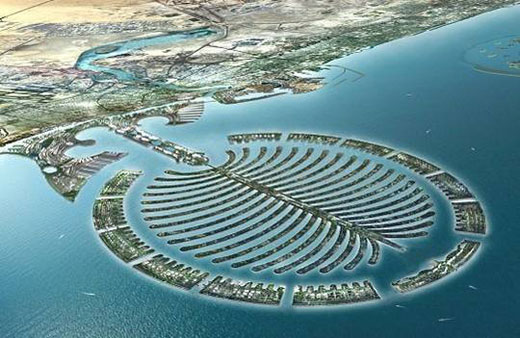 Dubai Artificial Palm Tree Island located in the Southern Persian Gulf This next example can be seen from outer space. It is an artificial island extending out into the southern end of the Persian Gulf from a country known as Dubai. It is just one of many water front developments going on in that country today. A new Dutch dredging technology is being used to create these massive man made islands. Fifteen present to 25 percent of the world building construction cranes are in use at Dubai. Many Western countries have dotted their city skylines with artificial forest skyscrapers made of concrete and glass. Dubai is in the process of extending Jacob’s later into the stratosphere. It would seem to make more since to go rocket science and build a space program. However there is one slight problem with that. The Israelis would see it as nuclear enrichment Program designed to produce nuclear weapons and use that as an excuse to turn Dubai into a parking lot. This is Dubai’s hors d'oeuvre or appetizer; the entrée is yet to be served. Dubai’s coastline has to be the most expensive art real estate project under way on planet earth ever. It gives a clear message to the universe concerning intelligent life or the lack of it here on earth. There are several more works of this type, but this art piece has the best esthetics, balance, color, elegance, composition and simplicity. It it is due to rival the Great Wall of China, Great Pyramids of Giza, Angkor Wat of Khmer, Taj Mahal of India and Mayan Lost City in Yucatan Mexico. The only problem is it may not last nearly as long as the other monuments due to rising Ocean levels which mean sea levels will eventually raise with the oceans levels. There is a strange irony or twist to the Dubai story. The Persian Gulf is owned by Europe and the United States. They alone determine what goes in the gulf and what comes out of the gulf. The Persian Gulf, a large body of water, is a colony owned by Europe and the United States. The sovereign countries bordering the Persian Gulf have no say about what goes on there. So the question is who gave Dubai permission to build those islands on someone else’s private property and who or what is Dubai? Islamic fundamentalist are bent on trying get rid of Western dominance in the Islamic world yet you have a few Arab entrepreneurs going the opposite direction. Europe sparked and administered Western civilization for less than 600 years alone until 1960. Then Europe began using one of its former colonies to help police the world. Western Civilization was not founded on cultural sharing; it was predicated in cultural dominance and cultural theft of foreign lands and resources. In 1960 Europe had to pass the lion’s share to one of Britain’s former colonies to help them police and bully the world. Europe still maintained controlled while the United States became the target of being an imperialist in the foreground and Europe found time to update its military arsenals in the background. The sun was beginning to set on the British Empire and other European countries as well, that was why the United States of America was called to help them out (as their flunky). Europeans first had prototypes of their own buildings in Europe constructed in their colonies. The Spanish ones in Mexico City had a strange irony to them. The early government buildings and churches were built from recycled stones taken from the Aztec pyramided complex in Mexico City. The Spanish humiliated the Aztecs by forcing them to work as slaves, removing one block at a time from Aztec structures and reshaping each block to fit into a Western Colonial style building. The degradation of a people did not stop there. From that point on things began to get real nasty. Next the Conquistadors (Spanish Conquerors) had men of the indigenous people bring their own daughters for Conquistadors to choose from to fill their stables. If the men of households did not comply with the Spanish wishes their families starved to death, because the Spanish made impossible to obtain food unless you had money. The men of the indigenous used their women as trade in order to obtain access to jobs in the silver mines to feed their families. The Conquistadors raped the women in their stables in order to produce a cast known Mestizos. The children resulting from the Spanish male studs and women livestock only spoke Spanish and they were taught to believe that their mother’s people were ignorant. The aftermath of colonialism produced culture were Mexican Native American and Mestizo men sought light skin women with thick eyebrows and hair on their legs as suitable material for marriage. By the year 2000 Mestizos had almost succeeded whipping out indigenous languages in Mexico. Colleges and Universities began hiring Mexican Native Americans to teach indigenous languages. They then began teaching children at grade school level to speak as well. The indigenous Mexicans manage to do all of these things mentioned on their own without further intervention from the Spanish. The indigenous population developed confused schizoid minds capable of being Spanish one moment and Native American the next. Greece and Rome have been credited with starting “Western Civilization”; that is false. The Greeks and Romans never used that term “Western Civilization”. They never knew anything about Western Civilization, because it simply didn’t exist. Rome concurred much of Europe, which was cultural dominance within the “same cultural complex”. European Civilization grew out of Roman Civilization the same as Roman Civilization grew out of Greek Civilization. Greece and Rome concurred Egypt, Kush and parts of North Africa, but so did Persia, Syria and finally the Arabs, so there was no Western Civilization until after European dominance. In fact Arabs have made a more lasting impression on that part of Africa than either Greece or Rome. The Moors stayed in Europe for 400 years. There was noticeable change in the culture after they the Moors left, but no one has suggested that the Spanish and Portuguese are Moorish instead of European. People from a place, today known as Turkey invaded the Eastern part of Europe and stayed until they were pushed out of Europe in the 15th Century. Those countries maintained their culture. The industrial revolution was the first large scale contribution to Western Civilization. The industrial revolution started in England 1750. England had to rely on its colonies to make industrialization affordable and practical. I haven’t found a suitable definition for Western Civilization provided by Europe or the West and I don’t expect to find one anytime soon. European Civilization is somewhat easier to date. We will use the Gregorian calendar for Europe. Europeans are in a habit of using the terms Western and Europe loosely, as though they are one in the same terms. As far as we are concerned “European Civilization” and “Western Civilization” are separate terms. As they would have it Europe and the West are like the chicken and the egg. We don’t know which one came first? I don’t think so. Europe would say that Western Civilization started in the “West”, so Africa is South West and that makes Europe “North West”. Yes Western Civilization started in the West. Name me one civilization in history that started and managed two civilizations by themselves at one time strictly for their private use and I will show you a civilization that failed - NUBIAN. Come on let’s get real Civilization is not something you wake up to the next morning and say “I think we need another civilization; let’s go out and start building another civilization.” Europe had a French revolution plus two world wars because they did not know how to manage two civilizations. Like one would be enough; so what they need a second one for? They must have had a reason. Europe needed to share the responsibilities of a second civilization with someone else, which they were finally forced to do. Even the Nubians realized they could not manage more than one civilization by themselves. When one died out they started another Civilization. Egypt told them to get away from them and take their hands off, because they could run their own civilization. Then centuries later here comes Nubian again with Kush and after that they built Meroe. On top of that Nubian went back to take Egypt away from Rome and spent 200 years trying to save Egypt. “Nubians, they be doing too much and finally ended up losing it all.” Europe started Western Civilization somewhere somehow, but they only need one civilization for themselves. They didn’t need two. One is hard to manage. What would they need a second one for? Another strategy Europe uses is to say that Western Civilization and European Civilization are one in the same. You don’t need two names for the same term. Western Civilization is less than six hundred years old (600 yrs.) and it is the first global civilization that includes all mankind. The civilization responsible for creating Western Civilization is European Civilization. European Civilization is over 2,000 yrs. old. Europe used its colonies to create Western Civilization and in doing so Europe became apart of Western Civilization as well. Europe and Western Civilizations are the first two civilizations with different languages and cultures that use the same system of measurement, numbering and writing systems; same calendars and adopted same international law. Western Civilization is Global and European Civilization is continental. European Civilization encompasses all of the European continent and parts of northern Asia which includes Russia. By contrast Chinese Civilization is over 6,000 yrs. old and is located in one country and has one language, one political system, one economic system, education system and many cultures. China is last of an old school civilization. It tried to organize a South and Far Eastern Civilization as one unite, one umbrella, but there wer no set of demographics or guide lines which they all adhered to. All the people in the Far East had similar cultures, but there was not enough cohesiveness to bring all the countries together. Far Easter Civilization has been subdued because it was overshadowed, dominated and infiltrated by Western Civilization. There is a third civilization on the rise which is spearheaded by Islamic fundamentalism started not by Arabs but by a Persian Islamic Scholar and cleric Imam Khomeini. He distributed pamphlets far and wide from his refuge in Paris from 1953 until the revolution started November 4, 1979. Iran became the first successful fundamentalist government in the Near East. Islamic Fundamentalist occupies regions as far away as West and East Africa to Indonesia and Philippians in the Far East. One of their goals has been to remove Western Civilization influence from the Islamic world. Why is Africa so important when studying Western Art? Western Civilization and Western Art began in Africa. Art began in Africa. As you have probably already noticed Africa was first in many things. The first and only Hominids were African. Homo sapiens are Africans, agriculture, iron smelting and civilization began in Africa. All of these developments helped in some way to shape the paths human cultural development would take elsewhere. We will also need to know the difference between the sharing and appreciation of culture, rape culture or culture castration and Western Art. We will cover each of these areas in this topic.
If Western Art had first taken root someplace else we could probably show a few African Western Art pieces and dismiss the subject concerning "Roots of Western Civilization in Africa", but we could not do that since both Western Art and Western Civilization began in Africa. Another reason why we could not dismiss the beginnings of Western Art in Africa was because the first examples of Western Art were some of the finest early examples of Western Art anywhere. Since Western Art produced in African and Europe were some of worlds best artworks this makes it imperative that we begin the history of Western Art by starting with Western Art produced in Africa and Europe. Western Civilization is hybrid, but European Civilization is hybrid as well. There is no French Civilization, no English Civilization, no German Civilization, no Russian Civilization, no Spanish or Portuguese Civilization only European Civilization. None of these people have an alphabet or numbering system of their own that serve any function. The alphabet Europeans uses is Roman and the numbering characters used are Western Arabic. It consists of nine characters and the zero which were invented in India. Babylonians and Mayans also invented the zero, but the numbering system Europeans use is Indian. Europeans use Pope Gregory’s (XIII) calendar and the French invented the metric system of measurement (now called the International System of Units). Around 127 AD Hipparchus of Niceae working in Alexander Egypt proposed the 24 hour system. Christianity and the New Testament came from Egypt and the Near East and a seven day week is in the Book of Genesis. Each country in Europe has its own philosophy, but all countries in Europe embrace Greek Philosophy. The same principles used in uniting Europe are also the same principles used in the process of creating Western Civilization. Each country in Europe has its own culture separate from European Civilization. Some ethnic groups created their own writing systems, but when Roman characters became a standard; most writing systems in Europe became “ritual relics”. The same process has been at stake in the Western World. In some places whole cultures became “ritual relics”. Ritual relics suffer from rigor mortis; because they do not serve a living function anymore and museums help prevent the relics from returning to dust. © Claude Lockhart Clark August 27, 2012 |
|||||||||||||||||||||
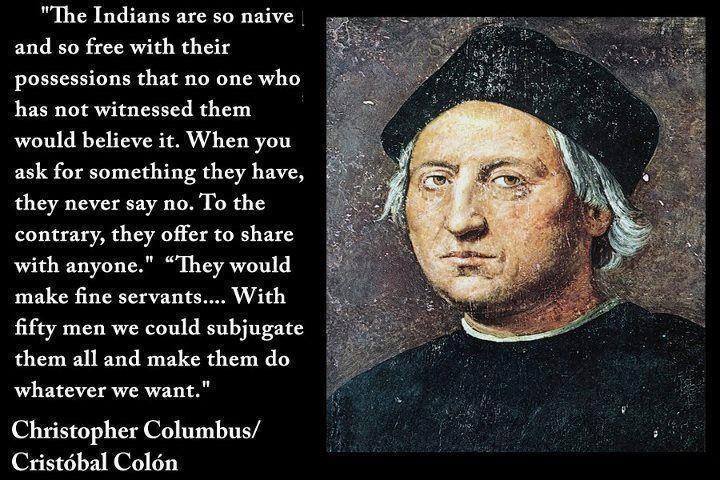 CHRISTOPHER COLUMBUS & WESTERN CIVILIZATION | |||||||||||||||||||||
|---|---|---|---|---|---|---|---|---|---|---|---|---|---|---|---|---|---|---|---|---|---|
|
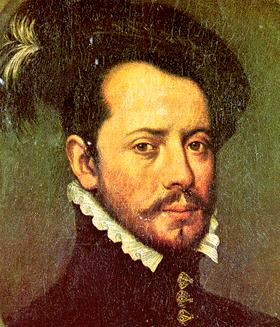
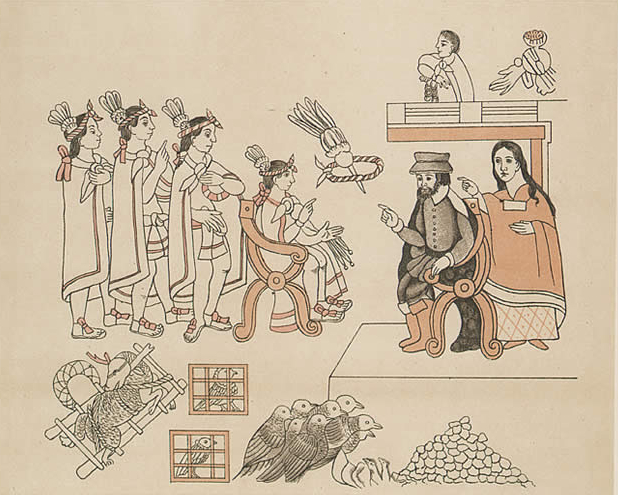
That way of thinking in 1492 is exactly the same thinking many Europeans have today in the 21st century. It is rather unfortunately their philosophy teaches them to think in a redundant manner. They are quick to classify many people of color as “child like sapiens”. In their way of thinking, the “child like hominid” never matures beyond a sub sapiens” level of thinking after reaching adulthood and therefore must always remain a child. Many Europeans feel ill at ease around people of non European origin and try to get center of attention. They are often not reciprocal and act as though the world does or should revolve around their interest. © Claude Lockhart Clark October 17, 2013 Christopher Columbus was the second European to visitor visit the Western Continent. The first European visitors to the Western Continent were Leif Erikson and his father Eric the Red. Marco Polo was the first European to visit China. Notice how friendly that sounds. You never know that some one was plotting to mistreated or molest you. Both sentences catch you off guard. You don’t expect any harm to come to anyone. Find out what happened to China. Notice the difference in this next description. In 1492 Christopher Columbus discovered America and named the Island where he landed San Salvador and planted the Spanish flag. He found the native inhabitants uncivilized but very friendly. This second description shows a total disrespect for non-Caucasian Homo Sapiens. The inhabitants are treated as lower Hominids. There land is has been assigned to some foreign country. Their island has been given a foreign name with out consulting the inhabitants. When they learn a little Spanish. Someone informs them that there will be thousands more Caucasians coming without asking if they can invite themselves into your home. If you don’t suspect anything is wrong then the job of destruction and transforming to your conscious mind is complete. The person writing the two above paragraphs should be treated with extreme caution as though one is dealing with schizophrenic psychopath. They should not know what you think about them and they should always be treated with great respect until you figure out how to remove them from your presence’s. Western Civilization was the first global civilization of mankind on the planet. Christopher Columbus was the founder of Western Civilization. He never discovered American as most Western and European historians have suggested. When you discover a place and you find humans already inhabit it, then we have to assume that the “explorer” or persons believe that the hominids living there are less than Homo sapiens; that would mean that people living there were discovered as well. If it turns out that you were discovered in the beginning of a chapter of history by someone else I can assure you that any dealings between you and them will not have a happy ending. Their thinking along with your thinking will never change with out a Cultural Revolution. Any crises between you and them will bring out the worst in both of you. While we are on the subject of some of the bad things that can happen, I want to make something very clear. Once a people have been relegated to bowel movements and skin grafts of society an oppressor will not tolerate any resistance from people not willing serve in that capacity. Bowels are waste products that come from inside the earth such as diamonds and coal, which are, produced from carbine found in decade plants. Petrol and oil come from the greasy carcasses of dead animals. Your skin grafts are like cash crops, wild herbs and trees that need to be cut. Your bowel and skin products are what keep Europe alive and they are determined to have free access to every bowel and skin product that they claim is theirs. They don’t even want you producing lumber from timber, steel from iron, compounds from herbs, refinement of oil and cutting diamonds for whole sellers. Are you serious? That last one will get you killed. Only second world; second class citizens are allowed to cut diamonds and the larger stones are reserved for Caucasian stone cutters. All you are supposed to do is lie on your back, gap and squeeze. And when you can‘t give it up no more they will get rid of you. There has never been any products produced by Africans that have made it to the supermarket shelves, or department stores and stayed any length of time. Only Morocco did it and she had sit on European heads for 400 years to get it done. Christopher Columbus was the founder Western Civilization and the conqueror Hernán Cortés de Monroy y Pizarro “Cortez the Killer” (or was he the humanitarian as one French writer suggest?) was its first architect of Western Civilization. An important point needs to be made here neither Columbus or Cortes knew anything about this Western Civilization stuff. They told people that they were making discoveries. Columbus, poor soul, said he had found a western route to India and China. He said tbat his ships landed in the East Indies on an Island (in the Bahamas) that he named San Salvadoor. Columbus didn’t even know where he was so how could he be credited with discovering anything. He was lost himself and needed someone to discover him. Columbus died thinking he was somewhere off the coast of India. Columbus proved to be such an embossment Spain that the Queen Isabelle finally would not grant him any money for more exhibitions. Columbus was out of touch with reality. He could not even control conflicts in San Salvadoor. The native population were fed up with the new comers and wanted them out of there. Columbus went to battle with Spanish troops who were sent to relieve him of his post and send him home. The Spanish Catholic Priest told Columbus that his service was of no use any more since the situation had deteriorated so badly. The priest got on his hands knees and begged Columbus to send him home. It was Amerigo Vespucci that later found that the Body of land had no connection with the Eastern Hemisphere so they named the new landmass after Vespucci with out first consulting the original inhabitance. Cortes with the help of his concubine La Malinche succeeded recruiting several thousand Native American mercenaries to add to Cortes military force of two hundred solders. Malinalli or Doña Marina as she was also known was an interpreter, advisor, lover, and intermediary for Hernán Cortés. She was one of Cortes’ most important assets concerning Native American conquest. One important note needs to be mentioned. Cortes disabled the ships so that his solders could not leave the Americas without his permission. If the Spanish solders ran from any conflict they would be shot in the back. |
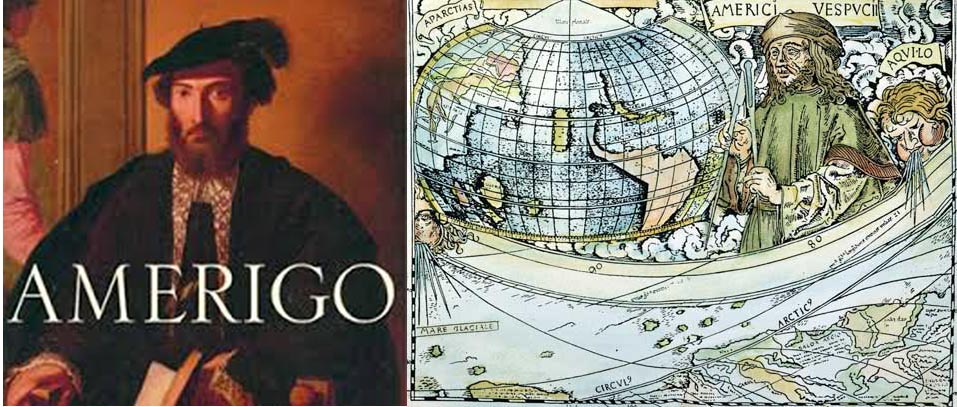 This map by Amerigo Vespucci is probably much later than the map drawn by German Mapmaker Martin Waldseemüller shown below Before we bring in Cortes a map maker and another navigator must be brought forward. Hernán Cortés did not set foot in the Western Islands until 1504, to a place now named Cuba and he did not go to the Western Continent until 1501. Cortes stayed there until 1502, just long enough to do all of the things that we will attribute to him later in this chapter. |
 This map was the earlies map drawn of the Western World drawn by German Mapmaker Martin Waldseemüller Mapmakers were probably one of the most important contributors to the success in producing foreign settlements in the Western World. Amerigo Vespucci gave a written report of his find during his voyage along the Western land obstruction. |
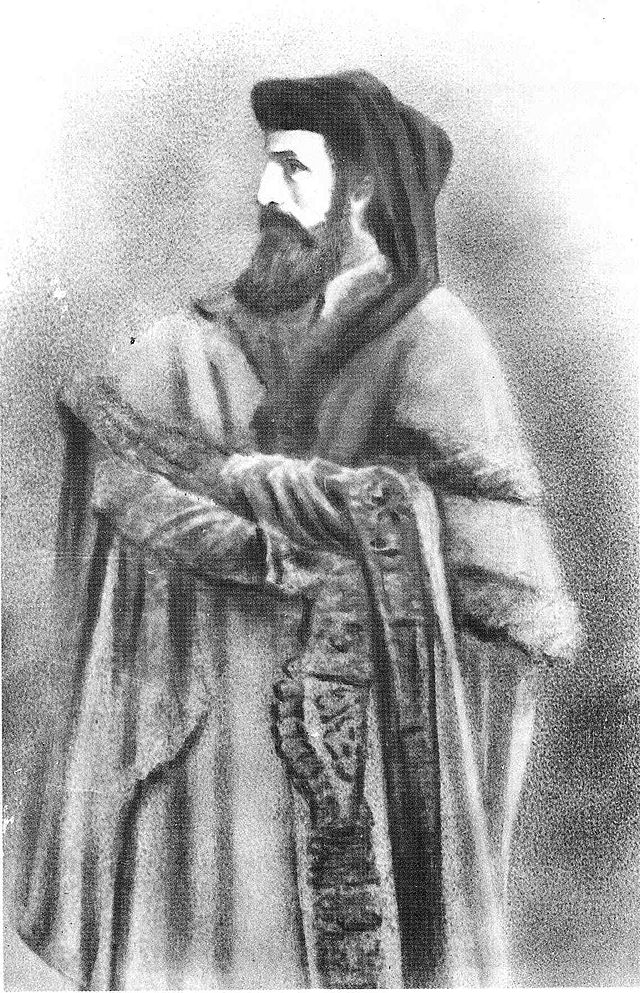 Matthias Ringmann - the man in Charge of Map making. Matthias Ringmann a geographer and a German mapmaker named Martin Waldseemüller would be needed to provide the public relation Image and book for this obstacle that the Amerigo Vespucci had recorded was blocking their path to the orient. They would also need artists recording the indigenous people and writers to publicize information in order to encourage investors to gamble their wealth and governments to subsidize in the risk to be taken concerning land in the West, which promised non-measurable wealth. |
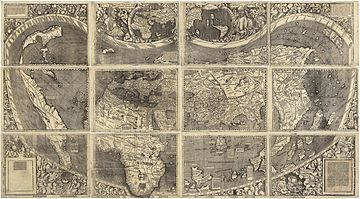 Matthias Ringmann - the man in Charge of Map making. The Western land was given a name, America, by Matthias Ringmann. Matthias feminized Amerigo’s first name. He noticed that Two other continents had feminine Identities, Asia and Africa, he took a gamble and named the obstacle America. The obstacle was land blocking Europe’s access to the Far East. The next thing Matthias Ringmann assumed was that the obstacle was a fourth continent. The third and last thing Ringmann gamble with was the expanse of Ocean on the side of the Western continent. He believed it to be immense and he was right. Ringmann was taking a gamble with little certainty that both the name and geological claim he has making would pan out. All three of his claims proved successful. The Western land was given a name, America, by Martin Waldseemüller. Martin feminized Amerigo’s first name. The reason for the change has never been clear, but one thing for the land that that Columbus bumped in to was not the East Indies at all. The obstacle was land blocking Europe’s access to the Far East. |
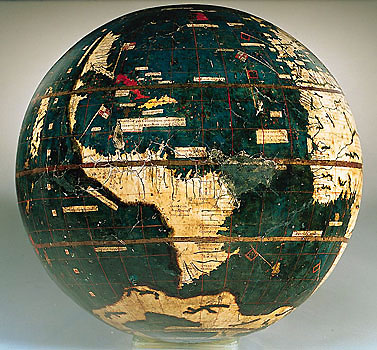 The Green Gobe based on Waldseemüller's map A green globe was produced shortly after the maps were drawn. The green globe convinced governments and investors alike that it was worth investing their money in the new find. It also convinced investors that ships and crew would not fall of the edge of the world because the earth was round and not flat. Egyptians and other Africans said the world was round, but now you had visual proof of it. This kind of visual evidence had not been produced by anyone before this time, in human history. Amerigo Vespucci set sail for the Western Continents in 1499. He along with a German Mapmaker named Martin Waldseemüller drew maps between the 1499-1500 and 1501 to 1502. They both proved that there was a huge land obstacle in the way of China. They would needed to find a way around the obstacle first before going anywhere East. It was these maps along with others that sparked the plunder of Europeans that followed. These maps were not the first one however. A son of a Norseman navigator from Iceland produced the first map of islands in Canada. His name was Leif Erikson and his father who settled in Green, name was Erik Thorvaldsson. Erik was known in the history books as Erik the Red because of his red hair. |
This description looks into the origins of the Aztec and their capitol city Tenochtitlán taken from the (University of Florida Press, 2012). ORIGINS of TENOCHTITLAN According to legend, the Aztec people left their home city of Aztlan nearly 1,000 years ago. Scholars do not know where Aztlan was, but according to ancient accounts one of these Aztec groups, known as the Mexica, founded Tenochtitlán in 1325. The legend continues that Huitzilopochtli, the god of war, the sun and human sacrifice, is said to have directed the Mexica to settle on the island. He “ordered his priests to look for the prickly pear cactus and build a temple in his honor. They followed the order and found the place on an island in the middle of the lake ...” writes University of Madrid anthropologist Jose Luis de Rojas in his book "Tenochtitlán: Capital of the Aztec Empire" (University of Florida Press, 2012). Here are several quotes from brainyquote.com made by Cortes, which reveal something else, that Western and European historians failed to notice: "Among these temples there is one which far surpasses all the rest, whose grandeur of architectural details no human tongue is able to describe; for within its precincts, surrounded by a lofty wall, there is room enough for a town of five hundred families". Hernan Cortes "An abundant supply of excellent water, forming a volume equal in bulk to the human body, is conveyed by one of these pipes, and distributed about the city, where it is used by the inhabitants for drink and other purposes". Hernan Cortes "There are apothecaries' shops, where prepared medicines, liquids, ointments, and plasters are sold; barbers' shops, where they wash and shave the head; and restaurateurs, that furnish food and drink at a certain price". Hernan Cortes Cortes never once mentions any human made product that he or the Spanish wished to purchase or trade from the Americas. The Europeans and Arabs did the same in Africa. They bought absolutely no human made products from Sub-Sahara Africa. Note - read “Coin Conspiracy” on this same page. Europeans wanted silk, paper, porcelain, tea and explosives from China. And spices from South East Asia and India. The outpost that developed into Western Civilization was never supposed to happen. Furthermore the colonized were not supposed to become independent countries, or a global civilization. It just happened that way. The same as Columbus never discovered America; some European historians and their miss-educated flunkies don’t understand yet. The economies in Africa and the America were suppose to be bowel, flesh and skin economies. Minerals were taken from the bowel movements inside the earth's crust. The flesh was animal life native to that location and people for cheep labor and cast reproduction. Skin contained cash crops and timber. There were to be no products made or manufactured from any of the resources taken from these posts. Europe was supposed to manufacture everything and sell the finished product to people living the colonies. Other existing civilizations such as Islamic, Far East, South East Asian and Chinese Civilization were not supposed to flourish. Those Civilizations were supposed to disappear from the face of the earth, but that didn’t happen; instead Europeans spent time trying to reestablish their own identity so that the monster they created “Western Civilization” would not consume them. © Claude Lockhart Clark December 17, 2014 |
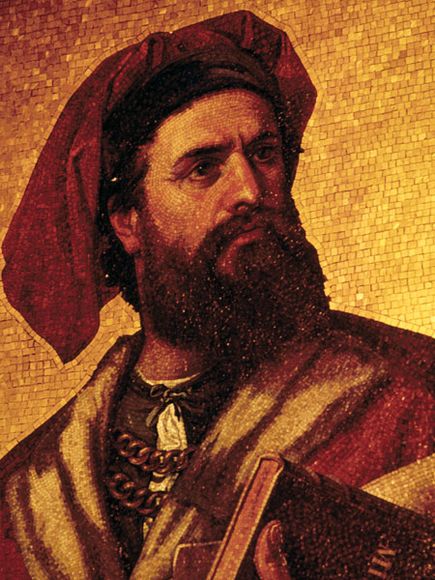 Marco Polo Made two trip to China; the first one was in 1271 and the second trip was in 1295. | 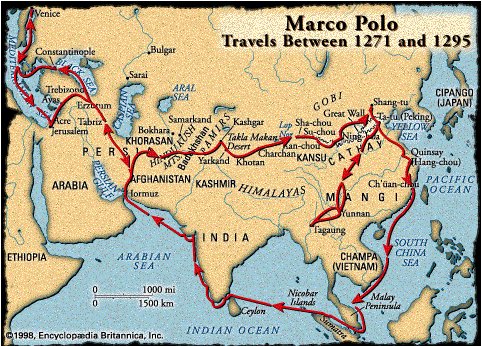 This is a map showing Marco Polo's two trips to China; once in 1271 and a second trip in 1295. |
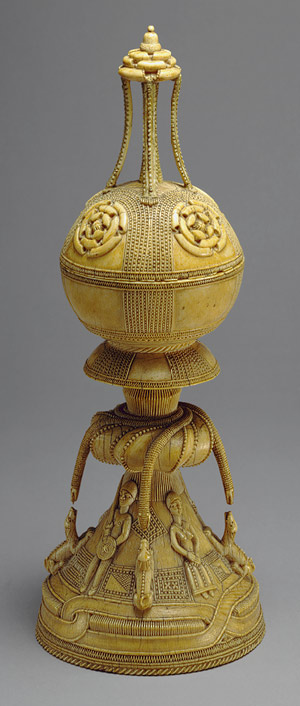 SHERBRO LIDDED IVORY SALTCELLAR
This ivory saltcellar was produced for Portuguese clientele in 15th Century AD on Sherbro Island, off the Coast of Sierra Leon. Ivory artwork produced on this island mark the “Beginnings of Western Art”. This was during the height of the Italian Renaissance in Europe. Western Civilization was just getting started in European colonies. This is one of the finest examples of Western art works produced during that period of time. Ivory carvings produced by Sherbro and Edo craftsmen rival any ivory carvings produce in Europe and Asia during that time or hence. Africans produced some of the best. This Sherbro Island Lidded Saltcellar was donated as a gift to the Metropolitan Museum in New York City, New York in 1991, by Paul and Ruth W. Tishman. The sculpture was carved between the 15th and 16th Century. It measures 11 3/4 in. (29.8 cm) in height. Wild elephants still lived on Sherbro Island the time this sculpture was carved. The quote listed below was taken from a blog and may not be an original statement of its author. The quote may be that of an art curator or art historian. I have attributed it to the author of the blog since that is where I obtained the quote. Afro-Portuguese Ivories, by Latrice logika Gedink Posted August 14, 2012 in Hot Topics. ON VIEW: GALLERY 352 Last Updated July 27, 2012 “This saltcellar is both an extraordinary example of skilled workmanship and an artifact that epitomizes a singularly important convergence of cultures. In the second half of the fifteenth century, Portuguese explorers and traders were impressed by the considerable talent of ivory carvers they encountered along the coast of West Africa. As a result, they were inspired to commission works of this kind for their patrons, which ingeniously combine both European aesthetics and forms with those of Africa. During this period, salt and pepper were costly commodities and elaborate receptacles were appropriate for their storage in princely homes. The top half of the piece includes four delicate rosettes and is crowned by what appears to be a distinctly European-looking rose. The spiraling interlocking forms may relate to a similarly entwined beaded style called gadrooning in early sixteenth-century Portuguese decorative arts. The lower half includes imagery relating to indigenous African belief systems. The snakes may refer to spirits who are believed to bring immense riches to those who control them. It is possible that this is a reference to wealth gained through trade with the Portuguese. The four snakes appear to approach and almost touch noses with four growling dogs. According to regional traditions, dogs are considered spiritually astute animals able to see spirits and ghosts that are invisible to humans. This depiction of the dogs, with teeth bared, hair bristling, and ears laid back, may relate to that supernatural ability. However, the level of animation in this scene could also derive from chivalric hunting scenes in European woodcuts, which were furnished to local African artists by their European patrons. The delicate gap between the descending snakes and the snarling dogs creates a dynamic of dramatic tension that dominates the work. The four African figures along the base appear to be a series of attendants, individuals of no particular rank. The women rest their hands on their genitalia, emphasizing their fertility, while the men hold swords and shields.” © Latrice logika Gedink Posted August 14, 2012 | ||
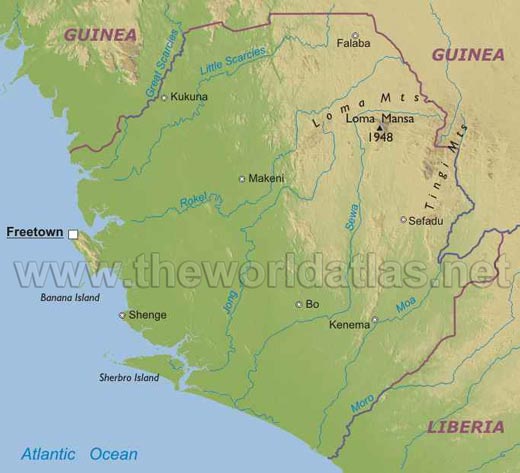 SHERBRO ISLAND OFF THE COAST OF SIERRA LEONFrom these photographs we are able to notice two important contributions that Portuguese made concerning European Imperialism. First they began establishing Western Civilization through art and they made it possible to do this by demonstrating how to gain control of foreign lands. The Portuguese establish island post first and other European colonist that followed used exactly the same procedure. The islands served as fortress against European adversaries. Here are some of the names of island posts established in the Old and New World Macau-Taipa, Hong Kong, Jamestown Virginia, Manhattan, Loango Democratic Republic of the Congo, Lagos Nigeria, Santo Domingo and countless others. Another interesting factor the Portuguese established was that the artisans and skilled craftsmen could be made to produce items for European taste and consumption that had never been seen before. The artifacts produce were more than adequate and suitable for European needs, but the designs reflected cultures that they were not familiar with, providing Europe with a fresh new look for change. European artisans began to implement designs and patterns of other cultures into their own lifestyles. We will begin to see how Western Civilization takes root in Africa and the problems it presents for Africa people before it takes root anywhere else in the world. Sapi, Edo and Kongo are the earliest examples of people sharing in this process. marchBARTOLOMEO MARCHIONNI "...What was there about Sierra Leone and Benin during the early days of Portuguese trading that differed from the rest of West Africa? In 1480, the Portuguese King, John II, sold the right to trade slaves, spices, and elephant tusks from Guinea to Bartolomeo Marchionni, a wealthy Florentine banker and merchant in Lisbon, for forty thousand crusados.(4) Sierra Leone, situated on the Atlantic coast of Africa, was at that time included as part of Guinea. This license was extended in 1486 to include the Slave River in the Gulf of Benin and was further extended to 1495 in return for 6.3 million reis(5) for each year that Marchionni held the contract.(ii) King John II followed by his nephew Manuel, maintained control of the trade between Guinea and the Gulf of Benin, where they had located a steady supply of gold at Elmina. The Portuguese were mainly interested in gold, slave trading and in finding a sea route to India. Marchionni had established an extensive network of agents and clients that extended from Portugal to Spain to England, Flanders and Italy. His influential patrons included the Kings of Portugal and Spain and associates from Florence, like Lorenzo de Medici.(iii) He was the dominant trader in slaves from West Africa. Slaves he obtained from Benin were traded with the African gold merchants at Elmina for gold. Those he could not sell were taken to Madeira to work on the sugar plantations or to the slave house in Lisbon for sale in Europe". The following is only my option, however I am convinced that it is a fact. I have dealt with it ever since I was a young boy from age 10. I began hanging out with Japanese children in school. At the time I lived in Sacramento California. The Japanese community had been out of prison for only 10 yrs. I know what I said; I said that they were in “prison”, because that is exactly where they were. Their property and personal possessions were taken away from them in 1942 and never returned. They were allowed to take only things that would fit in a suitcase. Many were American citizens and all Japanese living in the states of Washington, Oregon and California were denied due process of the law and transported to prison camps. Before incarceration Japanese parents were teaching their children to become American. They were not teaching their children the old ways of Japan, so prison for them served as a wakeup call. We lived in Sacramento for three years and I went to Cherry Blossom Festival every single year and stayed all day. Cherry blossom time and the death of Emmett Louis Till were enough of a wakeup call for me. I knew that my time had come and I had better do something fast. Western Civilization was created for one purpose only; to serve and protect the interest of European Civilization. Some former European colonies became international bullies to protect European interest, others became avid consumers and then there were street hookers and prostitutes proving their pimp masters with cheep labor, cash crops, minerals and natural resources. kongo
KONGO BRASS CAST CRUCIFIX AND PORTUGUESE CITY COLONY OF LOANGO |
This little brass fetish is an example of Western art produced for African use by the Kongo people after Portuguese tried unsuccessfully to make Christians out of them. The images the Portuguese brought with them did not look like this one. The image the Portuguese brought with them suffered from albinism and stringy hair. The Kongo people did not like that one, because they had their own concept of spirituality and what the image on the cross should looked like.
MAP OF LOANGO COAST AND KONGO PORTUGUESE IVORY |
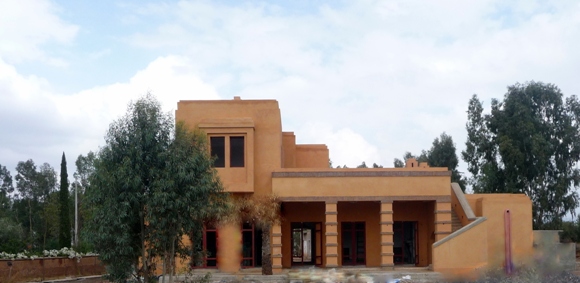 Moorish Home Exterior | 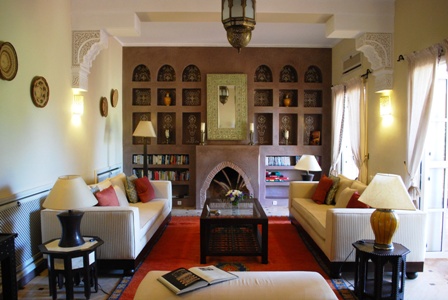 Moorish Home Interior | 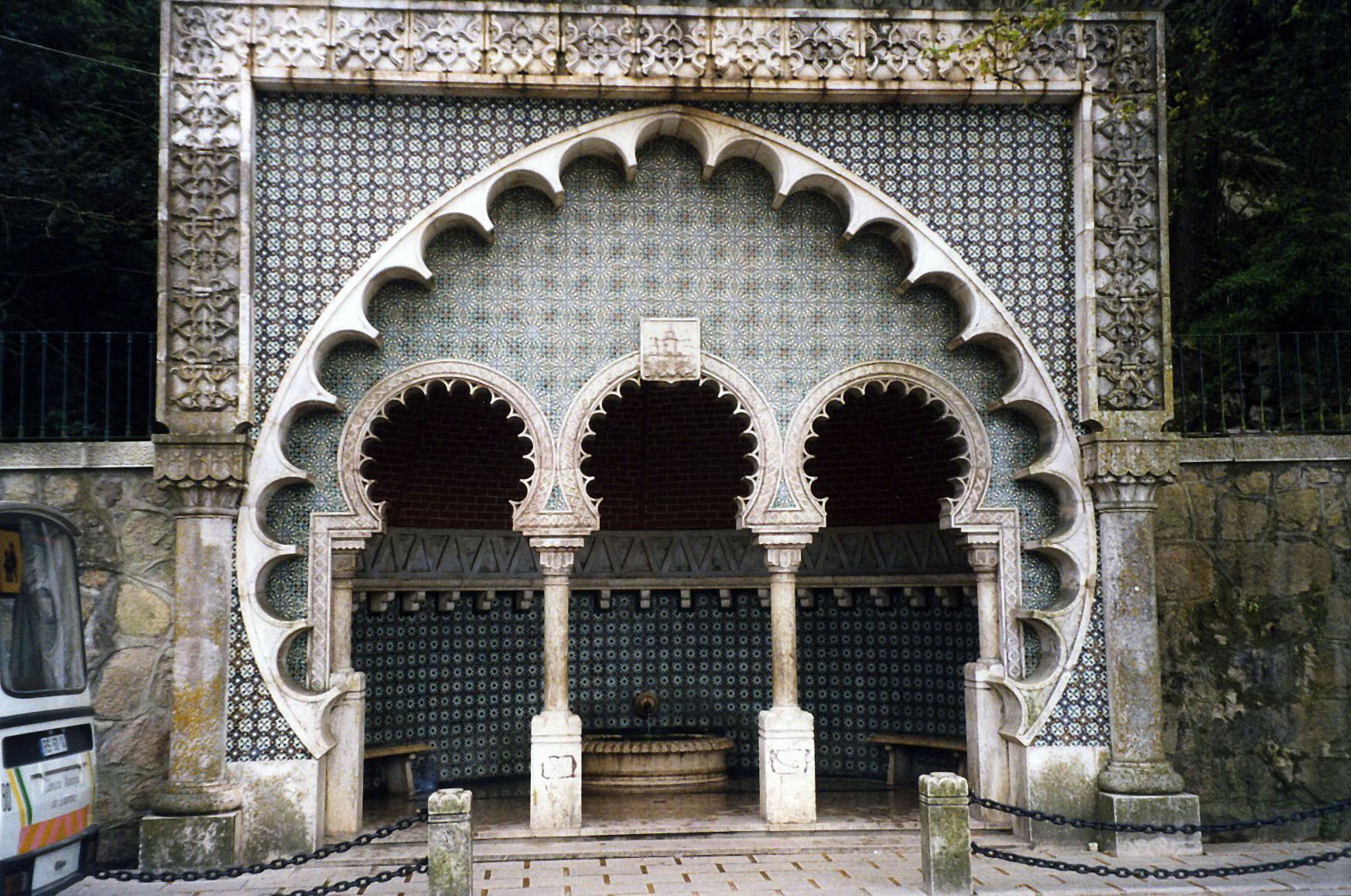 Moorish Architecture | 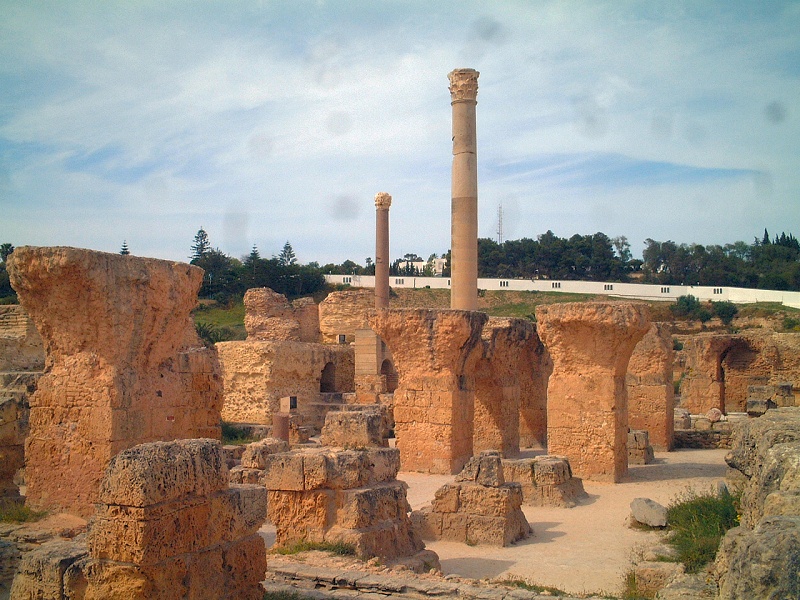 Ancient Carthage | 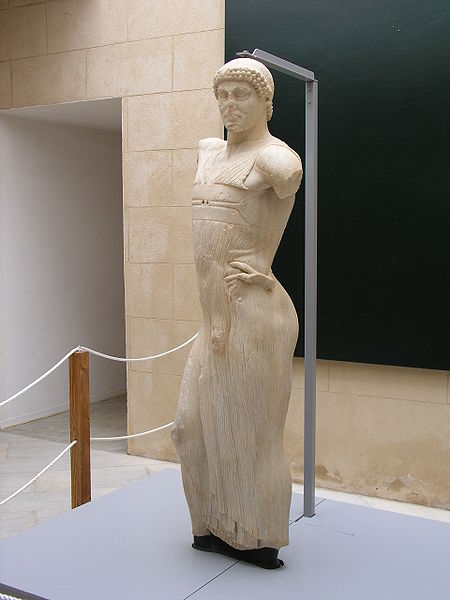 Mozia |
|---|
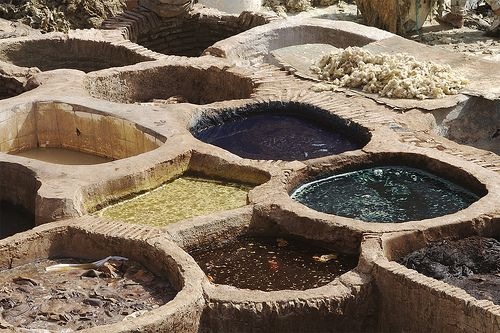 Moroccan Tannery Dye Vats |  Moroccan Leather Goods | 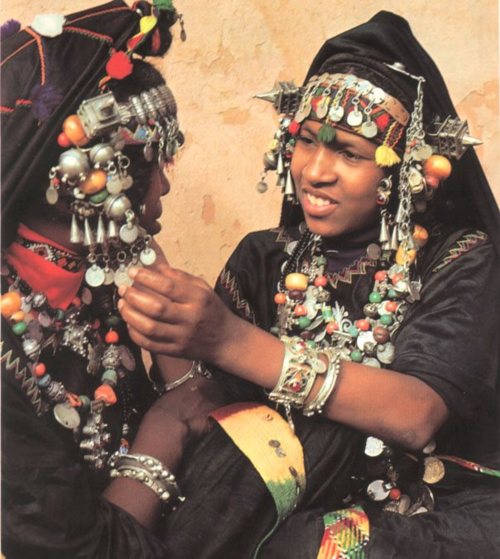 Moorish Jewelery | 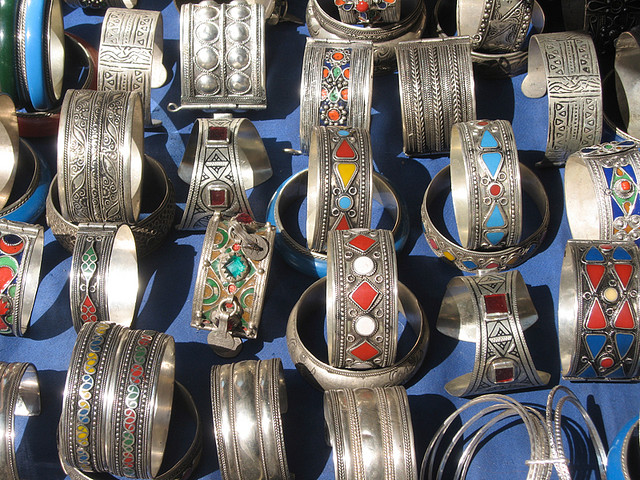 Berber Jewelery |
|---|
 Moroccan Textile Industry | 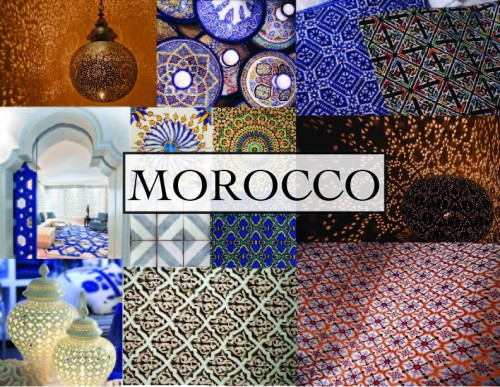 Moroccan Textile | 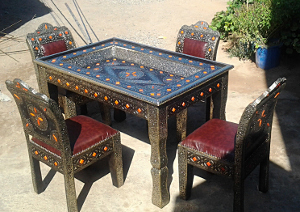 Moroccan Furniture |  Moroccan Ironwork & Bedding |
|---|
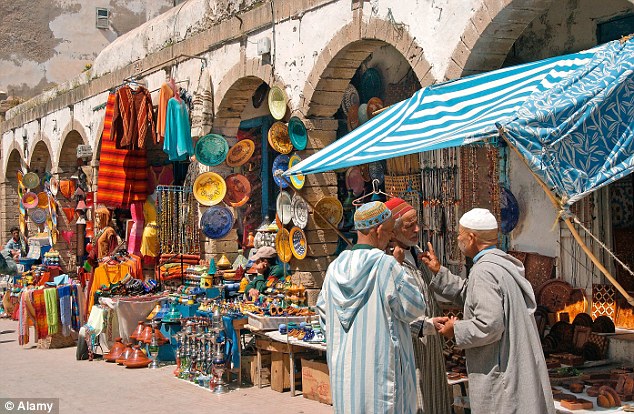 Moroccan Market | 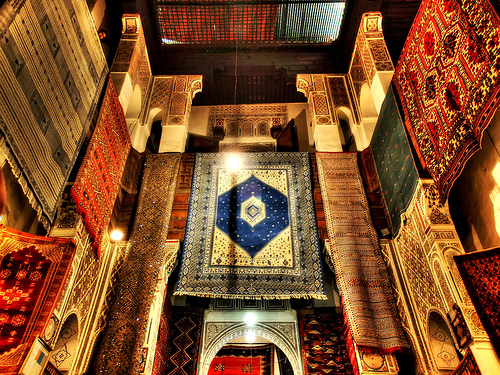 Moroccan Carpets | 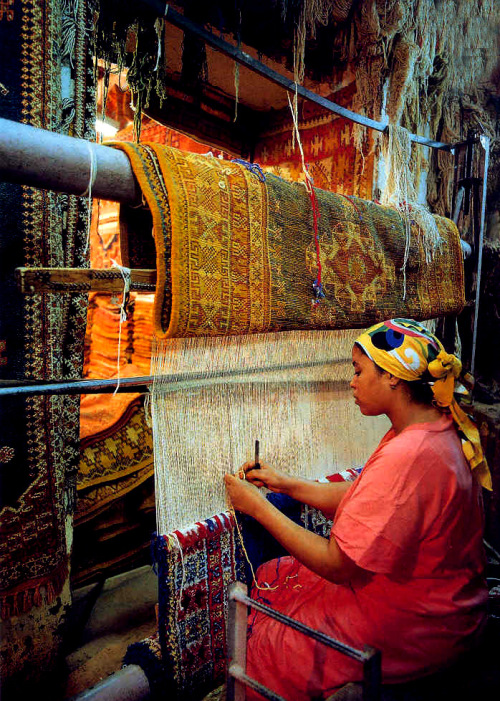 Berber Rug Weaver | Moroccan Woodcarving in Real Time |
|---|
|
When we think of North Africa the first thing comes to mind are the Phoenician ships that sailed across the Atlantic to the New World (Americas). We are also reminded of Moorish architecture that left its mark on Southern Europe and continues to influence Western Civilization home interior and exterior architecture to this day. The Moors produced many of the furnishings used by interior designers and decorators. Don’t get Southern Mediterranean Civilizations and Nile Valley Civilizations confused. The two civilizations are not in the same league. They originated on different playing fields. When the baskets of Fertile Crescent Goodies were brought into North Africa by foreigners Egyptian Civilization was already in place. Egyptian Civilization’s origins are Nile Valley not Mediterranean. When The Moors and Phoenicians swept across North Africa they came laden with Fertile Crescent Goodies. The Phoenicians came from the Eastern Mediterranean shores of the Near East and the Moors were straight out of Arabia. The Moors and Phoenicians were riding the backs of white horses when they came into North Africa. The early Egyptians did not have any horses. CLC 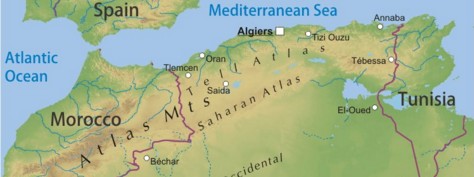 When the Phoenicians came in to North Africa where Tunisia, Libya, Algeria and Morocco are today, there were people living there. These people were basically from Europe and Africa. They had developed an African culture of their own. When the Phoenicians arrived they brought with them architecture and art from the Eastern Mediterranean. They were a mixture of Semitics, Caucasians and Africans consisting of Dravidian and Negroid people, physical types. The Dravidian and Negroid physical types are often referred to as Black People by some historians and many go as far as saying they are a “Black Race” of people. There are a large group of historians that classify Dravidians as Semitic people or Caucasian. We are concerned with art images and artifacts made by people living in Africa. That is a cultural issue. A person’s physical type should not be the first issue. In our study culture comes first. 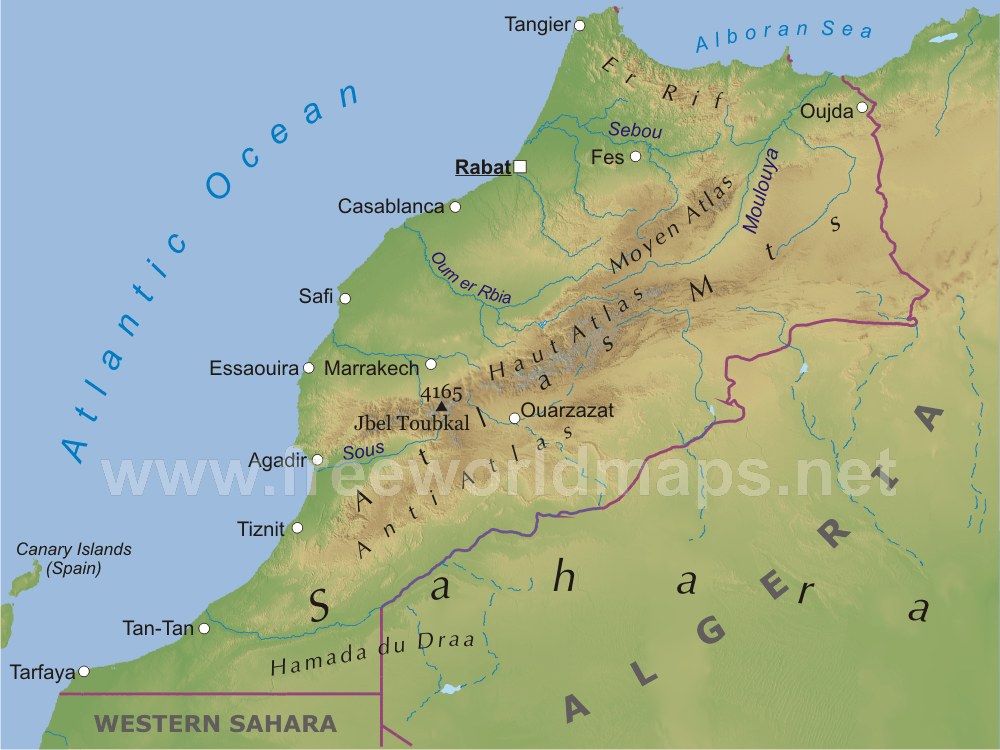 Carthage architecture and sculpture resembles architecture and sculpture of the Near East, Greco-Roman and Etruscan cultures. Phoenician writing was an alphabet like the Greeks and Romans. It was strictly abstract character symbols and no pictures. African cultural characteristics are harder to find in Phoenician culture than the ones exhibited in Moorish art and architecture. Sahara |
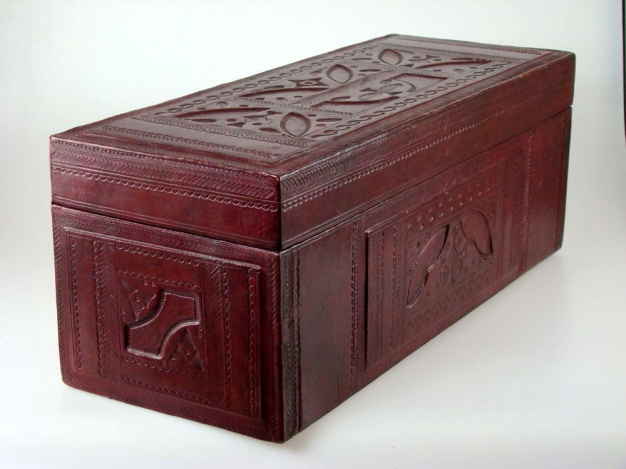 Tuareg Leather Box | 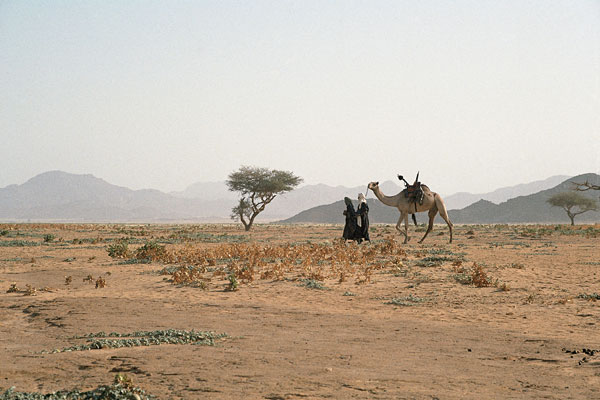 Arid Steppe | 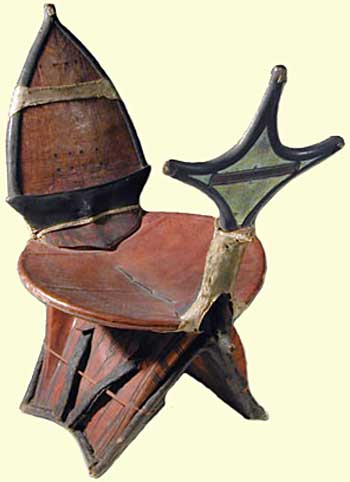 Tuareg Camel Saddle | 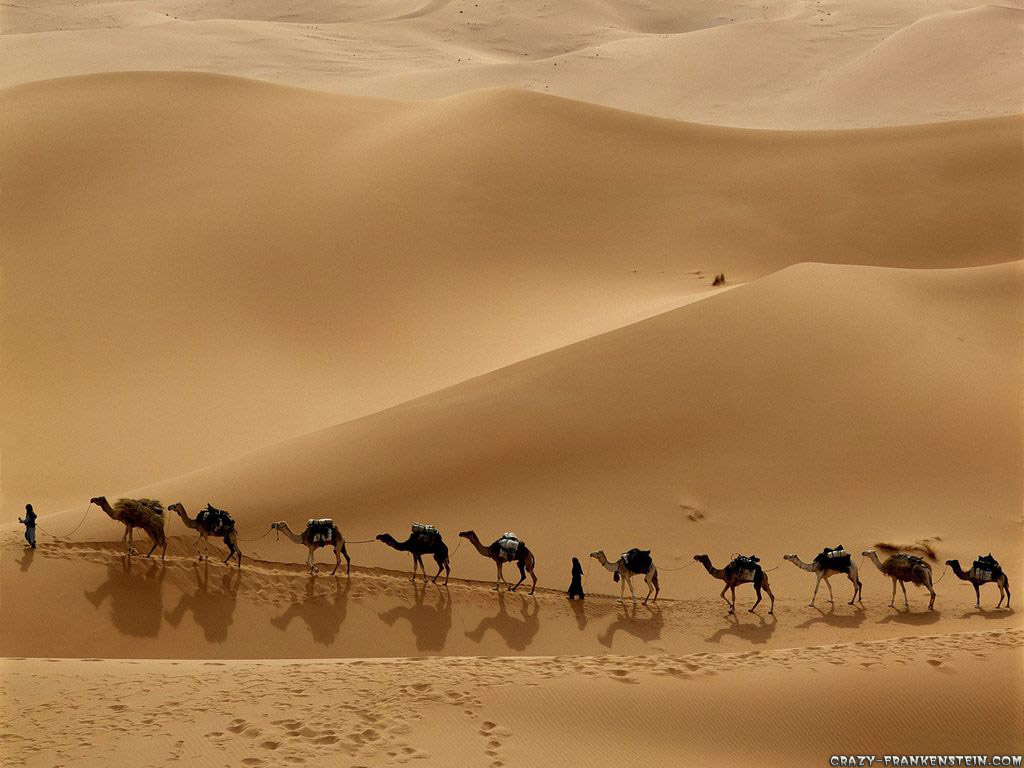 Sahara Desert | 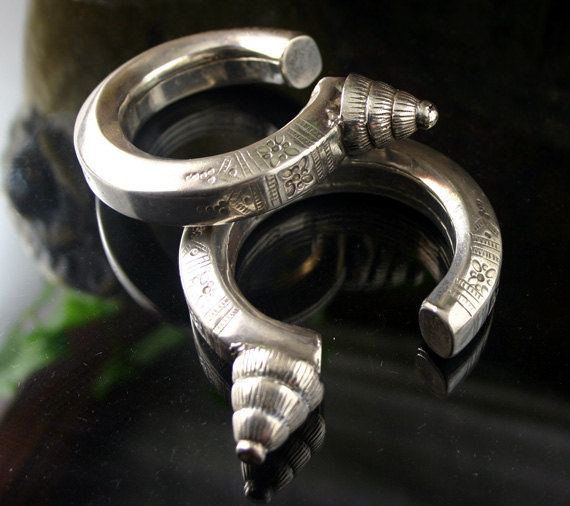 Tuareg Siver Jewelery |
|---|
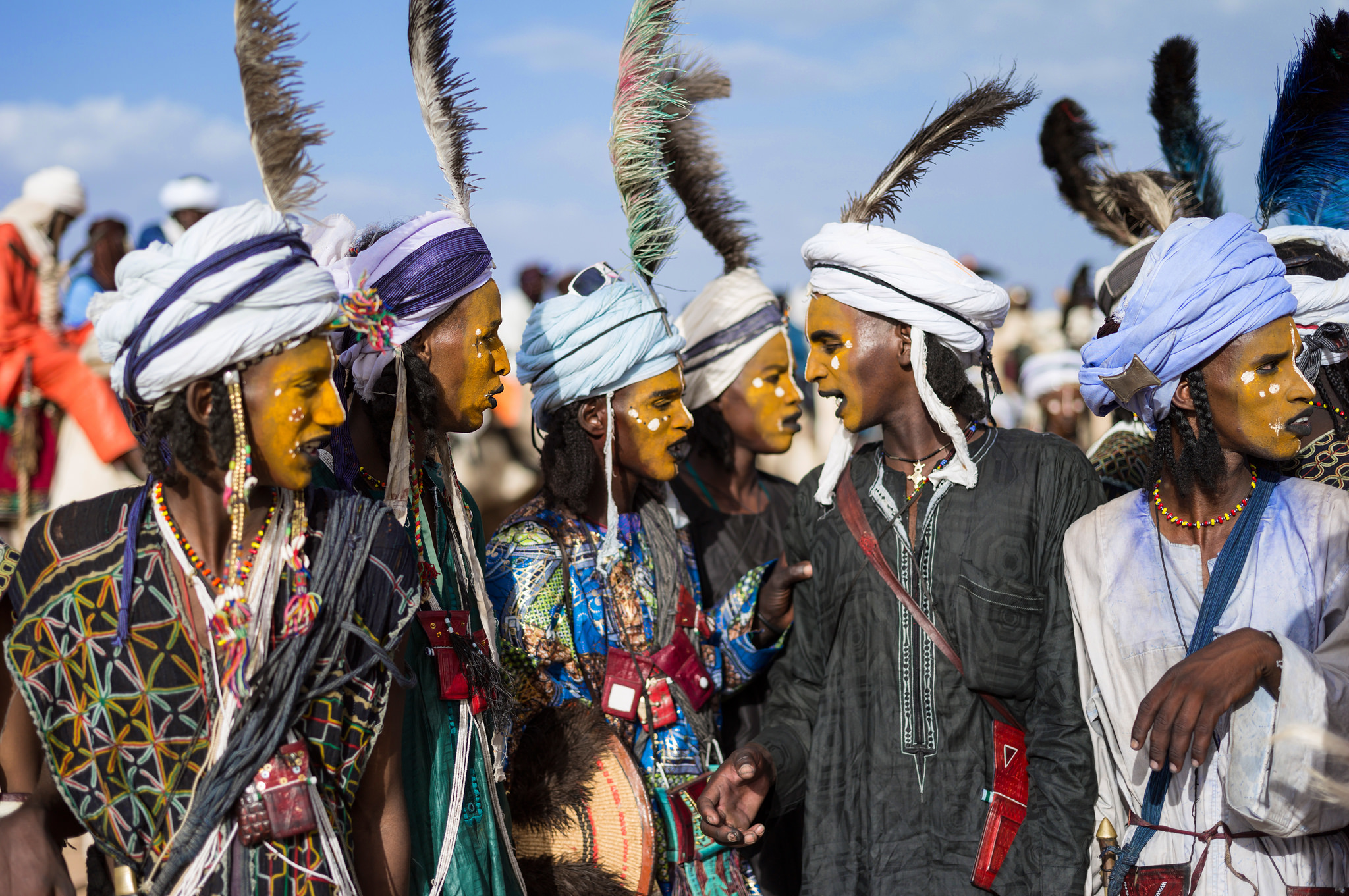 Wodaabe Men | 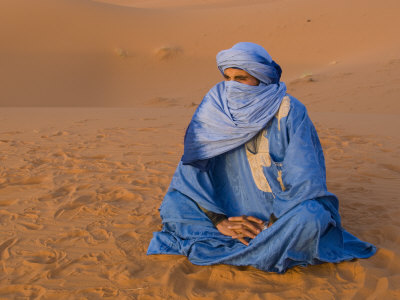 Tuareg Man | 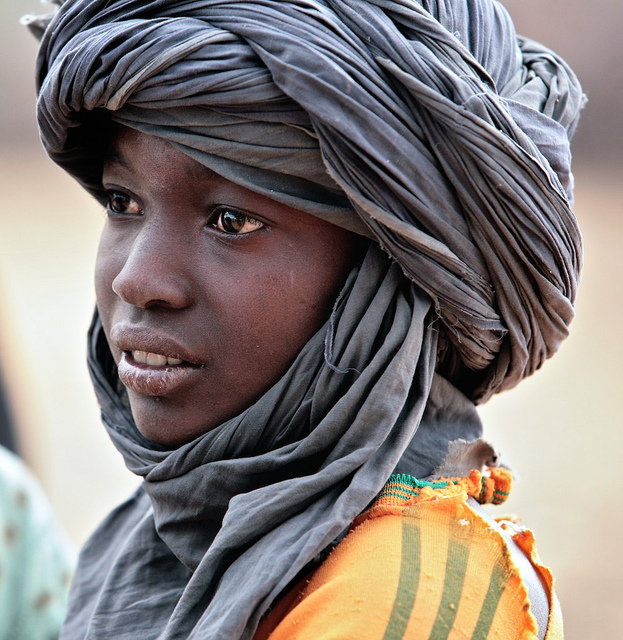 Berber Woman |
|---|
|
When we think of Sahara Desert we see an obstacle created from mountains made of sand. We see a place where animals and plants can not survive. Quite to the contrary human camel caravans constantly cross the Sahara. When they leave poop and pee in the sand scarabs are attracted to water, nutrients and bacteria left in the feces and urine. Desert lizards finding scarabs dine on the tasty little morsels. And other animals that crawl and fly feed off the lizards. There is enough animal and human traffic crossing the Sahara to make it worth while living there. How cool. 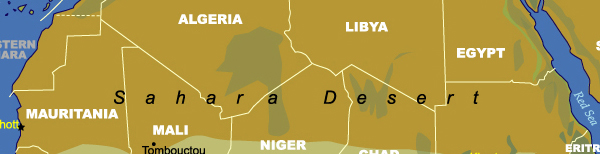 There is another secret about the Sahara Desert I think you should know. The sand mountains are not permanent. When the desert winds start blowing around there the sand mountains move somewhere else. How would you like to be caught in a sand storm when a mountain of sand is on the move? Tuareg caravans encounter them all the time. |
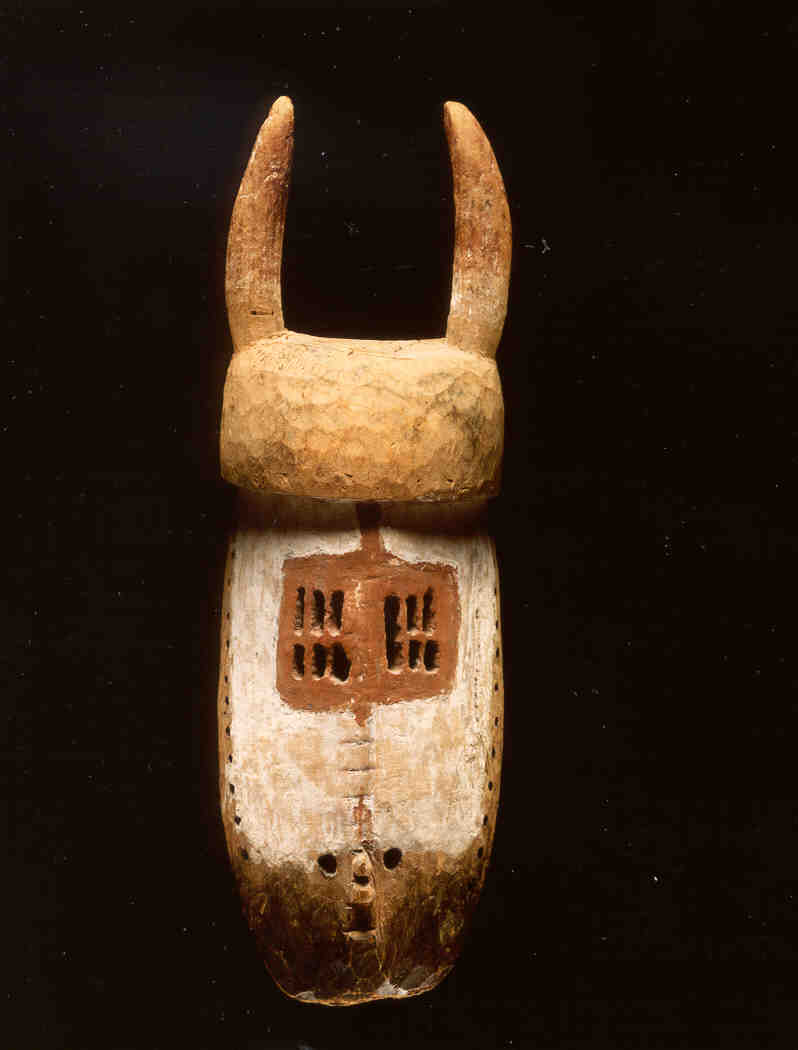 | 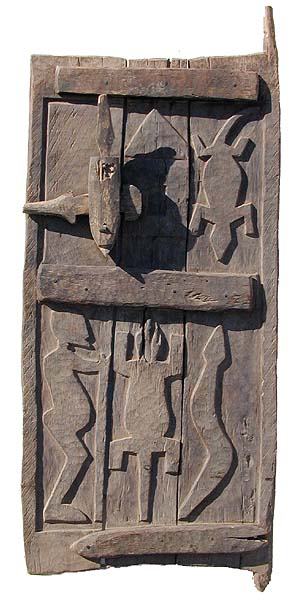 |  |  | 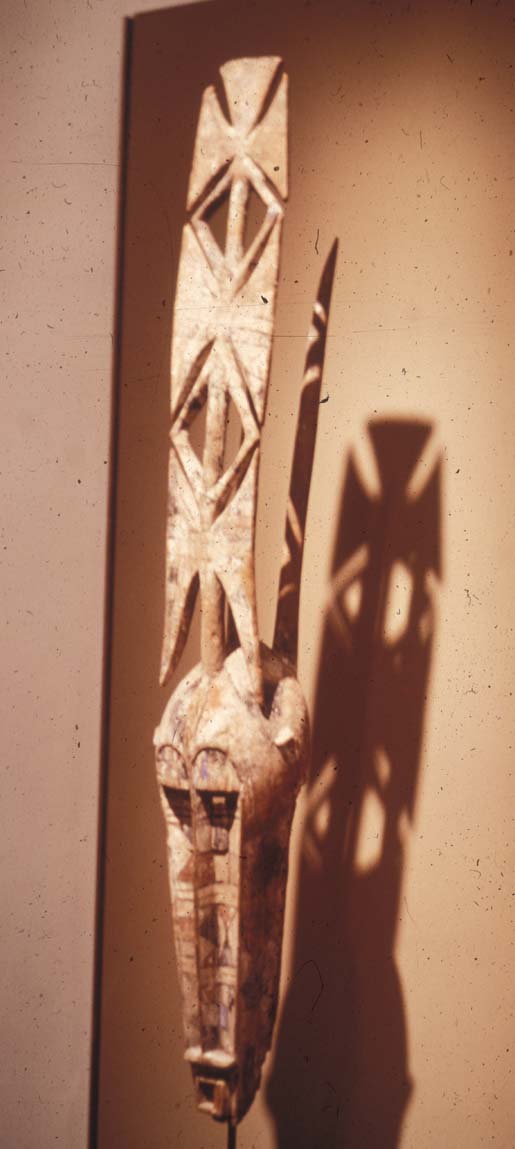 | 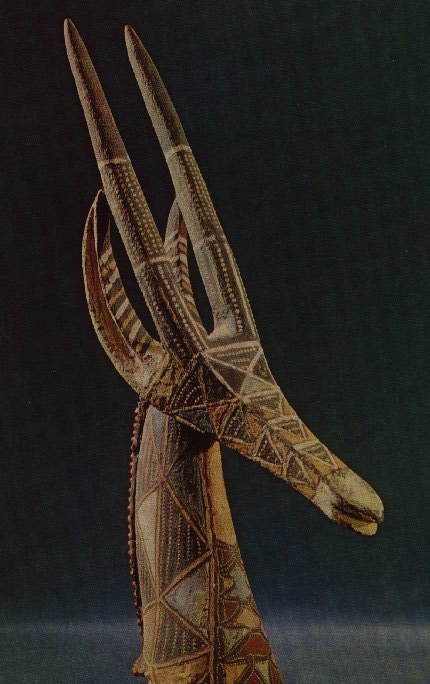 | 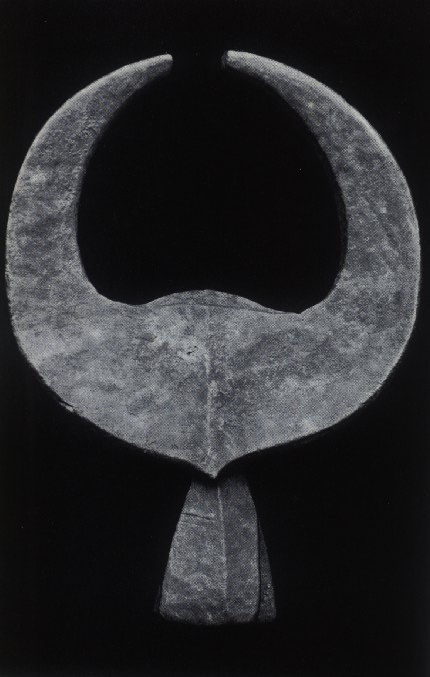 |
|---|---|---|---|---|---|---|
| Mossi Mask | Dogon Door | Senufo Mask | Bamana Head Piece | Bobo Mask | Kurumba | Mama Mask |
| West African Black Tool Bar | Top | Three West African Empires Movie | | Timbuktu Movie | Two Dogon Movies | | Western Savannah | West African Black Tool Bar |
|
West African is made up of Arid Steppe and Savannah Dry-Rainforest. The steppe region is located between the Sahara Desert in the north and Savannah Dry-Rainforest areas in the south. The Western Steppe receives less rain than the Savannah and Dry-Rainforest regions to the south. The Steppe consists of grass, brush and thicket accented by an occasional tree. This area of Africa has two seasons a year wet and dry seasons. Rain comes only during the six months of wet season. Western Steppe has many rivers and lakes that don't appear on world maps, because these bodies of water only exist when it rains. During the six months of dry season the temporary lakes and streams dry up. Droughts plague this rejoin as well. Occasionally a lake may last for several years; long enough to support large numbers of fish, boats and fishing communities; then it would eventually dry up and disappear. The Niger river and the Songhai people are the two constant bodies that remain in that area year after year. It has been said "If you want to kill a Songhai take him far away from the Niger". The same can probably be said about the Niger River as well. CLC  West Africa is known for having the most abstract sculpture of mankind and it is the Arid Steppe region where the most extreme abstractions can be found. There has been no such thing as non objective art in traditional African art. All images in traditional African culture represent something and there was no image which could not be identified. Woodcarving was often the work of a blacksmith. Woodcarvers used the same principles used in farming, iron work and woodcarving. Farmers strike the soil with a hoe. Iron smithies strike metal using a stone or iron hammer and strike the wood using a steel adze. Blacksmiths made iron sculpture and often did bronze casting as well. Blacksmiths were the smelters. Blacksmiths in this region did not have to do any farming. They made hoes, cutlasses for farmers and hunting gear for hunters during periods of farming and carved wooden masks and sculptures during off seasons. Their wives in most cases made pottery.
The woodcarvings reflect the blacksmiths metal work. Metalwork, scarcity of wood and Islam seem to be the three major influences on woodcarving in the region. Islam seems to have influenced African art disappearance more than it has the appearance of design or artwork. Geometric designs were being used in that part of Africa long before Islam came into the region. Telem woodcarvings and Dogon woodcarvings are good examples of testimonial concerning before and after the influence of Islam. African use of design and abstraction played a major part in saving Traditional art culture in the region rather than a homogeneous relationship between the two culture demographics of Western Asia and Africa. Metal smiths influenced the woodcarving in the area first, because they were the ones doing the work and their carvings were a reflection of the linear structures and patterns of their metal work. The carvings reflect first and foremost “Iron against Wood”. The two media are integrated in the woodcarving in such a way that the wood is respected for being what it is wood rather than trying to be metal. The scarcity of wood plays an important but lesser role in the appearance of the art. |
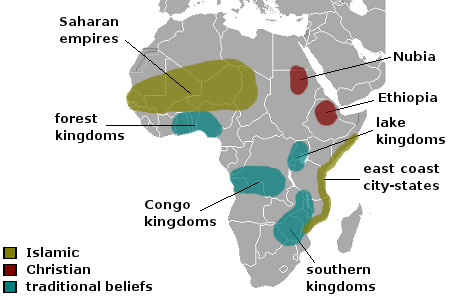 Map of African Civilizations and Kingdomes |  Map of Great West African Empires & Smaller States The Lost Libraries of Timbuktu. |
||||||||||||||||||||||||||||||||||||||||||||||||||||||||||||||||||||||||||||||||||||||||||||||||||||||||||||||||||||||||||||||||||||||||||||||||||||||||||||||||||||||||||||||||||||||||||||||||||||||||||||||||||||||||||||||||||||||||||||||||||||||||||||||||||||||||||||||||
|---|---|---|---|---|---|---|---|---|---|---|---|---|---|---|---|---|---|---|---|---|---|---|---|---|---|---|---|---|---|---|---|---|---|---|---|---|---|---|---|---|---|---|---|---|---|---|---|---|---|---|---|---|---|---|---|---|---|---|---|---|---|---|---|---|---|---|---|---|---|---|---|---|---|---|---|---|---|---|---|---|---|---|---|---|---|---|---|---|---|---|---|---|---|---|---|---|---|---|---|---|---|---|---|---|---|---|---|---|---|---|---|---|---|---|---|---|---|---|---|---|---|---|---|---|---|---|---|---|---|---|---|---|---|---|---|---|---|---|---|---|---|---|---|---|---|---|---|---|---|---|---|---|---|---|---|---|---|---|---|---|---|---|---|---|---|---|---|---|---|---|---|---|---|---|---|---|---|---|---|---|---|---|---|---|---|---|---|---|---|---|---|---|---|---|---|---|---|---|---|---|---|---|---|---|---|---|---|---|---|---|---|---|---|---|---|---|---|---|---|---|---|---|---|---|---|---|---|---|---|---|---|---|---|---|---|---|---|---|---|---|---|---|---|---|---|---|---|---|---|---|---|---|---|---|---|---|---|---|---|---|---|---|---|---|---|---|---|---|---|---|---|---|---|
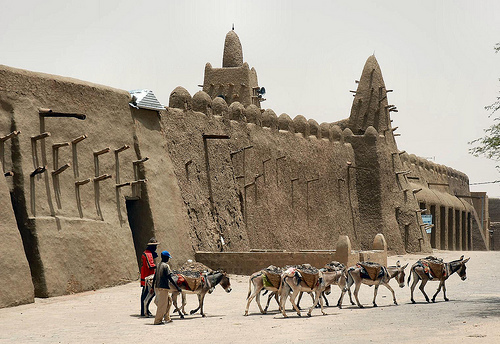 A Wall Outside The City Of Timbuktu | 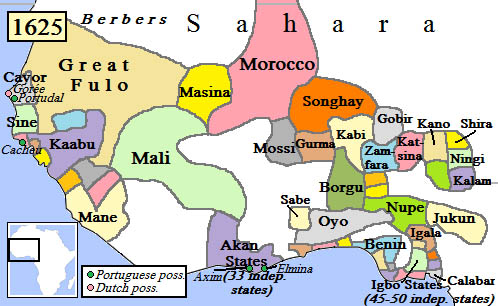 Break Up of Great West African Empires Into Small States & Kingdoms |
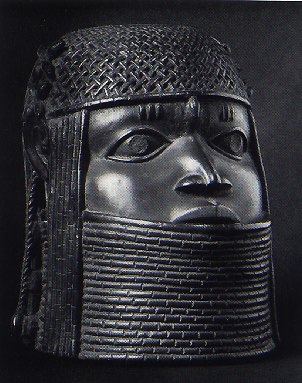 | 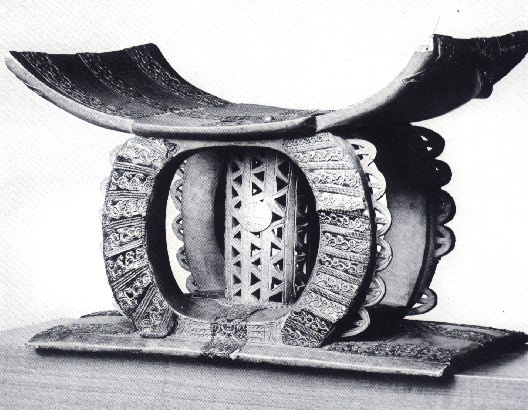 | 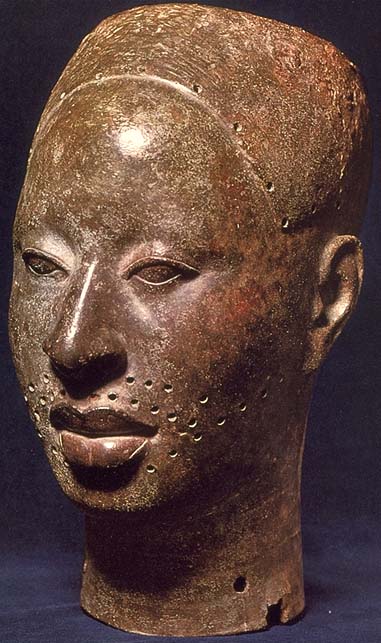 | 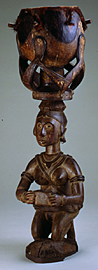 | 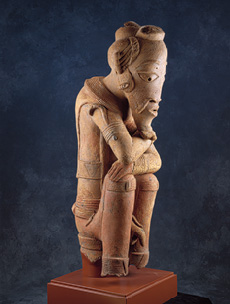 | 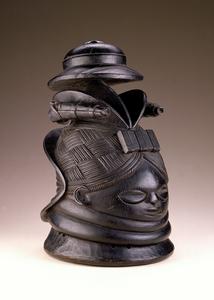 | 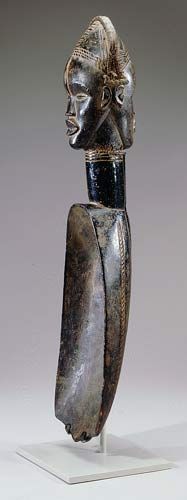 | 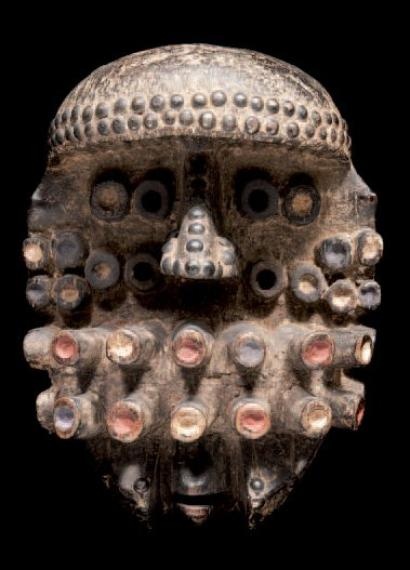 | |
|---|---|---|---|---|---|---|---|---|
| Benin Tusk Mount | Akan Stool | Ife Head | Baga | Nok Figure | Mende Mask | Dan Spoon | Kran Mask |
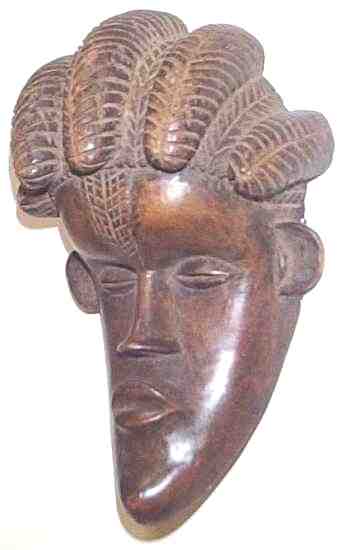 | 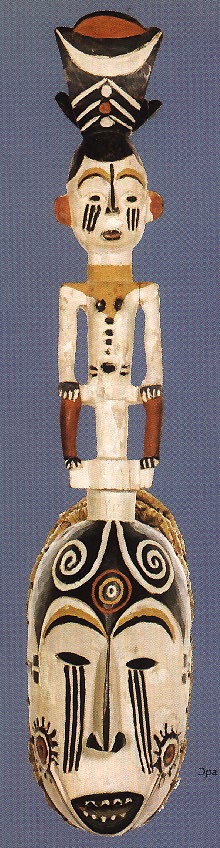 | 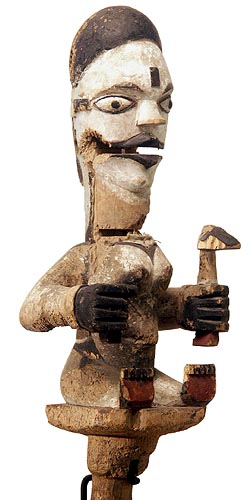 | 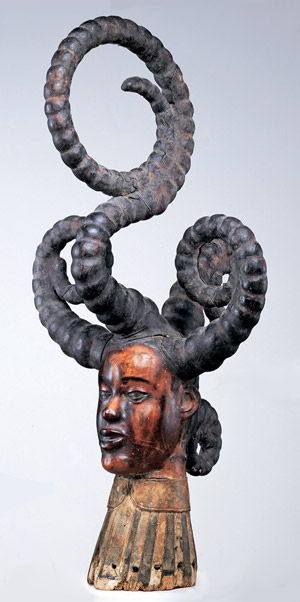 | 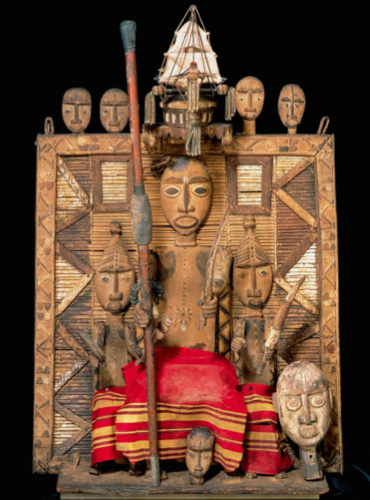 | 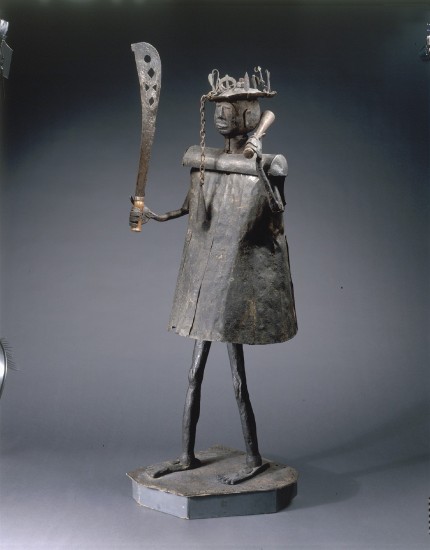 | 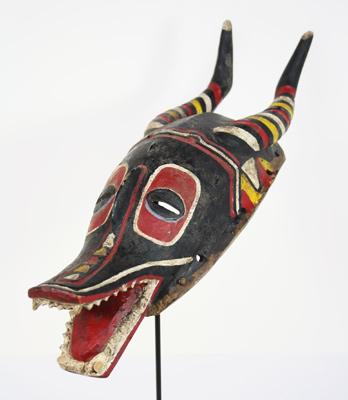 | 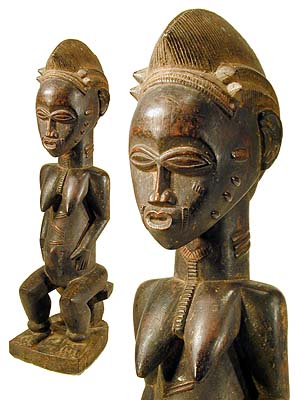
|
|---|---|---|---|---|---|---|---|
| Basa Mask | Ibo Mask | Ibibio Pupet | Ekoi Head Piece | Ijaw Panel | Fon Iron Sculpture | Guro Mask | Baule Figure |
| West African Black Tool Bar | Top | Yoruba Muvie | | Ashanti Movie | Benin Movie | | Arid Steppe | West African Black Tool Bar |
|
Savannah and Dry-Rainforest region are the home to the largest number of ethnic art cultures and variety of art for different uses west of the Nile valley. The oldest art in West and Central African Art can be found here as well. The Dry-Rainforest is a region that is noted for its variety of art iconography and its use of separate iconography for many of its different art mediums. This region practiced specialized labor skills in the arts. Agriculture economies in the region supported exclusive specialized labor in arts the year round. In this region of Africa three major "artempires" reigned starting in 12th Century AD until almost the end of the 19th Century. They started with Oyo Empire, Benin Empire second and the Ashanti Empire third. Both Benin and Ashanti held colonialism off until almost the beginning of the 20th Century. The Oyo-s were the most art productive and the two most feared empires were Benin and Ashanti. Benin was the larger of the two and considered the most dangerous. Benin had slipped into a very demoralizing and deep decline long before the British made their assault on the city. Colonial geographical division provides very little logic when it comes to identifying art cultural groupings and art environments in Africa. We will use colonial geography only to point out where people live. The largest number of art groups and variety of art exist in Nigeria. (Note: with the changes due to Neocolonialism the facts being provided are no longer true). Yoruba people are the largest population among art producing people in West Africa. Yoruba people have the largest variety of art and largest variety art uses found in both West and Central Africa. This fact can be verified by collected artifacts distributed though out private collections and museums found in Europe and the United States. The Ibo people living in a densely populate area in Eastern part of Nigeria are the next most prolific art producers in Nigeria. Nigeria contains the largest number of art ethnic groups in West Africa. When we us the term “West Africa” we are including the Arid Steppe along with the Savanna and Dry-Rainforest regions. The selection of work displayed above only represent a small selection of people from the Savannah and Dry-Rainforest.  Alaafin Siyanbola Ladigbolu of Oyo-Ile ruled from 1911 to 1944 Benin (Edo), Ife (includes Yoruba), Nok, Ibo, Ibibio, Ekoi and Ijaw all can be found living in Nigeria. The Yoruba produced art in Republic of Benin back in the day when the Republic of Benin was known as Dahomey. The production of Yoruba art in that region probably shutdown shortly after the master Woodcarver Duga died during the 1950’s. Yoruba produced art in Togo and I have seen at least one Youba akuama (fertility image) from Ghana. Just because you establish colonial boundaries for the purpose of ripping off minerals and resources from the land, doesn’t mean that culture and people are going to stay within those boundaries. Yoruba were established in Old Oyo around the 11th Century AD. Classical bronze portraits were being cast around the 12th Century in Ile-Ife (in Nigeria). The art culture was established earlier culture, which European Anthropologist referred to as Nok. This civilization began about 500 AD and flourished for about one thousand years. The influence of Nok pierced eye pupil, triangular shaped eyes and simple curvilinear geometric forms can be seen in the woodcarvings throughout Yoruba culture. Bronzes in Ile Ife and Benin have a very peculiar feature added to their alloyed. Ife bronzes have slight iron deposits distributed evenly throughout the bronze alloyed both inside the core of the bronze head and outside. If you put a small magnet on the surface of an Ife bronze cast, it will slide down the surface of the sculpture. An Ife bronze head is about two-thirds the size of a real human head. In Benin the Iron deposit is much higher. You can put a small magnet on the surface of a Benin bronze and the magnet will stay in place. It won’t slide. I made a test on one Benin bronze that was a full human head size. The Benin bronze had a much thinner core and weighed less than the Ife bronze head. Benin bronzes tend to tend to yield rust deposits rather than turn green because the “ion in the brass” alloyed is almost equal to the copper. The next Country displaying a large group of art cultures is Côte d’Ivoire (Ivory Coast). These people are Dan, Kran, Bassa, Guru and Baule. Ghana is next. Most of the art producers there speak one language; Akan. Sierra Leon has Mende, the Republic of Benin support the Fon and the Baga are in Guinea. Concerning the Ivory Coast there is a whole culture conglomerate belonging to Poro or Sandi society. This conglomerate extends its boundaries through Liberia and Sierra Leon. Not all art groups in Ivory Coast belong to this conglomerate. Guru and Baule are a separate culture group. 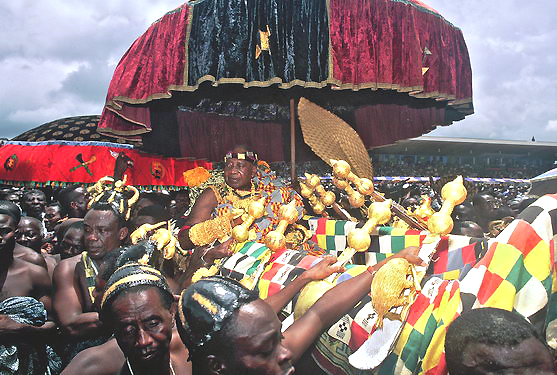 Kingdoms of Africa - Kingdom.of.Asante by historian Dr. Gus Casely-Hayford This is one of two major West African Empires. The other is Benin The 21st Century showcase for African art and culture in West Africa can be found in the republic of Ghana. The Ashanti are the leading group in its development, which started shortly after the country’s independence in 1957. While government support in other West African Countries began to fail Ghana prospered. |
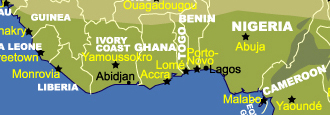 | 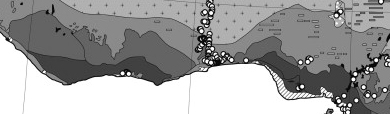 |
|---|
The Savannah and Dry-Rainforest lie between the Arid Steppe and the Atlantic Ocean. This region receives rain for six months each year and is dry without rain during the remaining six months. That is why we use the term “Dry-Rainforest”. The trees are essentially the same as the tropical rainforest but the climate demographic conditions under which this habitat flourishes is quite different from the tropical rainforest. The trees in this region have broad leaf evergreen leaves that form a canopy in the forest. These leaves remain on the tree the year round. In between the Savannah and the Dry-forest is a deciduous forest. The leaves fall to the ground during the dry season then return to the tree branches during the wet season. This area has some grassland. Farmers in this region of Africa use hoes with long iron blades attached to wooden handles. The principle behind the digging stick used by food gatherers before the invention of agriculture is the same. Farmers do not chop or swing at the soil. They bring the hoe straight down into the soil then lift it straight up. Woodcarving is done the same way. You don't chop the wood you strike it. 
Rice, yams, maize and cassava are staple crops in the region. Maize and corn were obtained from the Americas by African explores long before the coming of Europeans. The Portuguese introduced cassava from Brazil for making fufu during the 1500’s. Rice farming was practiced in Sierra Leon, Liberia, Guinea and parts of the Ivory Coast. Maize planting occurred in several of those countries as well. Nigeria has been noted for its yams. Yams are grown though out many areas of Dry-Rainforest regions. The growing of maize takes place in Western Savannah.
Each art area had artists specially trained in that craft. The divisions of craft labor for different trades were more clearly defined in the Savanna Dry Rain Forest than in the Arid Steppe region. In the past this region produced more art than any region outside the Nile Valley.
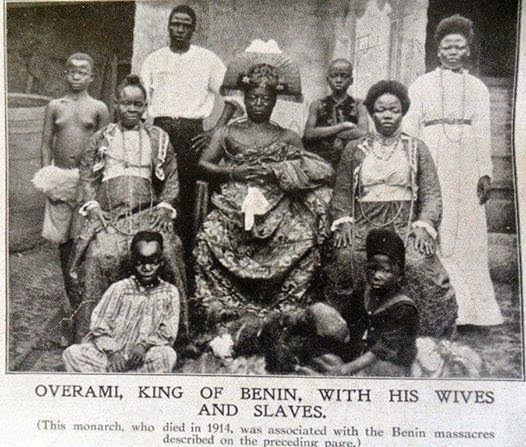
Traditional bronze casting, woodcarving and ivory carving from this region have no rivals anywhere else in the world. Ife and Edo (Benin) bronze casting during the 13th and 14th Centuries were unmatched concerning uniformity in thinness-thickness of the cast, possibly do more to the scarceness of metal resources rather than any esthetic considerations or concern recarding preservation of resources by the artists. In the two remaining art areas ivory and wood the story is much different. Ivory is limited by its size and shape and the artists respect that. They show a command for composition and reverence for material rarely seen in ivory carving elsewhere. Woodcarving is at the top of the chain of African art achievement. Composition and reverence for material go far beyond the period in which the work was created.
Something must be said in behalf of textiles. A cotton revolution swept West Africa before the coming of Europeans. Cotton changed both the types of looms being used and the designs used in the cloth. We have some clue as to what some of the designs may have looked like shown in Yoruba Egungun appliqué art. Once the cotton introduction was complete wood carvers could no longer use textile for design iconography support in their woodcarvings, making it easier for woodcarving and other media to develop icons of their own.
Late in the 19th Century as the European Camera began recording and printing chemical based pictures, European artists were concerned and worried about what to do next, since their art had been obsessed with perfecting natures work rather than creating new culture. Pablo Picasso and George Brock were studding the works of Paul Cézanne. The two artists noticed that Paul Cézanne’s art gave them a departure needed to create culture. Cézanne had noticed that everything in nature could be depicted using human made geometric shapes and forms, something that the Egyptian could have taught the Greeks thousands of years ago. Greeks probably thought Egyptians did not know how to make sculpture resembling humans look realistic or naturalistic, but they were wrong. They did not understand the nature of African cultures and African religions (an argument to be pursued in a separate chapter).
Meanwhile art critiques in Paris kept insisting that Picasso and Brock were painting these cubes. Brock and Picasso were busy studing Cézanne’s work. They did not know anything about "no little cubes". The two artists stumbled across Masks from Gabon in Central Africa and wooden statues from West Africa. They noticed that the art work made use of principles being used in Cézanne’s work, but there was a whole new “thang” going on there which was not about approximating nature at all, thus Cubism was born. Cubism is about painting and the term has nothing to do with African sculpture at all. African sculpture helped open European eyes to what art culture was supposed to be about. So Europe's discovery of Cubism and creation of Cubism is not an African creation or discovery at all. We never saw our sculpture as being cubistic until someone told us to see it that way.
Artists along the Guinea Coast were on to something unprecedented. They began using different iconography for different media and different art processes. A separate iconography was used in metal casting another iconography was used in Iron work. Separate iconographies were used in textile weaving another for stencil printed textile and still another iconography for relief printed textile. An evolution in that type of thinking process was still in effect when the first Europeans arrived. The iconography process that West Africans were using was wide spread. Artists as far away as Western Arid Steppe were using separate iconography for different media. As a result of Europeans trading for slaves and the decline of Traditional African art this evolution was never completed. CLC
Navigating Earth metropolis |
Using the Black Tool Bar |
African Ancestor Images |
|---|
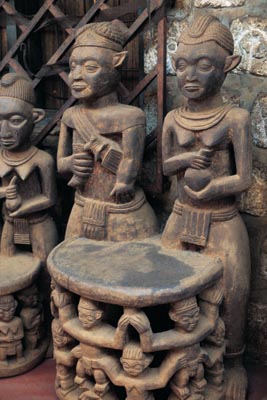 | 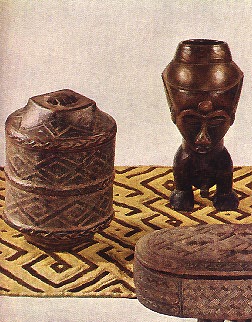 |  | 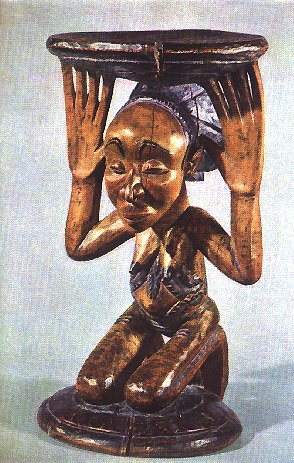 |  |  |  | 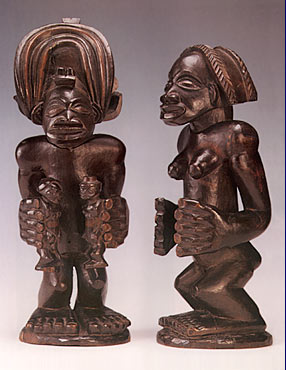 | |
|---|---|---|---|---|---|---|---|---|
| Cameroon Stool | Kuba Art | Kongo Figure | Luba Stool | Mangbetu Cup | Pende Pendant | Songe Axe | Chokwe Figures |
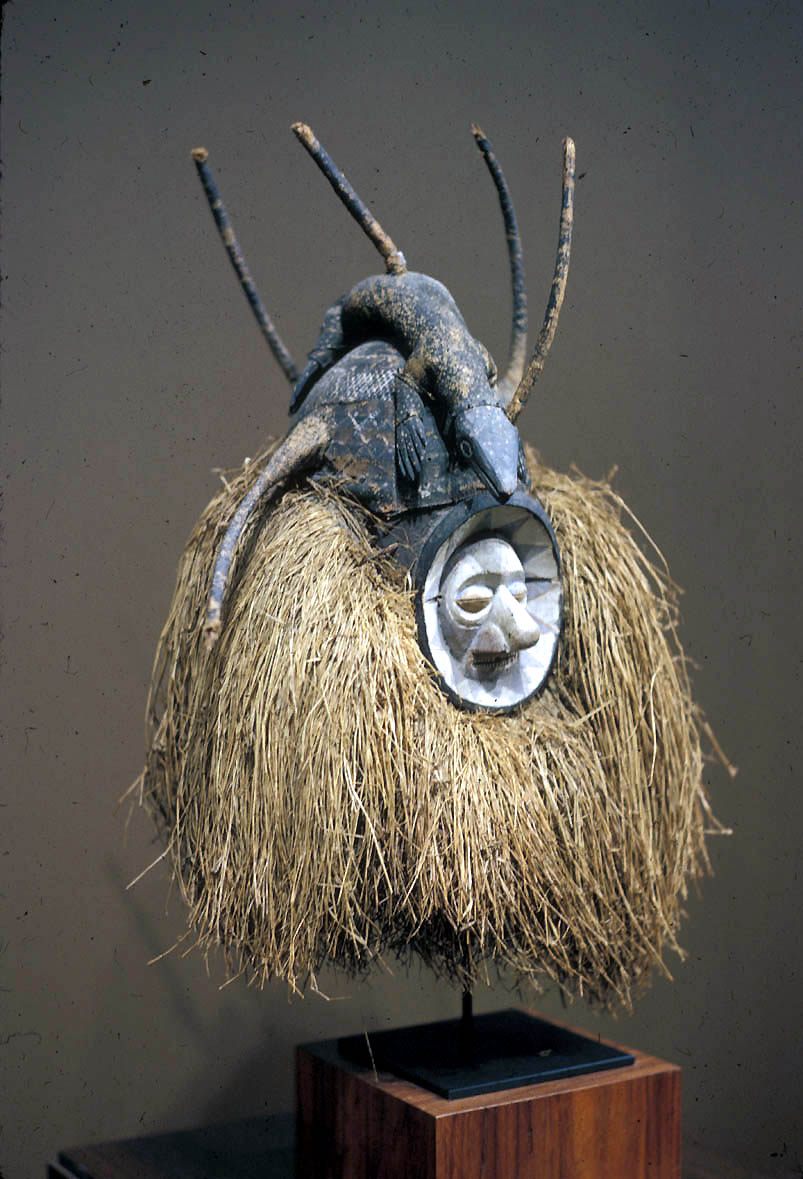 | 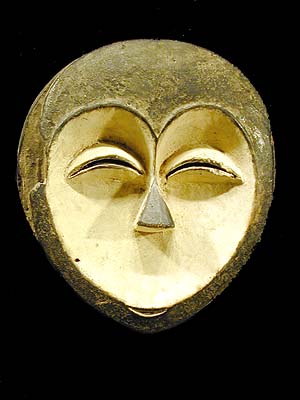 | 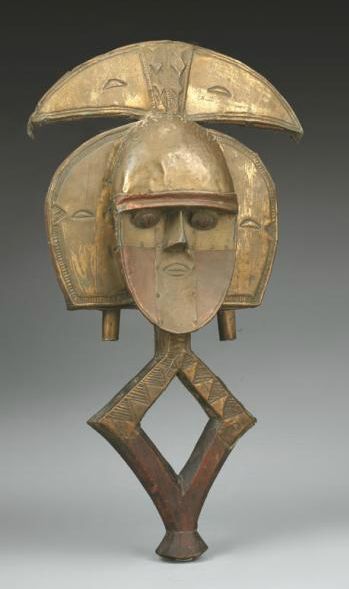 | 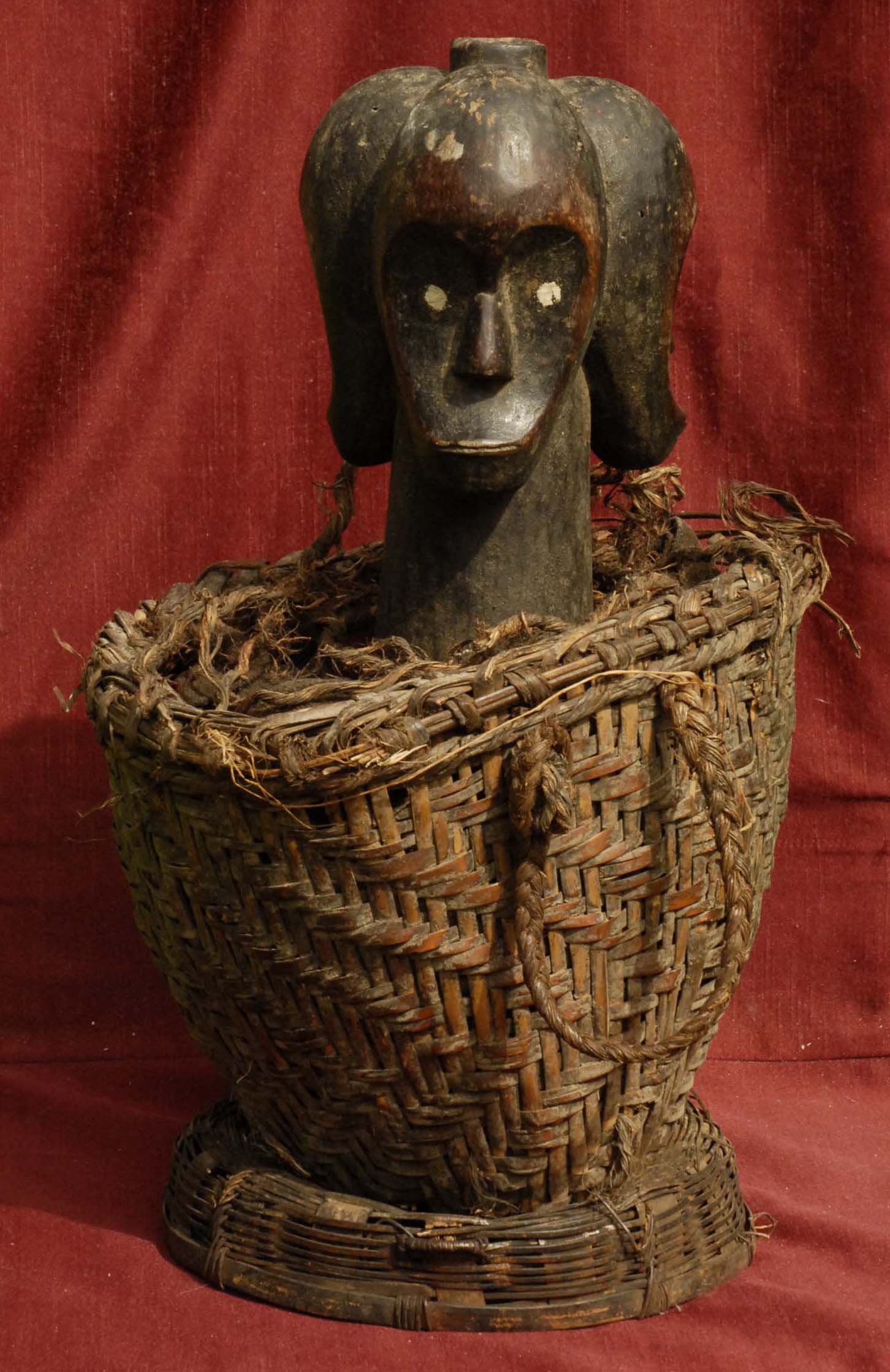 | 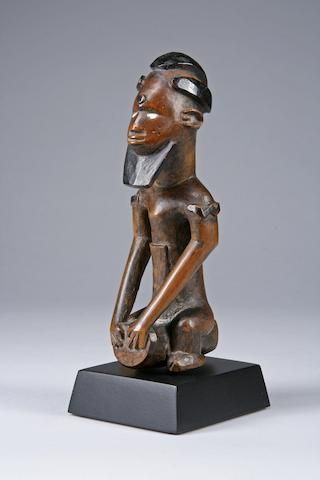 |  | 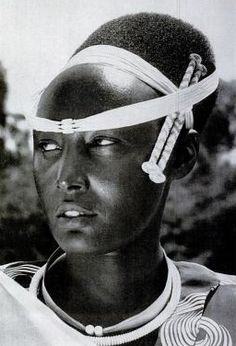 |
|---|---|---|---|---|---|---|
| Yaka Mask | Kwele Mask | Kota Reliquary | Fang Reliquary | Bembe Drummer | Ogooué River | Tutsi Hutu |
|
Central Africa, Gabon and Congo Brazzavile have only one season a year; rainy season. This region of Africa has a tropical rain forest. The trees in this region have broad leaf evergreen leaves that form a canopy over the forest. The leaves remain on the tree the year round. It rains twelve months a year in this region, only stopping for a few hours, or few days at a time. This area also comprises Congo Kinshasa, and Equatorial Guinea. The Katanga Provence of Congo Kinshasa turns into a Southern Savannah. The Southern Savannah has two seasons wet and dry. The Equatorial Rainforest of the Central Basin is the second largest rainforest in the world. Much of the art from the Southern Savannah Region and Equatorial Rainforest Region reflect the art influence from the tropical rainforest. Both the Southern Savannah and Equatorial Rainforest communities are in very close proximity with each other. They trade in art artifacts as well as food and other commodities. The cotton revolution and horizontal loom swept through West Africa and never touched this area of the continent. Raffia weaving has its own iconography. All of the other art forms in this region have integrated iconographies which show considerable influence stemming from raffia designs as well. The Kuba people are the most influential people in the region as far as art is concerned. They first learned the arts of their neighbors, then began trading there art with other equatorial and savannah central basin people. If you click on the Kuba picture selection above you will see more of their work and learn agout Kuba history and their art. |
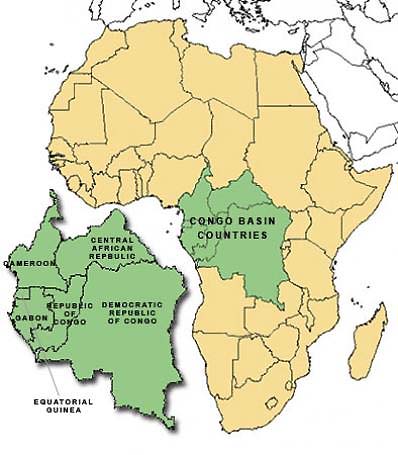 | 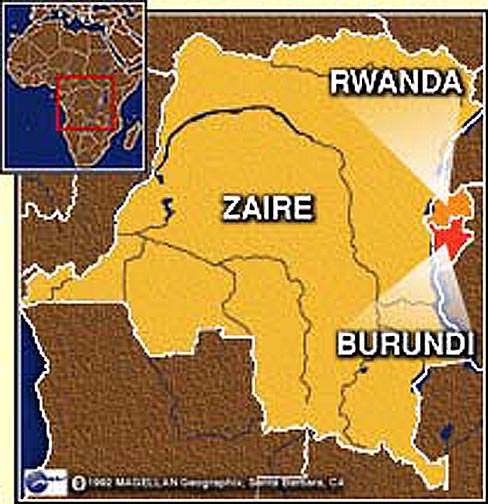 |  |
|---|
|
Luba are the next largest art producers in the region. They are famous for their images which depict the female figure in wood. CLC |
Intro. to Woodcarving Tools |
Introduction to African Images |
Intro. to Art Education Part 2 |
|---|
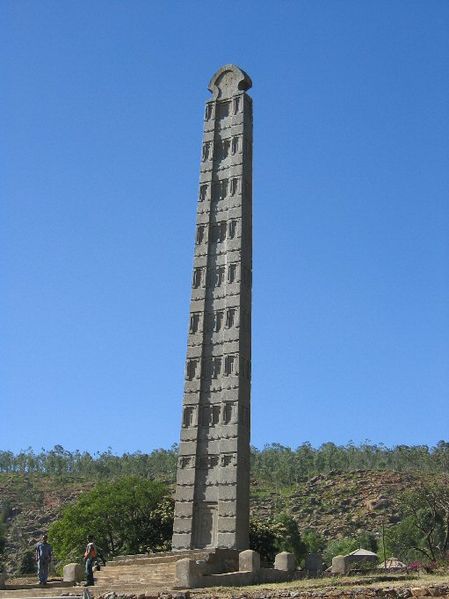 | 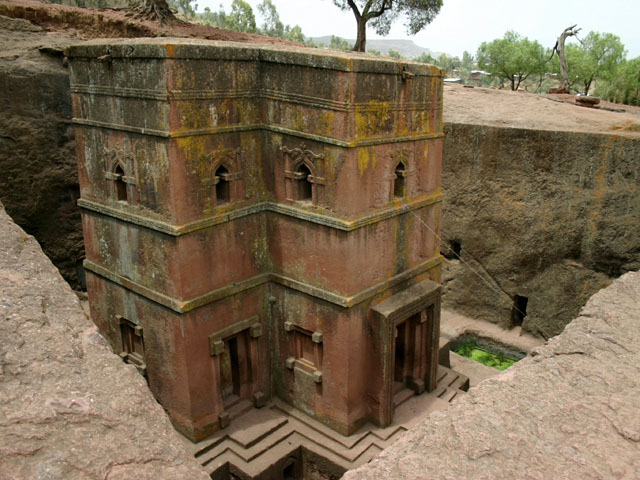 | 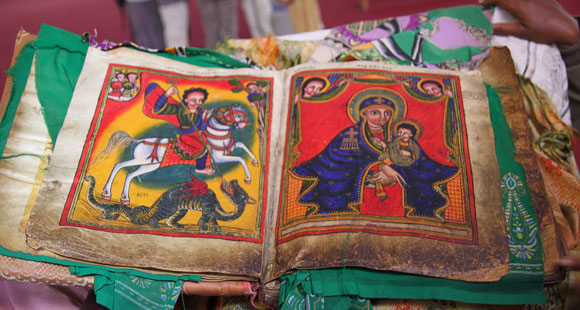 | 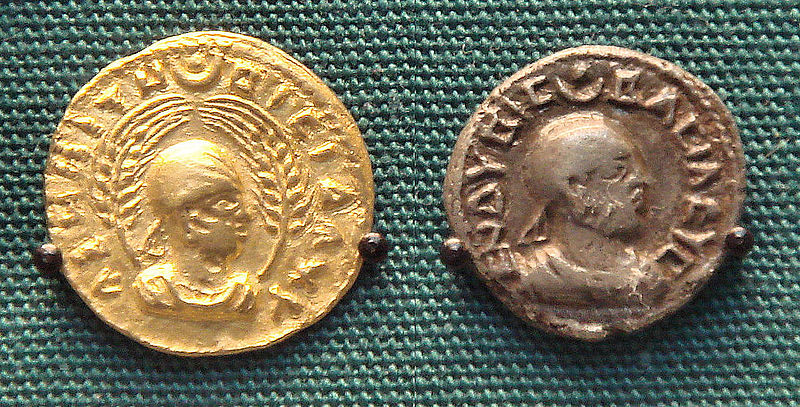 | 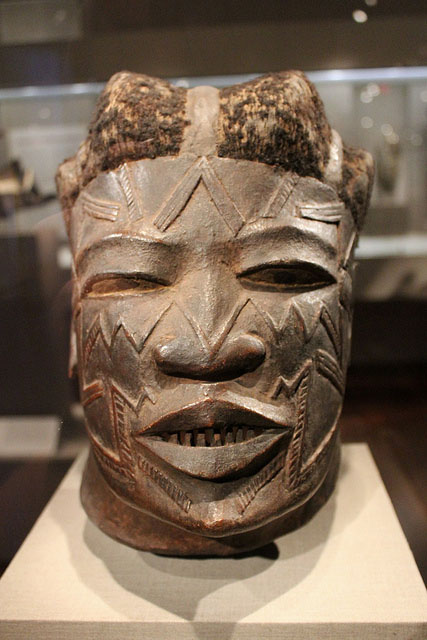 |
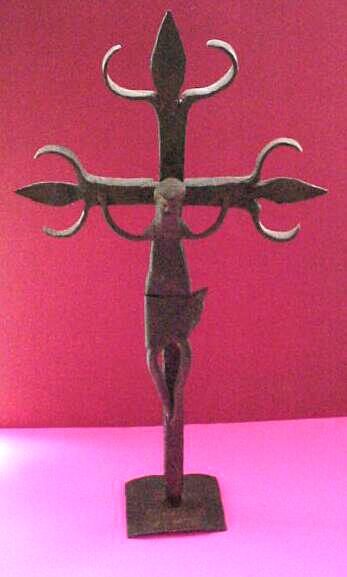 | 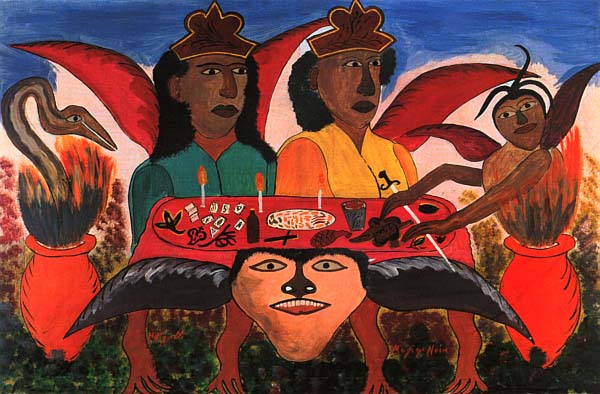 | 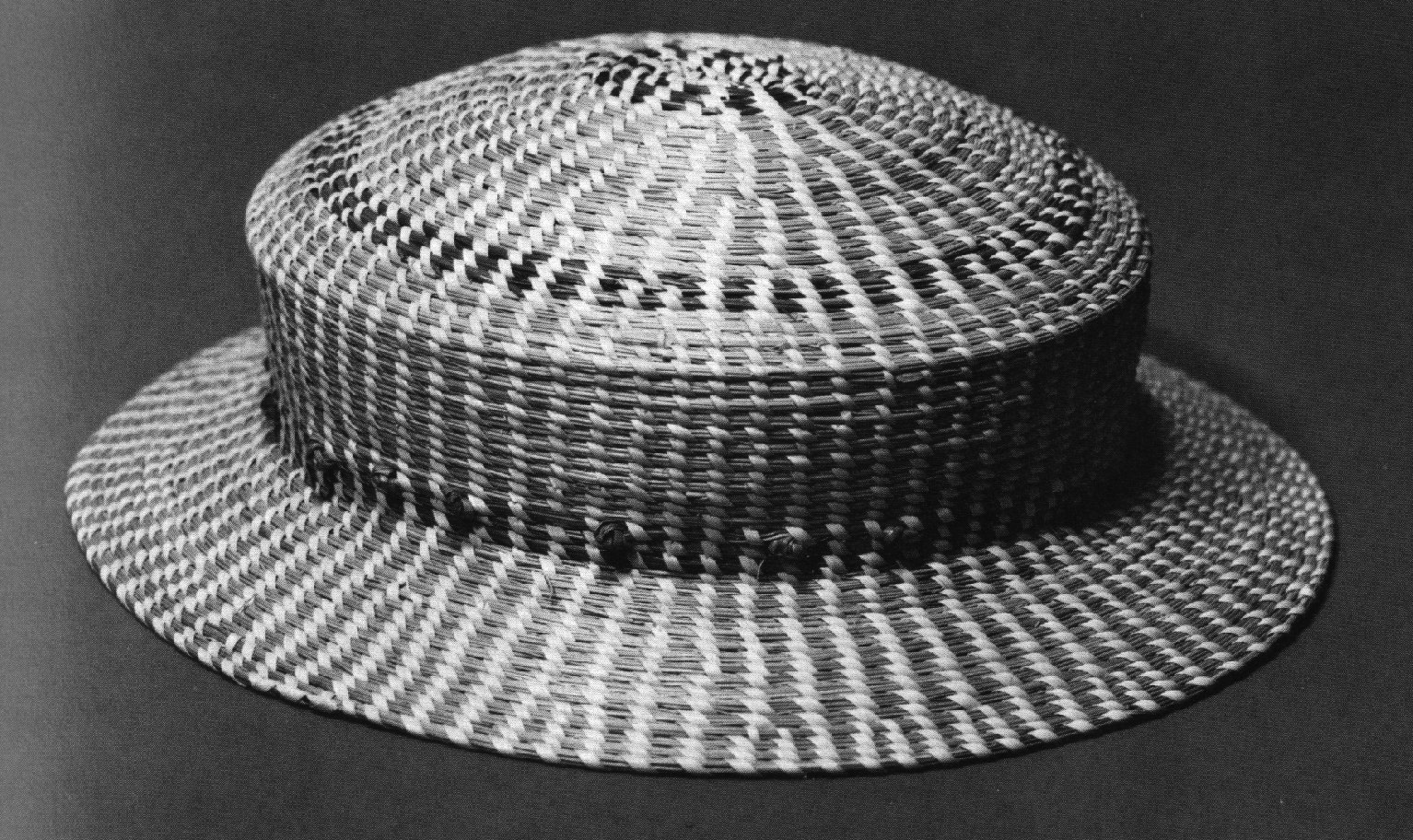 | 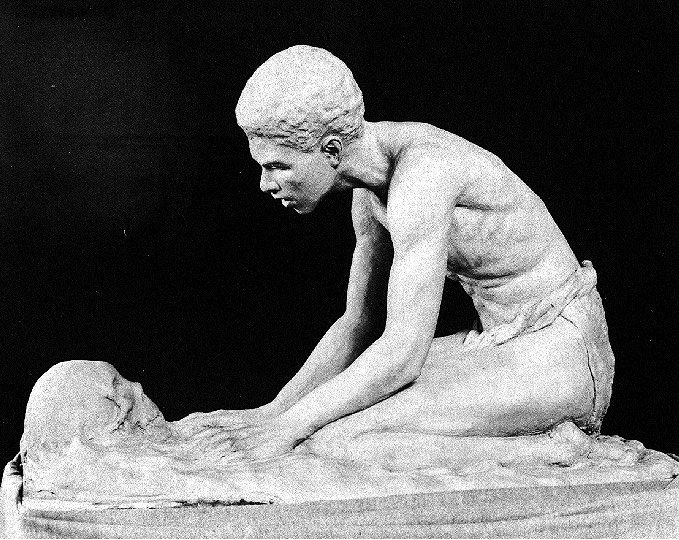 | 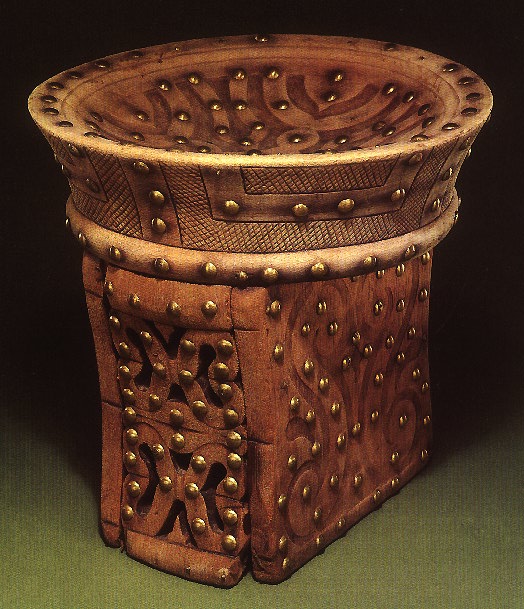 |  |
|---|---|---|---|---|---|
| George Liautaud | Hector Hyppolite of Haiti | South Carolina Hat | Meta Vaux Fuller | Suriname Stool | Raymond Saunders |
|
The Egyptians believed that the earth was round. Aristophanes of Byzantium learned this from his teachers while he was a student and working as chief librarian in Alexandria Egypt. With the help of Phoenician sailors Africans made their first voyage to the Americas around 300 AD. They found several earlier civilizations in existence. They had an influence on the art produced in the newly emerging Olmec Civilization. The pyramids that appear throughout out American Civilizations are combination of pyramids developed by Native Americans Pre-Olmec and influences from Egypt. CLC Beginning in the fifteenth century Africans were brought to the New World as slaves to work primarily in agriculture. Most of the locations where Africans were sent lie between 35 degrees latitude above Tropic of Cancer and from Tropic of Cancer to Tropic of Capricorn in the south. CLC |
Introduction To Art Database |
African Art Studies Part 1 |
Intro. to Art Education Part 1 |
|---|
|
Earth Metropolis is a project that started out as African Metropolis in 1997. By year 2000 I realized that African Metropolis would fall short of its goal unless I expanded the project to include Earth Metropolis which has far more advantages for Africa than if I had restricted the information for Africa and about Africans only. I can now show networks and other cultures crossing each other with ease. I do not have to make a special case or justification for doing so. An education component was not included at the other website. We have expanded into an institute and possibly an academy. African Metropolis was mainly a directory for Africa and African Diaspora. This website places emphasis on education and the Education Institute is open to anyone who wishes to use its materials. We are not an online college or university. Our material only supplements higher education. We provide course curriculum for course taught at the University level in another section of this same website. The directories can now be analyzed and evaluated based on what we find in them and based on the history of its authors. - Claude Lockhart Clark © September 11, 2011 / Peace – I found that navigation at most websites was slow and very tiresome for me because each time I went to a new webpage I had to wait patiently for the pictures and other media to load before I could view and surf the page. At African Metropolis I used a menu scan and back button to get from one menu to the next to find the page that I wanted. That took too long also. At Earth Metropolis I decided to shorten the page menu and introduce a black tool bar for surfing page content on a single page. Eureka!!! That was much better. Next I made sure that the education section had a tool bar that stayed in one place rather than moving with the page. We now have at least 3 navigation procedures working for us. I may introduce menu scan in Earth Metropolis if I find it can be useful. Later I hope to make it convent to use a site search engine for both African and Earth metropolis. I found it to be useful in the past. - Claude Lockhart Clark © August 10, 2012 There is no advertizing at Earth Metropolis. If you have things popping up in your face as you surf at Earth Metropolis then you need to check our computer and have those cookies and plug-ins removed. If you find that there appear to be links placed arbitrarily on our web pages, then your computer has a virus placed in your web browser illegally by advertisers to make it appear as though those links are on our webpage and they are not. This is a multi-purpose feedback form. It is used for the purpose of helping visitors with information concerning art or earthmetropolis.com. The only parts you are required to fill out each time you use this form are your name and E-mail address. Use this form as often as you like. You will receive an E-mail address from me as soon as I answer your request. If you have time please answer our very short questioner (below the map). Information you provide will not be shared or stored on this website. Your material is sent to a secure E-mail location. When you press submit you will leave this page. Select the small blue link that says “continue” at the right of the words“Form Sent”. The next page will say “Thank you for your submission”. There will be a copy of your submission to view. You can wait a few seconds with out touching the page with your mouse or click on the word “continue” once more and you will return to this page. You may use this form as many times as you want. Make sure you always inter your Name and E-mail address each time. You will always receive a return E-mail with my reply, making it convent to send E-mail by what ever method is most convent for you. |
CURRENT MOON |
TRADE|
PHILOSOPHY, CULTURE AND TRADITION
by Claude Lockhart Clark |
| Top | Scholar | Fakeye | Owens | Harry Best | Pablo Picasso | Alain Locke | Albert C. Barnes | Race |
| Geoffrey Nwogu | Claude L Clark | Merton D Simpson | Belief Systems | Culture | Tradition | Heritage |
|
AN INTRODUCTION
Every culture has its own unique foot print. We define something African by its "footprint". We find out what that footprint looks like by exercising the practice of Sankofa. Sankofa means look back to your past and bring something forward. That which you bring forward from the past is "Tradition". Tradition is a very slow changing process. Tradition is something that reoccurs over and over again throughout the life span of a culture and its people. "Culture is the bread basket which manifest itself in the human mind, and spirit" © Claude Lockhart Clark May 09, 2016 “We must be very mindful that we do not let torrential rains of Europe and the West wash our cultural heritage away as thought it were soap”. © Claude Lockhart Clark December 27, 2012 “The West has three virtues that we can all benefit from; secular thinking, communication and the scientific method. The rest we can probably do without”. © Claude Lockhart Clark December 27, 2012 “Secrets are kept and if a secret is not kept it does not exist. There are two ways to lose a secret either you tell and make it public or die before passing it on to someone else. Remember secrets are kept; the secrets not kept don’t exist. Question: What would you rather have?” © Claude Lockhart Clark December 27, 2012 In this section we will see five different approaches to creating a new heritage and or taking an old heritage and advancing it forward into something different. In each case the artist has relied on using some basic principles from Africa that are thousands of years old. In the first example, there are literally no tools and images to work from. The mountain containing information was far in the distance and years to come. Fortunately the mountain came to the artist by way of correspondence and African art trafficking. The artists sees 4 carving demonstrations performed by a master woodcarver named Lamidi Fakeye; two hours each and without any lessons or help from the master he becomes an accomplished woodcarver on his own in 3 years. The artist starts his own collection of traditional African art brought in by traders and commission’s African blacksmiths to fashion steel blades for him to carve with; using correspondence. He completed his self training in woodcarving before ever setting foot in Africa. The artist had a beginning in his father’s interest to promote African art, but providing for the family came first and the same discipline of self support was passed on to the son. The son’s first work experience was to own his first business, a vegetable wagon at age eight, which he managed by himself. This father and son did not make a living doing art. They had by design figured out how to continue doing artwork without being forced to sell. The son was a teacher like his father and he had an import business. This family made good investments and they had one other important asset; longevity. The second example is about a fourth generation traditional African woodcarver. He wanted to make a living selling his work, but his training was interrupted by his father’s death. Fortunately there were relatives all around him carving sculptures and there were support systems near by to help him produce an international economic network of patronage. Blacksmiths that fashion steel tools, trees to carve from and carvings produced by master craftsmen provide a living museum environment for the young man. He was not alone. In a third example, an African American woman received her training in Western ceramics and pursued an interest in African pottery. She supported herself as a teacher. In this case the mountain wouldn’t come to her, so she had to go to the mountain. She becomes a master potter before age 30 and takes on the responsibility of finding markets for pottery, developing a tourist business geared to art and culture appreciation. She had the responsibility to help train young girls to become potters in one of the villages in Ghana. The last artist was born around the time his art form was invented. He has had a chance to be apart of the avant-garde in promoting his cultures’ new art heritage. He became a master pan maker; pan designer, master music teacher and an outstanding performing artist. He moved from his home in Trinidad to the continent and continued encouraged people to take an interest in the art while supporting himself and family as a journalist for a local newspaper, until he retired, then opened his own school for pan teaching.
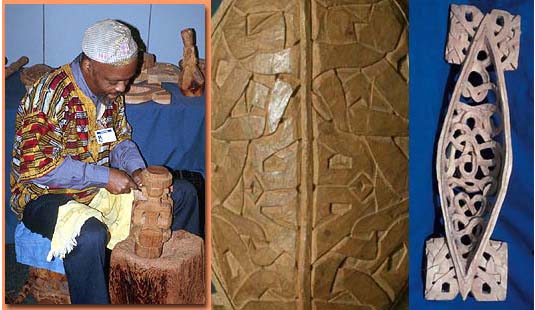 Claude Lockhart Clark - African American Woodcarver My area is art and I have tried to explore much of the material I have had at hand. I specialize in African culture and I try to do most of the things that I am telling you to do so that you get information first hand from someone that has already been there. I can do many of the things that I point out in my online web lectures. I produce images; I have seen over several thousand African images from the homeland. I was not satisfied with seeing them in books or behind museum glass I had to have hands on. I need to know what some of the basic principles were behind African art so that I could rely on something else besides drums, masks and dance to continue the work. The cultural patrons were not there anymore, so one had to develop different reasons for doing the work. Many of the areas of the past used for images were gone, but new areas can develop.
The items that are shown above and below are not familiar to most people living in Western society and shouldn’t. People living in Western countries don’t know what these things are or how they are used, so they have no use for such items. I purposely left out walking sticks, masks and drums in the first three rows of this display. The stool on the left side that I included I made sure that it would leave you in a quandary as to what else it might be besides a stool (see Talladega Post Renaissance). Your traditional art should be as private as your spoken language, as private as using the toilet and as private your bedroom at night. Your language and traditional art both should be private even when viewed or spoken in public. This makes it easy for you to distinguish it from other cultures. Positive identification should never be confusing, however your art should be as easy and comfortable to use and live with as your language is to speak. As an African, living in Africa or Diaspora, if that much cultural diversity bothers you, then you are not ready to take on the tasks that lie ahead. No one is going to praise you for what you are doing, so don’t look for admires. No one is going to hold your hand and guide you day by day though tasks that have to be done. You may find a hand full of people to work together and if you do, then consider yourself very, very, fortunate to have such company at hand. When it comes to art my first rule is “I do not believe in a democracy; my art work is the results of a dictatorship”. I make a very clear distinction between what is Western and what is African. An African can be both African and Western at the same time. That is not a cultural contradiction, but I just happen to have a bias, because I do not believe in cultural sharing concerning art. I barrow, rip it off and steal ideas from other people and their artwork all the time, but I don’t want you to know about it. I encourage getting ideas from other cultures. It is the only way your artwork will grow, or else it will become sterile if you don’t. When you steal just make sure no one else know you stole it. Chew it up and swallow. Do not integrate culture; dilute culture, decode it, dismantle, or miscegenate. Having ethnocentric ideas in regards to creative arts is normal and perfectly healthy, so enjoy. Such ideas come into conflict when it comes to human rights, sharing earth resources and national sovereignty, so you will need cooperate and share in those areas. I will let you in on one little secret. Do you see those two turtle boxes in the photographs above? I did not carve those boxes from tree timber. I carved them from lumber that I purchased at the lumberyard, but you are not supposed to know that. Always be conscious of everything in your environment and immediate surroundings. A small amount of paranoia and suspicion is very healthy when it comes to your personal welfare and your culture. I do not carve wood or timber from trees that I do not know anything about. I leave other people’s trees alone. I was not born or raised in Africa so I leave trees from home and other tropical forest alone. Tropical trees are for the people that are born there or live there. If you were not born and raised in Africa, then those are not your trees unless you live there. Leave African trees alone. Those are not your trees. Anything that Africans make and I buy belongs to me, but the natural resources do not belong to me. When it comes to art my first rule is “I do not believe in a democracy; my art work is the results of a dictatorship”. I make a very clear distinction between what is Western and what is African. An African can be both African and Western at the same time. That is not a cultural contradiction, but I just happen to have a bias, because I do not believe in cultural sharing concerning art. I barrow, rip it off and steal ideas from other people and their artwork all the time, but I don’t want you to know about it. I encourage getting ideas from other cultures. It is the only way your artwork will grow, or else it will become sterile if you don’t. When you steal just make sure no one else know you stole it. Chew it up and swallow. Do not integrate culture; dilute culture, decode it, dismantle, or miscegenate. Having ethnocentric ideas in regards to creative arts is normal and perfectly healthy, so enjoy. Such ideas come into conflict when it comes to human rights, sharing earth resources and national sovereignty, so you will need cooperate and share in those areas. I will let you in on one little secret. Do you see those two turtle boxes in the photographs above? I did not carve those boxes from tree timber. I carved them from lumber that I purchased at the lumber yard, but you are not supposed to know that. Always be conscious of everything in your environment and immediate surroundings. A small amount of paranoia and suspicion is very healthy when it comes to your personal welfare and your culture. I do not carve wood or timber from trees that I do not know anything about. I leave other people’s trees alone. I was not born or raised in Africa so I leave trees from home and other tropical forest alone. Tropical trees are for the people that are born there or live there. If you are not born and raised in Africa, then those are not your trees unless you live there. Leave African trees alone. Those are not your trees. Anything that Africans make and I buy belongs to me, but the natural resources do not belong to me.
The multitude of cultural and infrastructure damage recovery is too great for any one person or hand full to correct, but we must start somewhere. At the institute we are set up with core curriculum already in place. We are still working on essays about various ethnic people in Africa and various traditional African industries. We will need teachers that can apply our curriculum; essays and develop new curriculum for troubled areas in our communities. I will have to reach the multitude through various publishing devices. The World Wide Web is just one of the many publishing tools available, but it is a very important tool and it is free, just as Tim Berners-Lee and members of his W3C wanted it to be. Earth metropolis displays well on any screen shape or size. You do not have to scroll side ways to see the content of the pages on Earth Metropolis only scroll up and down and with the black tool bars in place each scroll is instantaneous. Scroll up and down on wireless telephone terminals, wireless book pad reader terminals, laptops and desktop computers. The Internet and World Wide Web are available to the world 24/07 and 360 days per year. It used to be you had to have a computer to receive information from the World Wide Web. With today’s technology and the Cloud Burst (see “Civil Communities”) both children and adults will` be able to use computer terminals in the form of remote wireless telephones and remote wireless book pad readers to receive instructional material from the World Wide Web. Students in middle schools and grade school will have book pad readers inside their cubbies and backpacks along with books and other classroom materials. They will be able to tap into instructional materials websites at any place that has a Wi-Fi connection.
I met Lamidi Fakeye in Pasadena California during the summer of 1972. He was carving a table from laminated lumber. My father was his sponsor in Oakland California during the fall of 1972 for about two weeks. Fakeye did 4 wood carving demonstrations while in Oakland. There would have been 5 but the first on was foiled because is carving tools were being held over by the airlines. Authorities thought his carving tools might have been weapons, so they wanted to have a closer look before returning them to Fakeye. The first demonstration missed being televised by Bellva Davis Moore. This is just one of the obstacles facing intercultural relations between older culture institutions and the Western World. Fakeye did traditional woodcarvings for a Western market. It was because of him that I would be able to see how traditional African woodcarvings were carved in the beginning stages 4 times. I also witnessed the dangers of carving sculpture for the Western World. They had a profound influence on what his artwork would look like and his apprentices suffered even more because of the changing from predominately Yoruba carving tools to mixture of Western and Yoruba carving tools and methods. Fayeye used the same tools but show fewer problems concerning the change. He was able to find an acceptable balance between the two cultures without sacrificing the integrity of the African Art form. We are left with a blend between Western Art and African Art that works very well. The change took place when Fakeye started carving lumber. Nigeria logging industry began using power saws at mills to cut timber into lumber. African woodcarving begins in the timber industry not lumber. Lumber is the first wooden art form in Western art. People in Western civilization generally work from lumber to build and carve things. Westerners work from lumber because their carving tools are designed mainly for lumber and small pieces of timber. African carving tools can handle any size wood. In Nigeria Fakeye would buy timber and then Westernized the timber by having woodworkers cut the timber into different sizes of lumber thus providing the first stages of artwork in all of his wood carvings. Fakeye would begin carving the second stage of his artwork not realizing that the first stage of work was completed at sawmill. Once the new style was established in lumber it remanded the same even when Fakeye returned to carving timber. Fakeye has been able to make significant inroads into the Western Art for indigenous art where very few have been able to succeed. We have witnessed a few artists in the Cameroon break into the Western art market. Other artists may begin to appear in the future.
New inroads into community and family art must open up as well. The Cameroon Grasslands has produced woodcarvers that have made woodcarvings and door panels for office buildings and traditional settings both in this century and the last century. Their work is timber oriented and reflects traditional work that is modern yet showing little influence of the outside world. The modern is on Cameroon terms. The woodcarvers there choose the wood they want to use for their products and outsiders don’t make those choices for them. They have made small inroads into Western interior design. Carved stools are fitted with glass tabletops then used as coffee tables for office buildings in the United States. The taller stools are fitted with glass tops and used for table lamps. The prices on Cameroon stools need to be higher to keep pace with the trees they are cutting down. Those trees take a long time to grow. The old avenues that used to be funded by traditional communities in Africa are drying up. Door carving for homeowners in Ghana has proved profitable. Other avenues need to open as well.
In America we do not have any Jazz musical instruments, but Africans were able to take European musical instruments and create a whole new Western form and sound called Jazz. To the south of the North American Continent lie the Caribbean Islands. There were large oil drums lying around in Tobago and Trinidad after World War II. African people stared using the oil drums as steel drums. When they cut the drums to different sizes they noticed the tone of the oil drums changed. The person that first dented the head of the oil drum and put a few bumps in it was the real genius and inventor of the first steel pan.
I first met Geoffrey Nwogu at Nontsizi Delores Courtland Cayou home San Francisco about 1973 or 1974 during the years I was getting started with African woodcarving. Geoffrey showed me three different masks depicting three different styles of Ibo art. Done by himself and two generation of his family before him. He informed me that he could carve all three styles of work.
Today Geoffrey does Western art woodcarving, but that is not what this topic is about. It is about his work as an ukpuru master of imbari art form. The first pictures shown here show the construction of the imbari by Nwogu and the final picture show what imbari looks like when finshed. - Pictures are taken from the following source. Nigerian altar at the academy - SFGate
If the mountain won’t come to you then you must go to the mountain. I do not consider myself-a historian. I am only a chronologist. I can present you with a series of events that have happened during a course of time and develop a philosophical approach to acquiring and applying tools that may be of use. As a young man I saw other men and women come across my path that gave lectures and wrote books, but I never saw anyone doing anything that resulted in applying constructive use of information stemming from those speeches and books. I did witness my generation repeating the same cycle of giving speeches and writing books; at least that was better than nothing. My question was are the writers able to apply anything illustrated in their text; can we build anything? I think we can. Those books have helped me, but I am not willing to continue that same cycle.
PHILOSOPHY AND BELIEF SYSTEMS Philosophy is a set of cognitive values and principles people choose to govern their lives with. Philosophy is legal culture. It reveals the guideline people choose to govern themselves and in some cases govern others as well. It applies meaning and purpose to what they are doing. Philosophy becomes their way of life. Philosophies are capable of govern people who don’t wish to be governed. An example of that is race philosophy. The ones being governed by a philosophy don’t even have to know what the philosophy is to follow it (read “Utopia, Race and Cast”). The think tanks know what it is and there are some in every human society on the planet. Many human societies don’t have a translatable word that corresponds to the term “philosophy”, but they all have guidelines for one. You just have to be able to recognize it when it is being presented. Some families have philosophies in the form of legal charters, which its members must adhere to generation after generation. An example of a family philosophy can be found in royal families and families belong to highly skilled trades often have charters. African spiritual belief systems are far more sophisticated than one could ever imagine. In West and Central Africa the priest moved the responsibility of the god king (as in Egypt) to the community and individuals themselves. The oracle priest and pantheon of deities would assist the community and individuals in making decisions. Ancestors and cultural heroes were most important centers of practice in African religions outside the Nile valley. African people depended on the family, departed ancestors and cultural heroes to help out in times of crises. The creator was simply too busy to get involved in human trivia, thus placing the problems of human illness and behavior with humans; where it should be. Departed cultural heroes became deities. They were given the power and attributes of material and physical forces in nature. There were more important things for the creator to do. Many Africans in West and Central Africa regarded the brain as the most important spiritual center of the Human body. They emphasize this in their art images by making the human head very large in proportion to the rest of the body. Unlike Egyptians they saw the heart as another organ of the human body, with no real spiritual significance or value to them in terms of harnessing a human spirit. © Claude Lockhart Clark March 17, 2013 "The importance of traditional African religion," Tshishiku Tshibangu writes (see Mazrui 1993, p. 505), "goes well beyond what the statistical affiliation figure of 20 percent of the total African population may suggest. For many Christians and Muslims," Tshibangu contends, "the basis of moral values still derives more from the old cosmology than from the new beliefs." He cites, as evidence, the continuing respect for ancestors, belief in the continuing involvement of ancestors in the life of their successors. He emphasizes belief in the forces of good and evil that "can be manipulated by direct access to the divinities through prayer and sacrifice. He says belief in the efficacy of charms and amulets to ward off evil," and, finally, "the vast area of African life which both I slam and Christianity have invaded but have not succeeded in completely displacing," the area of health and healing.
CULTURE Cultures display principles of behavior that present an idea of who we are and what we do. Culture is not something you see, feel, hear, taste or smell. Culture is something that has an affect on those senses through the media of touch, sound, sight, smell and taste. We see art that carries with it an idea we associate with a given group of people or culture, but we never see the culture; we only see a transmission or reflection of it. Cultures are found in countries, states and cities. Even some families have and preserve and pass on their cultures, which are different from their neighbors. Culture is not something that is easy to develop, maintain and preserve for successive generations. Culture requires hard work. Reestablishing culture direction and interest is no part time love; it is a fulltime business and obligation. In Western Civilization it is important to do well enough in your studies and work to get by, but do not over do it, just enough get where you need to be to cover your expenses for a very, very, very long time. Eat well and get plenty of rests, because your health may be one of the important factors as to whether you are going to make it or not. You have to begin purging things that are destructive and contradictory to your particular cultural interest; the fewer trappings and hang-ups the quicker you can make a transition. You might even need to consider getting rid of your friends because they have other interest that far outweigh what you may consider is important to you.
This section applies to those of us living in the homeland as well as those of us living in Diaspora. We have some issues to take care of. “Some of us have to go to a church boarding school and don’t have time to do heritage things during the summers, besides we have to study for the Cambridge exam so that we can be good British citizens in our respective neo-colonial countries or whatever”. Then there are those who say “They done stole everything and left us with nothing. We don’t have no cloths, no language, no culture and our minds are too far gone. They took our comb so that our hair would look unkempt and when they gave it back we decided to straighten our hair. I am going to study how to be a ‘White artist’ because there is no money in something ‘Black’ or African. You know you have to be very practical if you want to live in this society”. That is too bad; I am very sorry to hear that for fear restricts movement and prevent any growth, so you need to get over it real quick. If I seem malicious, mean and heartless, that is because what I am asking you to do is not what someone else made me do. These are disciplines I imposed on my self. Reclaiming and redemption is not for the weak; only the heartless and strong will suffice. During the late 1960’s and early 70’s until 1972 I did “acid works”. I was making comments on the “cultural prison/poison” that African people fined themselves in throughout their lives. It was an important process in mental detoxification, but you don’t want to stay there. If you want to be where you think Lamidi Fakeye, or Harry Best is then you first have to figure out where “you is at” before you can move on to something else. Once you find out where “you is at” and how you got there in the first place then you need to get over it real quick.
CULTURE STEREOTYPES Every culture has a character or cultural stereotype. We will use European and Western Civilization as examples of two very different cultural stereotypes. Western civilization is less than 600 years old. In the United States of America the country is only 300 years old and bent on getting rid of anything old and focusing on the new. The past does not exist; only the future maters. In essence if you live in the U.S. and trying to present culture that has a past to it, you would be better of taking your “pa_ _ some where else”. It is not wanted there. In Europe they are interested in their past but no one else’s. They collect the past of other cultures and put them on museum displays and on cold shelves in basement storage. They would prefer that their former colonies follow cultural direction set by the West.
Don’t make the mistake thinking that because Europeans have your art and artifacts displayed in museums that they have an interest in you as a human being. These people quite often are not interested in you. They only interested in the things they collected from you. They don’t intend to ever use your items so don’t get the idea that you are going to produce some more of those artifacts and sell to them. They may be preparing for your mass demise, but you may never know about it. Both European and Western Civilization are material oriented they consider the lives of humans secondary. If you don’t believe what I am saying then just look at what is happening in Western Asia and Africa with the use of vaccines to kill people and Mansanto poising the food supply to lower human populations world wide.
TRADITION Tradition is repetitive. It can be an activity or an event, which happens once every century, once a year, once a month, twice a week or several times in a day. Traditional can be any one or combination of those above activities. Tradition is repetitive. In order to be repetitive some portion of that tradition must stay the same or must not be changed. Tradition is the cultural core, which remains essentially the same, year after year and century after century. Tradition is the foundation and fundamentals that your culture was built on. What ever a tradition is, culture is the development and an expression as a result of it. Tradition is not always the earliest creation, but it serves to identify a people and their purpose in life. Tradition serves as a gateway, guideline and it distinguishes a people from every one else around them. Culture is constantly changing and tradition serves to stabilize or anchor it it. Tradition helps people discriminate and maintain what they see as their heritage. A culture must show an ability to absorb other cultures without losing its identity. Tradition philosophy and heritage combined help to maintain and reinforce cultural identity. It pays to seek out other cultures with paths similar to your own rather seek paths of total strangers. Europeans, the West and Africans have known each other for over 500 years, almost 600, but their cultural paths are total strangers. The cultural acceptance has always been a one sided issue. There was never any two-way street or acceptance between European/Western Civilization and African cultures. Because of that the two younger cultures have dominated the older one. You do not ever want to put your self in a position where someone else’s culture dominates your cultural identity or puts you in a compromising position. That is totally unacceptable. Put yourself in a dominant position and make every move you make is a conscious decision rather than unconscious, because you want to be able to hold yourself accountable for every action. You may find cultural paths that are similar to yours; belonging to people you don’t even know. It is ok to borrow from their paths because you understand what it is you are borrowing even though you don’t speak the same language, or live in the same part of the world. As long as paths are similar they can be integrated easily without one losing its own integrity. If the two cultures are very different, pursue both separately and make the paths where the two intersect very, very small ones. Such sharp differences require a sharp vigil, for one can not afford to fall asleep during the borrowing process. Whenever African art is integrated with the West, it should be seen as African Art but separate from African tradition, because in most cases the two paths don’t integrate very well and their paths and directions are so very, very different. It is important to come up with new ideas, but always keep a place for heritage. Heritage advances too but at a different pace and different direction. Always keep your heritages moving in a direction where it will be strongest. Never point it in the direction of weakness.
HERITAGE Heritage is history; a historical record. Heritage is functional; it can be used. In literate cultures heritage often appears in books. Heritage is the present; you can act it out or participate in it. In preliterate cultures heritage is transmitted orally through stories. Heritage is cultural past or a chronicle that you have inherited. You have biological rights to that past. That historical past is accumulation of ideas and events reflecting you, therefore it belongs to you as long as you claim and help preserve it.
CONCLUSION
SCHOLARS, BUSINESSMEN & ARTISTS
We need to make mention of people that made inroads into Western and European Civilization with African Art. Two scholars, two business men and two artists developed some basic principles that have become a part of Western and European culture. The scholars were Alain Leroy Locke and Albert C. Barnes. The two businessmen Albert C. Barnes and Merton D. Simpson and the two artists were Merton D. Simpson and Pablo Picasso. These individuals were able to develop an interest by either engaging a special interest group or appealing to bourgeois elite and they accomplished this goal without having any understanding of African culture or the people that produced the artwork. Obviously there are some limitations with this approach, but it is amazing that people are still engage in some of the practices these scholars, businessmen and artists theorized and initiated. Three of the pioneers in promoting African art were from the United States. Two of the pioneers Locke and Simpson were of African descent and the other one, Barnes, was Caucasian American. The first two pioneers were interested in African art because of their historical past, biological similarities and ancestral origins. Barnes may have been influenced by the African American people he worked with at his Argyrols factory, in Marion, Pennsylvania, or by what Pablo Picasso was doing with African Sculpture in relations to his painting. Barnes was fascinated by African American music and culture. Three of the scholars and businessmen chosen for this section grew up and received their early training in America, not Africa or Europe. All three of them showed a stronger kinship toward Europe rather than to Africa. Locke and the other two men chosen were all products of Western Civilization, not European Civilization or African. All three men visited Europe more than once, but my records fail to show that any of them ever set foot in Africa. What is important in this study is that we see how these individuals were able to explore more ways to make African art very useful in Europe and the West. What is remarkable is that they didn’t do anything to change the art itself; they were able to make these inroads with knowing very little about the art work, or culture and people that produced the work. As Barnes would probably say “the art work itself was capable of speaking for itself”. Locke saw it as “Ancestral Arts”. He saw a “bloodline” so to speak and he likened it to what happened in music and dance. Locke foresaw that possibly the same that took place in African American music and dance could probably occur in African American art as well. He was cautious concerning quote on quote “Modern Art”. He did not fully understand it, but he knew it had more to do with European Art and European America Art than it did with Africa or African American. Locke did not foresee that one day some African American or African Americans could internalize the essences of African culture to produce their own version of “Ancestral Arts”; nor did the other two men see it being possible either.
Merton Simpson was an American Western artist who was very much part of the Modern Art Scene. He benefited from Baroque and Picasso’s innovations in European art as well as advanced developments in American Western art. Simpson could see what Europeans were up against with having to move away from nature then come up with their own idea of art. African art had already revealed to outsiders new ideas; Picasso and Modigliani had taken notice of that so Simpson added Bebop and moved African art into another dimension farther “West” which was connected by a four way channel consisting of European art, European America art, Africa art and African American music. We are not concerned with whether or not Europe or Americans understand the true meaning of African art. We want to know enough about their cultures and how African art is being used and viewed. In this way we will know what moves to make next based on their cultural input.
Self-Portrait of Picasso PICASSO AFRICAN ART & THE MODERN
Pablo Picasso was the earliest person in this group of Europe and Western art African art philanthropist to draw worldwide attention to traditional African art, but that was not his intention as an artist. He was interested saving European art and at the same time maintaining a European integrity separate from Western art. Picasso was a Spaniard by parentage and birth but a French artist to the core. There was no art revolution in Spain, so for him French culture became supreme. He was in the forefront of artists seeking to depart from camera obscure. The camera was a great blessing during the Italian Renaissance but a curse to the impressionist. During Italian Renaissance the camera could not make a picture without the artist rendering it. During the age of impressionism the camera no longer needed an artist; for with the help of a chemist and technician it could take a picture by itself. Picasso and George Braque learned to compose human and animal forms using a cone, sphere and cylinder which they had read about in Paul Cézannes written artwork, but seen very little evidence of it being used in Cézannes artwork. What they did see were cubes being used to construct buildings in Cézannes paintings, which they intended to make full use of after 1907. Unknown to Europe, the theory concerning the use of cone, sphere and cylinder had been explored in West Africa by Nok Civilization around 200 B.C. And it was perfected by the Yoruba people at Ile-Ife during the twelfth century A.D. Picasso found through African art that human creative efforts was about creating another world similar to but different from nature. He wanted the same for himself and European art. Picasso tried to develop an art for painting as opposed to using painting to perfect nature which nature could do by herself. © Claude Lockhart Clark October 21, 2013
"Les Demoiselles d Avignon" -- painted in 1907 Imperialist never saw fit to purchase anything produced by an African for everyday use; but they sure knew how to exploit what we made to make their own products better. This is something we as Africans have not learned to do. Europeans created an additional civilization off of their colonies (Western Civilization) which they could use to improve and serve the needs of European Civilization. At the same time Europeans learned to reap the benefits of Non-Western Cultures present in those same Colonies. As I have mentioned earlier in our study of West and Central African Art, Cubism is about European painting not African sculpture or African art. African sculpture was used by Europeans help bring European Art out of a rut that it was in. Cubism is about Europe; not Africa.
Picasso and George Braque were the founders of cubism and it was Pablo Picasso who would determine the direction the movement would take. Cubism was made up of three types of formats; “facet”, “analytical” and “synthetic cubism.
The first example of Facet Cubism was produced in 1907. It could be best described as an experimental stage of cubism used to develop the next two stages of cubism. The experiment would consist of developing facets of certain key elements in cubist painting. The first painting was titled “Les Demoiselles d Avignon". In it Picasso utilizes both form and flat shapes with subdued and bright colors. The painting is split vertically in half with three very distinct different facets or elements appearing in the same painting. On the left-hand side the forms planes are all flat with the exception of an oceanic head and on the right hand side there is a mixture of three dimensional forms and flat ones. There is also an additional development taking place that would spark the movement and give birth to a new form of cubism known as “Analytical Cubism”. Several viewpoints were being depicted in the images of the painting and these viewpoints such as side, three-quarter and frontal view were more pronounce on two African Masks type faces on the right-hand side of the painting. A third facet being used in this type of painting was monster, savagery, and barbarism; which Pablo Picasso had used in his earlier representational art. Women were depicted as a delicacy of delicious beast. Picasso sometimes used colors which reflected Spanish bullfights which he relished very much. There is something more pronounced in “Les Demoiselles d Avignon" than the African and Oceanic heads and masks being used. There was a bitter rivalry going on in European art between Picasso and his worst nightmare Henri Matisse concerning who would take the lead in directing European and Western art into the 20th Century. Matisse was better know at the time. Both the German Expressionist and Blue Rider schools were on the brink of extreme abstractions, but only Matisse and Picasso had the information needed move European art the rest of the way into the 20th Century. l In 1907 Pablo Picasso literally rips off his old friend Henri Matisse. He used the same flat figure construction that Matisse had used, but where as Matisse used curved lines Picasso used straight lines. Both Picasso and Matisse produced twentieth century landmark paintings that would mark important turning points in the field of modern art. Henri Matisse produced a painting titled the “Blue Nude II” in 1907 the same year Picasso painted “Les Demoiselles d Avignon", but “Les Demoiselles d Avignon" would make the bigger noise not the “Blue Nude II”. Picasso produced controversy and “sensation” by doing “Les Demoiselles d Avignon". Picasso had provoked the same stir in the art world as Edouard Manet did thirty-four years before with his painting titled “Luncheon on The Grass” which he presented before the public in 1863. It was “SENSATION” more so than abstraction that would mark the new direction in 20th Century Art. “Sensation” coupled with “idea” would be the music listen to by both art critiques and art collectors concerning 20th Century Art.
"Les Ambroise-Vollard" -- painted in 1915 Analytical Cubism was the second phase of cubism. Many aspects of perspective were being analyzed all at once. These paintings were painted using a single color so that the artist could concentrate on structure rather than on colors. Analytical Cubist painting is about building structure and pulling structure apart all at the same time.
"Guitar and Violin" The third and final stage of cubism was Synthetic Cubism. The visual portion of this form of cubism was easier for the general art public to understand.
In spite of his efforts to conceal African influence and make it less noticeable in cubist painting Picasso drew international attention to African art and himself.
Picasso promoted African art more than any single person did in the 20th Century. Museums, curio shops, galleries and private collectors sprung up all over Europe and the United States promoting, saving or selling African art. Mexican Mural painters began employing cubist techniques in their mural paintings during the 1930s. The following quotation is taken from “Picasso and African Art” an article published June 12, 2012: African Art , Behind-the Scenes , Curatorial , European Art , Installation of 20th Century Modernism at the Dallas Museum of Art: “… Picasso is known to have been captivated by African art. He frequented the Trocadéro, Paris’s famed ethnographic museum, to study its holdings. He was also an avid collector of African objects and amassed over one hundred statuettes, textiles, and masks, all of which he stored in his studio.” “Although these so-called “primitive arts” held little monetary value—most were seen as mere trinkets and lined the shelves of curio shops, flea markets, and bistro tablescapes—their alien forms and dramatic abstractions were invaluable inspirations for Picasso. He carefully studied African works, mimicked them, and even openly copied them. He found them to be complex, conceptually sophisticated, and emotionally charged because their abstractions expressed the “unseen” and “unuterrable” in visual and quantifiable terms. Throughout his career, Picasso struggled with trying to represent the unknown or unrepresentable, and African abstract forms gave him a clear visual language to express what he couldn’t before….”
DR. ALAIN LEROY LOCKE DEVELOPED A PHILOSOPHY CONCERNING AFRICAN AMERICAN ART
The following quotation has two parts. The first is by an unknown writer who interpreted what Locke said in “Legacy of Ancestral Arts” and the second is Locke himself. I changed the color of italicized quotes so that you can identify them easily. Alain Locke: Excerpts from "The Legacy of the Ancestral Arts"
"Locke 's essay, "The Legacy of the Ancestral Arts,” has often been misinterpreted to mean that it was Locke's wish that African Americans emulate African art. Locke's exhortation was more subtle. He surmised that since the discovery of African art by Europeans, African Americans would now take "a cultural pride and interest" in their African heritage and that African art should be considered every much as "classic" as the masterworks of Greece and Rome. What African Americans could learn is the discipline that African artists brought to their work and the "almost limitless wealth of decorative and purely symbolic material." To Locke, who was himself struggling to understand modernism, "it is for the development of this latter aspect [the decorative and purely symbolic material] ofa racial art that the study and example of African art material is so important." By "racial art" he seems to mean an art expressive of the African American experience. In this essay, Locke also praises the illustrations, reproduced in color, of the portraits by the German artist Winold Reiss, who was a major influence on Aaron Douglas's developing modernism." "Locke became a leading advocate of Harlem's writers, poets and artists. During the 1930s and 1940s he worked tirelessly to promote art exhibitions of African American art, such as those mounted by the Harmon Foundation, and often wrote the introductions to their catalogues." "Music and poetry, and to an extent the dance, have been the predominant arts of the American Negro. This is an emphasis quite different from that of the African cultures, where the plastic and craft arts predominate; Africa being one of the great fountain sources of the arts of decoration and design. Except then in his remarkable carry-over of the rhythmic gift, there is little evidence of any direct connection of the American Negro with his ancestral arts. But even with the rude transplanting of slavery, that uprooted the technical elements of his former culture, the American Negro brought over as an emotional inheritance a deep-seated aesthetic endowment. And with a versatility of a very high order, this offshoot of the African spirit blended itself in with entirely different culture elements and blossomed in strange new forms." "A further proof of this is the fact that the American Negro, even when he confronts the various forms of African art expression with a sense of its ethnic claims upon him, meets them in as alienated and misunderstanding an attitude as the average European Westerner. Christianity and all the other European conventions operate to make this inevitable. So there would be little hope of an influence of African art upon the western African descendants if there were not at present a growing influence of African art upon European art in general. But led by these tendencies, there is the possibility that the sensitive artistic mind of the American Negro, stimulated by a cultural pride and interest, will receive from African art a profound and galvanizing influence. The legacy is there at least, with prospects of a rich yield. In the first place, there is in the mere knowledge of the skill and unique mastery of the arts of the ancestors the valuable and stimulating realization that the Negro is not a cultural foundling without his own inheritance. Our timid and apologetic imitativeness and overburdening sense of cultural indebtedness have, let us hope, their natural end in such knowledge and realization." "Then possibly from a closer knowledge and proper appreciation of the African arts must come increased effort to develop our artistic talents in the discontinued and lagging channels of sculpture, painting and the decorative arts. If the forefathers could so adroitly master these mediums, why not we? And there may also come to some creative minds among us, hints of a new technique to be taken as the basis of a characteristic expression in the plastic and pictorial arts; incentives to new artistic idioms as well as to a renewed mastery of these older arts. African sculpture has been for contemporary European painting and sculpture just such a mine of fresh motifs, just such a lesson in simplicity and originality of expression, and surely, once known and appreciated, this art can scarcely have less influence upon the blood descendants, bound to it by a sense of direct cultural kinship, than upon those who inherit by tradition only, and through the channels of an exotic curiosity and interest." "But what the Negro artist of to-day has most to gain from the arts of the forefathers is perhaps not cultural inspiration or technical innovations, but the lesson of a classic background, the lesson of discipline, of style, of technical control pushed to the limits of technical mastery. A more highly stylized art does not exist than the African. If after absorbing the new content of American life and experience, and after assimilating new patterns of art, the original artistic endowment can be sufficiently augmented to express itself with equal power in more complex patterns and substance, then the Negro may well become what some have predicted, the artist of American life." "Indeed there are many attested influence of African art in French and German modernist art. [... ] In Paris, centering around Paul Guillaume, one of its pioneer exponents, there has grown up an art coterie profoundly influenced by an aesthetic developed largely from the idioms of African art. And what has been true of the African sculptures has been in a lesser degree true of the influence of other African art forms decorative design, musical rhythms, dance forms, verbal imagery and symbolism." "There is a vital connection between this new artistic respect for African idiom and the natural ambition of Negro artists for a racial idiom in their art expression. To a certain extent contemporary art has pronounced in advance upon this objective of the younger Negro artists, musicians and writers. Only the most reactionary conventions of art, then, stand between the Negro artist and the frank experimental development of these fresh idioms. This movement would, we think, be well under way in more avenues of advance at present but for the timid conventionalism which racial disparagement has forced upon the Negro mind in America." "A younger group of Negro artists is beginning to move in the direction of a racial school of art. The strengthened tendency toward representative group expression is shared even by the later work of the artists previously mentioned, as in Meta Warrick Fuller's "Ethiopia Awakening," to mention an outstanding example. But the work of young artists like Archibald Motley, Otto Farrill, Albert Smith, John Urquhart, Samuel Blount, and especially that of Charles Keene and Aaron Douglas shows the promising beginning of an art movement instead of just the cropping out of isolated talent. The work of Winold Reiss,. . . which has supplied the main illustrative material for this volume has been deliberately conceived and executed as a path-breaking guide and encouragement to this new foray of the younger Negro artists. In idiom, technical treatment and objective social angle, it is a bold iconoclastic break with the current traditions that have grown up about the Negro subject in American art. It is not meant to dictate a style to the young Negro artist, but to point the lesson that contemporary European art has already learned--that any vital artistic expression of the Negro theme and subject in art must break through the stereotypes to a new style, a distinctive fresh technique, and some sort of characteristic idiom." "While we are speaking of the resources of racial art, it is well to take into account that the richest vein of it is not that of portraitistic idiom after all, but its almost limitless wealth of decorative and purely symbolic material. It is for the development of this latter aspect of a racial art that the study and example of African art material is so important. The African spirit, as we said at the outset, is at its best in abstract decorative forms. Design, and to a lesser degree, color, are its original fortes. It is this aspect of the folk tradition, this slumbering gift of the folk temperament that most needs reachievement and re¬expression. And if African art is capable of producing the ferment in modern art that it has, surely this is not too much to expect of its influence upon the culturally awakened Negro artist of the present generation. So that if even the present vogue of African art should pass, and the bronzes of Benin and the fine sculptures of Gabon and Baoule, and the superb designs of the Bushongo should again become mere items of exotic curiosity, for the Negro artist they ought still to have the import and influence of classics in whatever art expression is consciously and representatively racial."
My mother Reverend Daima Clark studied philosophy under Locke and religion under Howard Thurman while she was a graduate student at Howard University. She received a Masters in Philosophy with a minor in Religion; 1941. Mother later married and artist, my father and learned more about Dr. Locke’s contribution music and African American art, which he is best noted for. Dr. William B. Dubois was the first African American to write something about African art and its connection to African Americans in the Crisis Magazine about 1914, but it was Locke that became an authority on the subject drawing a connection between the ancestral arts of Africa and African American art in the U.S. He believed that African Americans should draw a closer connection between their ancestral arts and Western Civilization the same as the African connection found in African American music. Locke was an African Art Collector as well. I saw a nice display when I was visiting Howard University December of 1971. He had an excellent eye for quality as well as what might best be traditional representations of the groups selected.
ALBERT COOMBS BARNES AN ART EDUCATOR AND INDEPENENT THINKER There is one European worthy of note who looms ahead of European art collectors both in Europe and the West. Dr. Albert C. Barnes placed Traditional African Art in the classical art world alongside European and Asian art, where it was classified as art and not a tribal artifact. Dr. Albert C. Barns was a multimillionaire art collector and philanthropist who amassed a fortune in Nineteenth Century European art collection worth billions on today’s art market. He was a head of his European colleagues in Europe and the United States. Barnes mixed Traditional African Art pieces with European Art side by side in the same galleries. He was a genus when it came to business of marketing his pharmaceutical products and buying or trading for art. In education Barnes surrounded himself with individuals who knew more about the education process than he did and together with his own vision and scholarship created an educational philosophy and institution that bore his own signature. Albert Barnes was stuck in the 19th century; he would not be of much help when it comes to marketing African Art to a European and Western audiences. That was never his intention in the first place. His contribution was to put together the best collection of 19th century European paintings ever, develop an education approach to help a Western public understand art better; then pull African art out of ethnology display case closets and exhibit it as fine art. We need to look at his model to see how the Western mind operates then draw from those ideas concepts that best suite our purpose. Barnes was a ruthless arrogant tycoon who made millions off of a co-invention he discovered with a German scientist. He was able to turn their invention into a multimillion dollar business for himself manufacturing the product Argyrol and distributing it to pharmacies from his own factory even during the height of the Great Depression. During the Second World War, German Expressionist artists were stranded with no means to buy art materials to produce paintings. Barnes and his colleagues were obliged to offer the artist, paints, brushes and canvases for their art work instead of money. The following is a selection taken from an article printed in Philosopy.org, subtitled “Food for Thought” and titled “Albert C. Barnes: Cantankerous Freethinker - Tim Madigan ponders the mysteries of friendship” written by Tim Madigan © Dr Timothy R. Madigan 2006: Who was Albert C. Barnes, and why was Dewey so fond of him? Barnes (1872-1951), was a successful physician, scientist and entrepreneur. He co-developed the anti-inflammatory drug Argyrol, which went into production in 1902. He later quarreled with Hermann Hille, the German chemist who co-discovered Argyrol; not the first time he would have a bitter falling out with a close associate. The profits from his business made Barnes a wealthy man. He became a highly influential art collector, and his personal fortune – which he managed to keep even during the height of the Great Depression – allowed him to purchase many masterpieces, especially of the Impressionist School, which he displayed in his mansion in Merion, a Philadelphia suburb. As a self-made man, Barnes despised phonies and snobs. He had a love/hate (primarily hate) relationship with the Philadelphia art community, which he felt did not truly appreciate the works of art in their various museums. One of the things Barnes attempted to do at his factory was encourage the workers there to develop their artistic and intellectual capabilities, and he initially became an art collector to show his workers some of the best paintings then being produced, as well as to thumb his nose at the Philadelphia curators who did not see the significance of such contemporary artists as Renoir, Picasso, Seurat, Modigliani and Matisse.
One important note needs to be made. The workers at the Argyrol plant were all African American. Barnes may have been drawn to include African Art for the fact that his first classes consisted of people of African descent. Showing them all European success and nothing showing African achievements could produce negative effects on his audience. When not threaten Barnes was a visionary and open to new Ideas. African Americans were not threatening to Barnes for “they were not his equal”, but his own people, Europeans were threatening to Barnes. He wanted to be at the top of any innovation or idea that was presented to him and you can rest assure that he used any information his African colleagues offered to make sure his system was always in the forefront of his European counterparts. He saw wood burnt oil panels that he liked by an African American Artist named Horace Pippin. He included those in the collection as well. African Americans were excluded from the main social fabric of European American society and therefore served as convent confidant, dually, trusted agents for keeping Barnes secrets. Barnes share classified material with his confidants; but it was never called classified because it never leaked anyway. The factory was just up the street from the foundation and Africans were capable of running it without Barnes being present. These tactics proved to be in Barnes favor because most Europeans thought Africans were too stupid to know anything. Barnes became enamored with the writings of William James, a philosopher whom he believed truly understood the common people. James’ pragmatism was in line with his own ‘can-do’ approach to problem solving. Much to his disappointment however, James was already dead by the time Barnes discovered his writings. Then he learned that a professor at Columbia University named John Dewey was considered to be James’ successor as an exponent of pragmatism. He promptly wrote to Dewey in 1917 and asked if he might sit in on one of the professor’s philosophy courses. The always-courteous Dewey agreed to this. It was said that Barnes promptly fell asleep at the beginning of each lecture and only awoke when the class ended. Dewey was 12 years older than Barnes, and was flattered by the younger man’s attention. It also didn’t hurt that Barnes was fabulously wealthy and treated the professor to many trips to Philadelphia to see his growing art collection. In fact, Barnes later gave funds to supplement Dewey’s Columbia salary, which no doubt further helped cement their relationship. ……The third event occurred in 1940, when Bertrand Russell was denied a job teaching at the City University of New York because of his controversial views on sexuality, religion and politics, even though the courses he was scheduled to teach were all on mathematical logic. Knowing that Russell desperately needed a job, Dewey asked Barnes if he might be able to employ him at the Barnes Foundation. Barnes agreed, and paid for Russell to give lectures on the history of Western philosophy to the factory workers and other students. Not surprisingly, the equally-headstrong Barnes and Russell soon clashed (it was said that Barnes could not stand the fact that Russell’s wife knitted throughout her husband’s lectures, perhaps forgetting his own tendency to sleep through his friend Dewey’s lectures). Barnes fired Russell, who promptly sued and won. Ironically, the lectures which Russell prepared for the course were eventually published [as The History of Western Philosophy], and the proceeds from the book essentially supported him financially for the rest of his long life. My mother Reverend Daima M. Clark attended the Barnes Foundation for one year between 1943 and 1944. That would be the same period Bertrand Russell was hired and fired at the Foundation. I remember my father mentioned Russell’s wife knitting. My father who studied at the foundation for four years said that knitting was just an excuse for firing Russell. The real reason for firing the man had nothing to with his wife’s knitting. My mother did not like Russell. She said Russell was a bigot and fascist pig. She was glad to see his “ass” canned. Albert Barnes was a complex man. He had deep respect for African-Americans, and in his will left his Foundation to be administered by Lincoln University, a traditionally black college. But he sometimes made disparaging remarks about blacks, as he tended to do about all groups. He had a remarkable inferiority complex, yet he could also be extremely perceptive. Many painters – even those who despised him as a person – respected his sensitivity to their work. He was a lover of democracy who ran his company like a tyrant. He was an advocate for the common man who led a highly unconventional life. He was an advocate for public art who only allowed a select few to see his collection. Perhaps the most diplomatic term to describe this unusual and unorthodox man is “freethinker.” All in all, Barnes was a fascinating individual. He added spice to John Dewey’s life, and Dewey in turn helped to soften Barnes’ bad temper. They had a profound effect upon one another, not only as inspirers of each other’s works but as true companions. For all his ire, there is a humorous and human side to Barnes which can best be seen in reading the vast number of letters he sent to Dewey. Barnes died in 1951 after being hit by a car, and Dewey died the next year.
MERTON DANIEL SIMPSON 
THE GENIUS OF ONE MAN CHANGED HOW WESTERNERS VIEW AFRICAN ART Mer Simpson was able to recognize a strong kinship between traditional African art, 20th century Western art and jazz. Stripped of herbs, seeds, leaves, African culture significance and other trappings the Western viewer was left with something simple that would fit in with their life style and understanding. Merton Daniel Simpson was an African American Abstract Expressionist Painter and an Oceanic; African art dealer. Simpson first received training in art and later became an art dealer, but it was is his reputation buying and selling Traditional African Art that made him world famous. Simpson only had one art gallery and as far as I know Mer was not a multimillionaire. He was best known for increasing a wide public awareness of Traditional African Art both in Europe and the United States of America during his more than fifty years in the business. He found ways in which Europe and the Western World could incorporate African images in their urban public settings and private homes. Most important Simpson found away for the Western client to feel comfortable and see themselves and the African art incorporated in the same living environment together. Simpson used Western concepts of modern art and jazz to enable Western clients to identify themselves with Traditional African art and feel at home with their acquired items. He was able to draw parallels between African American Jazz, European American abstract art and Traditional African images. Simpson was able to achieve this without his clients having to know little or next to nothing about African art or the culture that produced the art, because Mer Simpson gave the art new Western meanings different from their African origins. He heightened viewer’s emotions so that they would be encouraged to pay high prices for art: for example Mer would take a brown patina ivory Pende pendant measuring one by two inches, mount it on a very tall needle like rod attached to a base and sell it for $2,000.00 to $3,000.00. By doing this transfer of an image of adornment and apparel into the realm of modern and fine art Mer could now slide the decimal point on an apparel image priced at $200.00 one place to the right causing the price of that same object to sore to a value of $2,000.00.
He has been known on at least one occasion to buy an art piece at an auction near his gallery, then sale it the next day for more than doubled the price he paid. The first wooden sculpture a Senufo rhythm pounder sold for over $1,000,000.00 at an auction indirectly due to Simpsons razing the market values of African Art in both Europe and the United States.
It seems odd that there is mention of Merton Simpson making three trips to Europe but there is no mention of him ever going to Africa in any of his biographies, yet most of his life Simpson bought and sold Traditional African Artifacts from European and American Auctions and collections. He also bought work from African suppliers from the continent of Africa.
Simpson inspired many African Americans to collect African art the same as the African art collections of Hale Woodruff and Paul Robeson inspired Simpson to collect and sell African art. He showed that African images could prove to be a good investment. He also introduced African traders to Western ideas to help them get better prices for African Art imports. Many of the traders purchased pieces from collectors and resold them again. Each biography mentioned that Merton Simpson cultivated “middleclass” African Americans interested in African Art and helped them with finding “art that they could afford”. This would seem to suggest that one could purchase affordable quality within a certain category or “enterprise zone”. There is no problem with that if you were satisfied with the circumstances; but what if you did not want any of those requirements or restrictions? Something needs to be said about Merton Simpson the artist. He was first known as an artist. Simpson trained in America as an artist. He participated in numerous gallery and museum shows. There was nothing African as far as culture was concern that can be linked with his paintings. His abstract and nonobjective work posed the same problems as African American figurative work. With few exceptions African American art is about Western Art and has no links with Africa other than the biological make up of the person producing the artwork. Most African American artists make figurative work. Most of the figurative work depicts African People. European Americans can produce the same art work because it is Western art not hybrid or African art. The European would have to hangout to obtain an understanding of differences in social customs and close their social distance between themselves and African people, but the rest of the training to produce Western art they can get from their European American art teachers, because that is where African Americans got their training from. As odd as it may seem Western art culture is separated from European art and culture and I can see where I would have a very hard time convincing people of that. If I am not able to convince you then you are going to have to trust me. Europeans are capable of producing both European and Western art separate or simultaneously. A Westerner only produces Western Art. He has or she has to be trained in European Culture and European art in order to produce European art. Jazz is hybrid culture. It is not fully integrated into Western culture enough not to require some “woodshed”. You cannot just hangout and pickup on jazz or go to a music observatory to study a clinical form of jazz and expect to perform well. You can pickup on many other forms of American music that have jazz in it and some of those forms you can teach yourself without any formal training in that art form. Jazz fine arts require some knowledge of European classical, American Euro classical, Caribbean classical, Asian, or African classical music. Jazz requires an understanding of the blues which has its origins in hunters music played on a hunters harp as indicated in conversations I had with Dr. Kouyate master of the donso goni (hunter’s harp). The donso goni (hunter’s harp) has its origins in Old Mali Civilization or older. If one understands either hunter’s music or the blues they can integrate that with some kinds of classical music and produce jazz. All jazz has blues in it and if you don’t understand the blues you won’t be very good at performing jazz. The blues is a sad form of the hunter’s music. It is donso goni roots which provide the African roots and essence of American Jazz. Jazz is hybrid culture; Cubism and Abstract Expressionism are not hybrid cultures. Hybrid requires the mixing of two entirely different cultures. Some artists paint images of African mask and use African designs in their paintings to try to make them look African. What the artist is actually doing is incorporating African images as motifs or veneer into Western Art. Any one trained in Western Art can do that. With years of practice I can train a Westerner how to carve the work I do using the tools I use, but it is much harder to transfer the culture. The same is true with blues. It is the African American experience behind the blues that makes it unique. The culture for blues is close by were one can see it sense it and feel it. My culture is secluded. It is not public or in the open.
Claude Lockhart Clark © 2012 All rights reserved - additional material added starting July 23, 2013 |
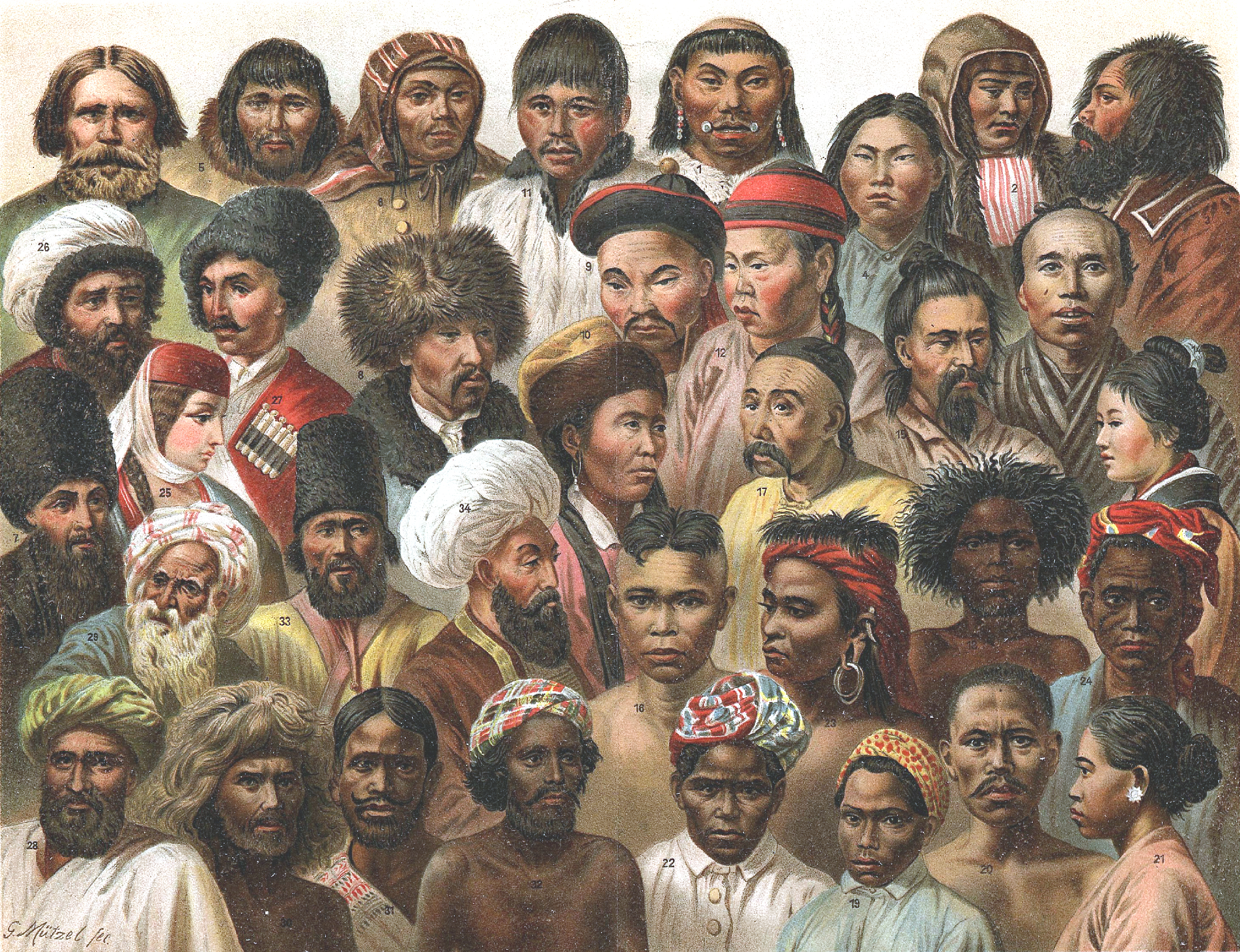 UTOPIA, RACE & CAST |
| Top | The Players | Human Zoos | Human Safari | Eugenics | Cultural Genocide | Police State | Below The Belt | Poice Facility & Arsenal | FEMA Training |
|
THE COLOR LINE – a series of essays compiled by Claude Lockhart Clark © January 09, 2016 |
| Top | Mister President | Autonomy & Expansion | Global Masters | Human Paradigm | | | American Cultural |
|
Race has nothing productive to offer people of color. The few positive creations concerning art under race culture was accidental and not by design. Most of that culture came about as creative expressions resulting from excruciating pain. Furthermore those who created the art have never been adequately compensated for their contribution to society. Ever since Charles Darwin used the word “race” to describe physical differences of one species of mankind. Social Darwin philosophy contends that each race is a different species of mankind. People who came in direct contact with European Caucasians during colonialism are confused as to who, what they are and what they should call themselves. This series of essays will explore a cultural phenomenon, which never should have been created in the first place. After WWII one of our U.S. presidents drew up a world organization plan for European using Plato Utopia as its foundation. By this time race was well developed and receiving polishing touches for the new “Plato”. Race had been slowly making progress since the late 15th century it didn’t have its name fixed to color until about the 19th century, but the pageant for the term was being aired several centuries before. Color competitive fundamentals were in full swing by the eighteenth century. People of color by now volunteered to demonstrate how to fasten and secure the bolts of racial tyranny. Beginning in the late 19th century African Americans wanted to save “beneficial portions” of “race” and get rid of only the parts of race that cause them pain; in other words we were willing to settle for a “race compromise” as if such a solution did exist. Race has been the catalyst to making Utopia work. Without it Utopia might still be on a shelf. This essay is about “RACE”. Every great civilization that has survived any length of time has developed a cultural philosophy to govern them selves and live by. There philosophy is what holds the society together as a group and keeps people from killing and pulling each others hair out. Principles of Greek philosophy are the ingredient that holds Europe together today. The philosophies of the various language groups and countries in Europe are not strong enough to do it alone. In the early stages of European Civilization even Greek philosophy did not serve as an adequate solution, so Europeans adopted Christianity from Western Asia and pulled themselves together under one religion ruled by one church. As time passed they could see that they would have a problem with that. In the 16th Century Martin Luther, John Calvin, Huldrych Zwingli and others developed a “redirection” of Catholic Church principles, so Europe would eventually have to find another solution if it wanted stay “civilized”. Around this same time European countries began acquiring colonies. Though they did not realize it at the time, along with governing foreign people and dismantling foreign civilization and cultures, Europeans were developing a hybrid civilization, which became known as Western Civilization. Starting in the early 16th century Europeans waged war against each other on high seas and off the cost of their colonies fighting for foreign land and its resources. Suddenly in 1789 right through 1799 all hell broke loose right in Europe’s back yard; then in 1775 war broke out in the New England colonies while Europe was distracted with breaking up house keeping. New England declared its independence in 1776 though the war waged on until 1783. Things went from bad to worse in 1791 to 1804 African slaves revolted and took over the island of Santo Domingo and Saint-Domingue (Hispaniola) against France and Spain. After the capture of Toussaint Louverture in1802 the Spanish recapture Santo Domingo and the French by 1804 had lost everything plus over two thirds of its troops deployed to fight “Niggers”. England was fighting “Crackers” that had less than third grade grammar school education and the French were fighting “Niggers” that had no formal Western education what so ever. How low can you get? That’s retarded. Europeans tried to tidy their destruction as best as they could. In the mean time a German chancellor and a Portuguese head of state smelled trouble ahead. Otto von Bismarck called a conference in 1884 to 1885 in Berlin often referred to as the Congo Conference. It was said the conference was planned to partition Africa. Africa was a pretext. Africa had more wealth than Europe and it would serve to stall any feather hostilities until Europe could come up with a plan to correct their problem. Europe was preparing for another European war as big or greater than the last one. Europeans believed if that should happened it would mark the end of their civilization. In 1914 the second war started and in 1935 a third war was fought. Each of the last two wars where world wars. This time two American Presidents from the one of the “former Cracker colonies” took an invested interest in their mother continent in exchange for colonial morsels belonging to their former master’s. The partnership between former colonizer and ex-colony has paid well. Woodrow Wilson introduced the League of Nations but he became sick before coming up with a viable plan. The next president Franklin Delano Roosevelt came up with a better plan skillfully using Plato’s Utopia as its foundation. |
 Thomas Jefferson |  James Monroe |  Otto Von Bismarck |
|---|
|
Autonomy and Expansion were the main concern of these 3 leaders. The first two were American presidents. They address the problem of Europe’s interference in pollicies of Americas. Thomas Jefferson helped the U.S. government acquired land in order to prevent Europe from making further claims in northwestern territories. Monroe took it a step further by declaring Europe should not intervene in New World policies period! He feather stated that Europe would be met with harsh reprisals if they intervened into New World affaires. Otto Von Bismarck in Europe had a slightly different approach: “Hold on to what you got and expand if you can”. In 1802 Napoleon sent Donatien-Marie-Joseph de Rochambeau to put down an African slave revolt, on the Western half of the Island of Hispaniola. French lost the Island and Napoleon sold Louisiana territory to the United States by way of Thomas Jefferson. Jefferson became the architect concerning direction and governing principles of the new American Republic. The U.S. in the past has supported “Jeffersonian Democracy” and in 1910 American citizens came under rule of “Wilson Democracy”. For the remainder of the 20th century Americans have been experiencing “Jeffersonian-Wilson Democracy”. James Monroe, 5th president of the United States, introduced Monroe Doctrine, in1823. His doctrine essentially declared that “the United States would not tolerate intervention by European nations in the affairs of nations in the Americas.” (Dictionary.com) Ha! Ha! Ha! Europeans laughed themselves under the table when they saw his “plan”, but by 1898 smiles came off of those faces when the Spanish were driven out of the Americas and the Philippians. America was an Imperial force to be reckoned with. England and France both lost colonies as a result of the French Revolution and Spain almost lost Santo Domingo. Europe would lose more colonies and possible end European Civilization in the process if they had anymore wars on their continent. It was Otto Von Bismarck job to apply paste, bubble gum, and a Band-Aid to the situation until Europe could figure out what to do next. Before I get started we need to get something straight. I am not here to talk about racism or racist. I am here to talk about race and if you are not here to address that issue then you need to leave this page and go elsewhere. By now we should know who the racist is and who practices racism. I will help you with that along with Neely Fuller Jr. and Dr. Cress Welsing M.D. They are the two experts on “racism”. There is another African American person you should keep in mind and his name is Dr. Claud Anderson. Anderson also speaks about racism, but he never tells you where he got his information from concerning “racism”. We will come back to Anderson in a moment because he point up some issues that the other two fail to acknowledge. When I was in school we were taught how to outline before writing an essay. It looked something like this; I., A., B., 1., C., II., A., B., etc. They don’t teach that anymore. When you start with “Racism” as your topic the sub-topic is “Racist”. Both the topic and the sub-topic of your argument are about Caucasian people and their plan. Racism has nothing to do with us colored people and our plan, because we don’t have one. Racism will not help us with our problem; I am serious. Read “Essai sur l’ Inegalite des Races Humaines”, by a Frenchman named Count Arthur de Gobineau. After he gets done with you might better understand what I am talking about. “Race is a "box system", which we should be striving to get out of”; “not fix it”. Only a fool would want to do that. You don’t want to “Improve race relations”. Heaven forbid. This whole subject of Tradition African Art is only one topic of many, many, many disciplines dealing with traditional African culture. I can tell you how to get out of the box as an artist, because it is no longer theory; It has been my practice and I have been there scaling walls. The box that I was in is in a series of boxes. I started scaling the walls of the first box when I was 12 years old. I have scaled between 6 to 7 walls since then and I have a long ways to go. The boxes that I am referring to have only to do with culture transition and nothing else. I am not talking about money or material gain. “Cultural Scaling” and “Cultural Transition” are a whole different agenda and requires a different set of skills. Now that I am on wall 8 or 9 I can see the last wall of this "box system" that we are all in off in the distance. I can also see the outer wall of another box system off in the distance. When I had scaled the 3rd wall many years ago I could not see the last wall of this box system that I am in. It seemed like it was going to take forever to get anywhere. Lets go back to Claud Anderson for a moment. He mentioned 3 basic issues we need to address 1) Inappropriate Behavior, 2) Race/ “Racism” is a Group Base Description and 3) Race is to Compete. I left the last point out when I backed up my definition of race. Race is about color competitiveness for both Caucasian and people of color. Each group tries to keep its race in place or move their race up. Race is a vertical group plan. Race never moves on a horizontal axis. Racism is group-based philosophy; it is of no use to you as an individual involved in a civil court case. During the mid 1970’s when students came to me with race issues involving them with white, the first thing I would tell them to do was never address the term race in court. Always list “methods of oppression” used against you. I give a list at the end of this presentation. Make sure you consider my definitions even though they don’t look like Merriam Webster. You have to keep in mind that those definitions concerned his people. Merriam Webster wasn’t looking out for us. The first point Anderson makes concerns “inappropriate behavior”; we fell victims to our own poor behavior, which is how we ended up over in the American continent in the first place. That how we got over here by bad behavior. We were selling each other and many of the ones doing the selling are over here with us. Dr Marimba Ani & “the Rebirth.. must view” and her lecture and work titled “The Secrets of Whites” are a must; something we should have been in secrecy right after slavery. |
 Woodrow Wilson |  Franklin Delano Roosevelt |
|---|
|
The next two candidates we refer to as Global Masters because they may have saved us from inhaling plutonium gas thus far. Two American presidents found a way to get Europe to “cool its heels” by venting violence and hostilities on nations of color rather than on each other. They developed a strategy, which uses colored people as a unifying force to control “White” peoples differences. The United Nations has given Europeans a golden opportunity to asses and examine the similarities they have in common rather than their differences and still be wicked. President Woodrow Wilson drew up a limited plan for the League of Nations. It did not include all independent countries. The countries were from Western Europe and Western Asia. Arabs walked out of the conference in the very beginning; so that was the end of the League. Wilson had 14 points that he wanted countries to observe. Later president Franklin Delano Roosevelt came up with a plan for a United Nation which included “all countries that were Sovran Nations”. He included Wilson’s 14 points and designed a foundation for the United Nations based on Plato’s Utopia. There was one requirement need in order for the plan to work. “Nations of Color” had to be “set free”. Some European heads of states did not like that idea. Roosevelt knew from American Revolutionary and Haitian Revolution Histories that the seed of insurrection are sewn when you lock your subjects in a colonial prison. Roosevelt was a smoothie. It would be better that you let be people free to make their own mistake, rather than have them blame everything on you. You can print their national currency and sell it to them with interest and control whom they trade with. The word "RACE" in reference to human genealogy and physical prototype is both degrading and demeaning. Use of this word in connection with human biological development should be an embarrassment to modern civilized mankind. The use of the word “race” should not be tolerated under any circumstances. Race supplies the "connecting links that make cast, utopia and Neo-Colonialism function”under Western Civilization for the benefit of White Supremes. White Supremes receive all kinds of privileges, services and benefits due to the fact that someone else’s time and labor are held captive just for their benefit. During Greek Civilization Plato came up with an idea of a cast system utopia “Plato’s Utopia”, but he didn’t have any place to apply his theory. During the early stages of European Civilization utopia was implemented under feudalism with surfs at the bottom of the cast system, craftsmen and merchants in the middle and nobility at the top; but it was not until colonialism and Western Civilization emerged that Plato’s Utopia became a fact. It was not until Charles Darwin coined the term “race” during the 19th Century concerning Homo Sapiens that a new breed known as Social Darwin had a platform on which to formulate Utopianism and put it into practice globally with a simple solution based on human skin color. A simple color code cast system could be devised by human reproduction. Every person born carried his or her own color code for consecutive generations. The United Nations in 1945 decided which color and / or countries would be designated First World, Second World and Third World people. Among the first world White Supremes bankers and industrial imperialist rocked the planet. Utopia, race, cast and colonialism benefited them first. In the material that follows we will cover these topics. Last we will show you how to identify injustice whether it be race or some other form of discriminatory practice.
|